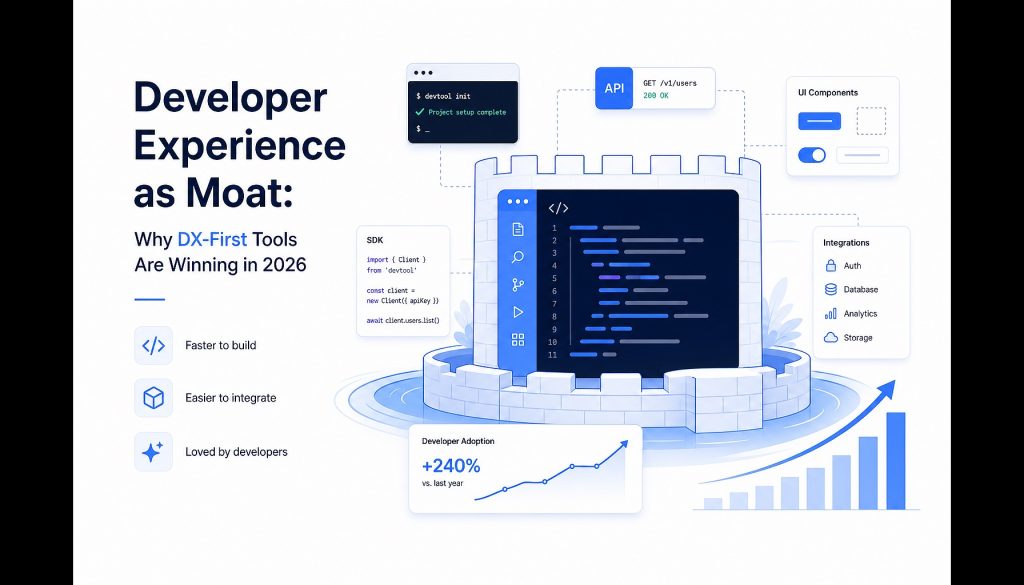
Something quiet is happening in the developer tools market, and the numbers tell the story. Clerk’s annualized revenue crossed $80 million. Neon’s ARR growth exceeded 300% for three consecutive quarters. Vercel’s enterprise renewal rate sits at 98%. Behind these figures lies a truth that many incumbents still haven’t internalized: developer experience has shifted from a nice-to-have feature to an existential competitive advantage.
Browse r/webdev on any given week and you’ll find dozens of posts titled “we switched from Okta to Clerk.” The comments are predictably one-sided: “should have done it sooner.” On Hacker News, AWS RDS migration guides no longer point to other managed databases — they point to serverless alternatives like Neon. Enterprise CTOs are asking a question that would have sounded frivolous five years ago: “Does our engineering team actually enjoy using this tool?”
This isn’t a branding victory. It’s a generational shift in product philosophy. Legacy tools treat developer experience as “the docs team’s problem.” DX-first challengers treat it as the product’s core competitive surface. When these two philosophies collide in the same market, the outcome is usually decided within the first 15 minutes of a developer’s trial.
The Three Dimensions of DX: From “It Works” to “I Love It”
Developer experience isn’t a vague feeling. It’s a system that can be decomposed, measured, and optimized. The tools winning in 2026 have pushed all three dimensions to their limits.
Dimension 1: Time-to-Hello-World
Clerk’s onboarding flow: enter email → verify → pick your framework (Next.js, React, Vue) → copy two lines of code → refresh the page → login button appears. Under five minutes, start to finish.
Okta’s equivalent: create an application → configure OAuth flows → set callback URLs → download the SDK → read 30 pages of documentation → debug CORS errors → spend another 20 minutes figuring out why the local dev environment won’t cooperate. This isn’t an exaggeration — it’s a composite of real complaints from developer Twitter.
Neon’s time from zero to first query: 90 seconds. Create a project → Postgres instance auto-provisions → copy the connection string → paste into your code → run a query.
AWS RDS: choose instance type → configure VPC → set security groups → wait 10 minutes for the instance to spin up → manually create the database → configure IAM permissions → debug network connectivity. Security group configuration alone is enough to lose half of first-time users.
The gap here isn’t “slightly faster” versus “slightly slower.” It’s “immediate dopamine hit” versus “an hour of frustration before you write a single line of business logic.” Research on product onboarding consistently shows that first impressions determine long-term retention. Developers aren’t impatient — they simply have better options now.
Dimension 2: Documentation Quality
What does good documentation look like in 2026? Open Vercel’s docs, search “environment variables,” and the first result is a copy-pasteable Next.js config snippet followed by complete code for three common scenarios (development, preview, production). Every API method has TypeScript annotations. Every error message links to a troubleshooting guide.
Now try the same search on AWS Amplify’s docs. You get an abstract conceptual explanation, a configuration flow spread across three sub-pages, and code examples buried four directory levels deep — written in JavaScript even though your project is TypeScript. Error messages are worse: “AmplifyConfigurationError: Invalid configuration.” Full stop. You’re on your own, scrolling through 200 GitHub Issues to discover the problem was an env variable naming format.
The documentation gap is most lethal in error messages. Clerk’s errors read: “Missing publishable key. Add NEXT_PUBLIC_CLERK_PUBLISHABLE_KEY to your .env.local file. [Learn more →]” — and the link takes you directly to the fix. Okta’s errors read: “Error: OIDC configuration failed” — and refer you to an 87-page OAuth 2.0 specification.
The underlying difference is what I’d call empathy engineering. Are you writing docs from the perspective of someone who already understands the domain? Or from the perspective of a developer encountering it for the first time? The former says “configure your OIDC provider.” The latter says “let users sign in with Google.”
Dimension 3: Community Velocity
Neon’s Discord has a well-known story: founder Nikita Shamgunov once responded to a connection pooling question at 3 AM. Not with “we’ll consider it” — with “good point, I opened a PR, shipping tomorrow.” Twenty-four hours later, the feature was live.
Compare that to AWS RDS support. Your question enters a ticket system, passes through three tiers of support engineers, and returns a “we’ll relay this to the product team” response. Three months later you might hear the feature mentioned at an AWS re:Invent talk. Actual availability? Add another year.
The open-source ecosystem gap is even starker. Vercel’s Next.js has over 120,000 GitHub stars and dozens of community-contributed templates, plugins, and tutorials every week. AWS Amplify’s ecosystem consists of a handful of official example repositories updated roughly once a year, with single-digit community plugins.
This creates a flywheel: good DX → developers share their work → more tutorials and tools → lower learning curve → more users → more active community. Legacy tools spin the wheel in reverse: poor DX → developers use it only when mandated → dead community → steep learning curve → churn.
Three Markets Where DX Flipped the Incumbent
Authentication: Clerk vs. Okta’s Enterprise Lock-in
Okta dominated enterprise identity for over a decade on the strength of feature completeness and compliance certifications. Clerk found the blind spot: small and mid-size teams don’t need 90% of Okta’s capabilities. They need a login system that works in five minutes.
Clerk’s design philosophy is “progressively complex” — start with two lines of code for basic auth, add MFA, SSO, and custom fields as needed. Okta’s philosophy is “enterprise first” — you must internalize the full OIDC/SAML mental model before implementing username-password login.
Pricing reflects the same divide. Clerk’s free tier includes 10,000 monthly active users and all core features; paid plans start at $25/month. Okta’s free tier covers development environments only; production starts at $1,500/month, and “basic” features like custom email templates require an upgrade.
The result: in the first four months of 2026, Clerk’s customer base grew 180%. Forty percent of new customers migrated from Auth0 (the Okta-acquired product). The developer community consensus is blunt: “Unless you’re 500+ employees and contractually required to use SAML, there’s no reason to pick Okta.”
Databases: Neon’s Serverless Postgres vs. RDS
AWS RDS isn’t under-powered. It’s just designed for a world that’s fading — a world where you plan capacity upfront, manually scale, pay for idle hours, and manage your own backups. That’s fine for large operations with dedicated DBAs. It’s a nightmare for indie developers and small teams.
Neon’s breakthrough: combining “serverless” with “PostgreSQL” in a way that actually works. Your database sleeps when idle (cost drops to zero) and wakes in milliseconds when a request arrives. The killer feature is branching — every pull request can automatically spin up an isolated database branch that self-destructs after tests pass, at no extra cost.
Could RDS do this? Technically, probably. But AWS’s business model is “hourly billing + reserved instance discounts.” Auto-sleep cuts revenue. Neon’s model is usage-based, so auto-sleep is a selling point, not a threat.
Developers voted with their wallets: Neon’s free tier surpassed 500,000 users in Q1 2026, with an 8% paid conversion rate (industry average: 2-3%). The migration path is consistent: use Neon for a side project → realize the experience is dramatically better → convince the team to move production workloads.
Frontend Deployment: Vercel vs. AWS Amplify
On paper, Vercel and AWS Amplify offer similar capabilities: automated deploys, CDN, preview environments, serverless functions. In practice, the experience gap is enormous.
Vercel: connect a GitHub repo → framework auto-detected → click Deploy → site live in 30 seconds with HTTPS. Every PR generates a preview URL. Deploy status auto-posts to the PR. Zero config.
AWS Amplify: create an Amplify app → configure build settings (commands, output directory, env vars) → set up a custom domain (manual DNS verification required) → configure HTTPS certificate (wait for ACM issuance) → debug build failure (default Node version is outdated) → spend another 30 minutes figuring out why environment variables aren’t being injected.
The gap becomes critical during incident response. On Vercel, you can push a hotfix, auto-deploy, and verify in under two minutes. On Amplify: commit → wait 5-10 minutes for a build → discover a stale cache → manually purge → wait for another build cycle.
Community sentiment is quantifiable. In the State of JS 2026 survey, Vercel’s satisfaction score was 96%. AWS Amplify’s was 43%. The common refrain: “Amplify isn’t unusable — it’s just annoying to use.”
The Migration Wave: Three Signals
Signal 1: Public Migration Stories
A Twitter hashtag called “Migration Monday” gained traction in early 2026. Every Monday, developers post before-and-after screenshots of switching from a legacy tool to a DX-first alternative. The most viral post — “After switching from Okta to Clerk, onboarding a new engineer went from half a day to 15 minutes” — earned over 5,000 reposts.
A pinned thread on Reddit’s r/ExperiencedDevs asks: “What tools did you replace in 2026?” The top-voted answers follow a clear pattern:
| Category | Replaced | With |
|---|---|---|
| Auth | Okta / Auth0 | Clerk |
| Database | RDS | Neon / Supabase |
| Deployment | Amplify | Vercel / Netlify |
| Monitoring | DataDog | Highlight / Axiom |
| API Testing | Postman | Hoppscotch |
The pattern is consistent: from “feature-complete but painful” to “core features done well with outstanding experience.”
Signal 2: The Markets With the Largest DX Gaps
Authentication has the widest gap. Legacy tools (Okta, Auth0) were designed for enterprise IT departments staffed with dedicated identity engineers. New tools (Clerk, Supabase Auth) were designed for full-stack developers who want login solved in an afternoon.
Observability ranks second. Legacy pricing (DataDog, New Relic) charges by data volume, forcing developers to either pay eye-watering bills or manually throttle their logs. Newer entrants (Highlight, Axiom) charge by query, making raw data storage cheap and removing the incentive to log less.
Deployment and hosting ranks third. AWS and GCP toolchains assume a DevOps team managing infrastructure. Vercel and Railway assume a developer who wants “git push and done.”
Signal 3: Enterprise Buyers Now Care About Developer NPS
The bigger shift is happening at the procurement level. Before 2025, enterprise tool selection hinged on feature checklists and compliance certifications. In 2026, a growing number of CTOs track “Developer NPS” — how much their own engineers enjoy using a tool.
One viral LinkedIn post from a CTO described their new evaluation standard: “We let three engineers trial a tool for two weeks. If they proactively recommend it internally, we buy. If they complain but can tolerate it, we don’t.” The post collected 80,000 likes.
The logic is straightforward: tools that frustrate engineers drag down productivity, increase attrition, and hurt recruiting. A company running Okta gets asked in interviews “why not Clerk?” A team deployed on Amplify gets ribbed for a “legacy stack.” This isn’t developer entitlement — it’s market pressure. Good tooling experience is now a hiring and retention advantage.
The Bottom Line
The developer tools market in 2026 has entered a new phase: feature completeness is table stakes; outstanding DX is the moat.
The incumbents’ problem isn’t technical debt. It’s organizational inertia. Their product design processes, pricing models, and support structures are all optimized for large enterprise accounts. The rise of DX-first tools proves a different go-to-market thesis: win developer hearts first, then penetrate enterprises bottom-up.
Prediction for 2027: more legacy tools will be displaced by DX-first challengers. Not because they lack features, but because developers have experienced what “good” feels like and won’t go back. Companies still treating DX as “the docs team’s job” will watch their market share erode — not to more powerful competitors, but to more pleasant ones.
The endgame may be this: a decade from now, we’ll look back at early-2020s developer tooling and call it the dark ages — the same way we now view web development tooling from the 2000s. The companies that survive will be the ones that put developer experience at the core of their product, not at the periphery.
Related Reading
- Developer Experience Is the New Moat: How DX-First Tools Are Eating Enterprise SaaS
- Developer Experience Is the Only Moat That Matters in 2026
Stay updated with our latest AI insights