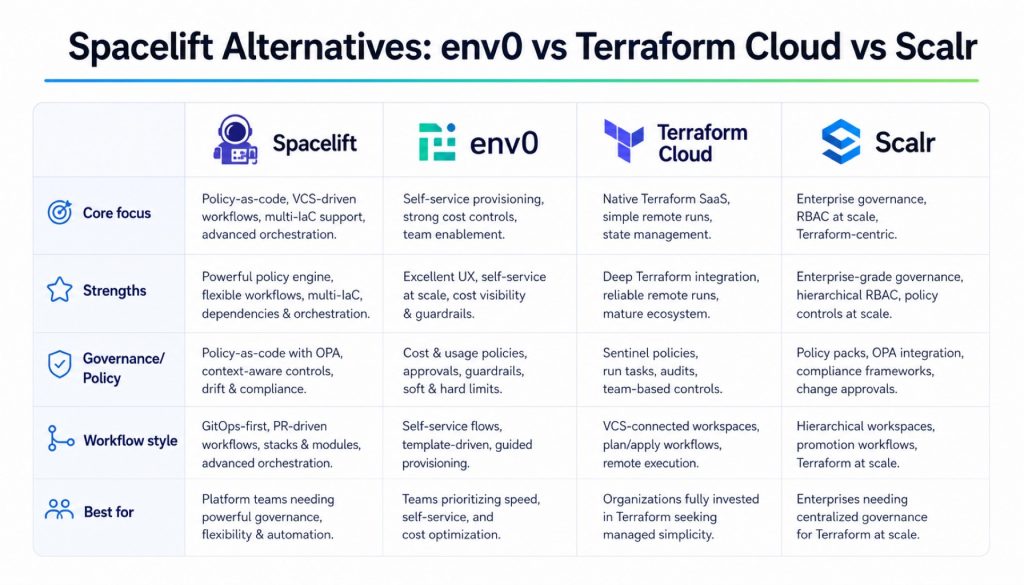
Spacelift handles Infrastructure as Code orchestration well enough. It supports Terraform, OpenTofu, Pulumi, and offers policy-as-code, drift detection, and workflow automation. The problem is cost. Pricing starts at $250/month for Starter Plus, billed per concurrent Worker. SSO, audit logs, and most governance features are locked behind the Enterprise tier. For teams that don’t need unlimited concurrency but do need basic governance tooling, the math stops working fast.
This comparison covers five alternatives: env0, HCP Terraform (formerly Terraform Cloud), Scalr, Atlantis, and Terrateam. Each one takes a different approach to pricing, feature gating, and team size. The goal here isn’t to crown a winner. It’s to map each tool against specific constraints so you can run your own numbers.
Quick Comparison
| Tool | Pricing Model | Starting Price | Primary Strength | Best Fit | Open Source |
|---|---|---|---|---|---|
| ,,, | ,,,,,,, | ,,,,,,,, | ,,,,,,,,- | ,,,,, | ,,,,,,- |
| env0 | Per Apply / active environment | ~$1,500/mo (100 environments) | Cost management + FinOps | Mid-to-large teams tracking cloud spend | No |
| HCP Terraform | Per managed resource | $0.10/resource/mo (Essentials) | Native HashiCorp ecosystem | Pure Terraform shops | No |
| Scalr | Per Run | Free 50 runs/mo, then $0.99/run | Enterprise governance, TFC migration path | Mid-size teams leaving TFC | No |
| Atlantis | Free (self-hosted) | $0 (you handle ops) | PR-driven, fully customizable | Small teams with ops capacity | Yes (Apache 2.0) |
| Terrateam | Free community + paid tiers | $0 up to $1,087.50/mo Enterprise | GitOps-native, zero-UI workflow | GitHub-heavy teams, 3-30 engineers | Yes (MPL-2.0) |
env0: The FinOps-First IaC Platform
env0 (branded “env zero”) competes most directly with Spacelift in terms of feature coverage. Where it pulls ahead is cost management. Not “we show you a number after deploy” cost management, but actual FinOps workflow integration.
What it does:
The platform tracks cost changes on every deployment and plugs into third-party tools like CloudHealth and Cloudability. Drift management goes beyond alerting. It detects drift, analyzes the cause, and can auto-remediate by either updating the cloud resource or updating the code. There’s also a self-service portal where non-engineers can trigger deployments through templates, with approval chains and policy checks running automatically.
It supports Terraform, OpenTofu, Pulumi, Terragrunt, CloudFormation, and Kubernetes.
Who should look at this:
Teams managing 50+ environments, especially those that need to report infrastructure costs upward. If your recurring pain is “nobody can explain why our cloud bill jumped 30% last quarter,” env0 is built for that conversation.
Pricing:
Billed per successful Apply or active environment count. Cloud Navigator starts around $1,500/month for 100 active environments. No limits on users or concurrent Runs. Cloud Voyager (the premium tier with AI analysis and advanced drift remediation) requires a sales conversation.
Tradeoffs:
The cost visibility is a genuine differentiator, and per-environment billing makes costs predictable at scale. On the downside, the entry price locks out teams smaller than ~10 engineers, and the UI takes more time to learn than Spacelift’s.
HCP Terraform (Terraform Cloud): The Official Option
After IBM acquired HashiCorp, Terraform Cloud became HCP Terraform. The bigger change was the pricing model shift from per-workspace to per-managed-resource billing. The free tier got cut significantly in March 2026, now capped at 500 resources.
What it does:
Native integration with the Terraform Registry, providers, and modules. Sentinel and OPA policy engines are built in (available from Standard tier up). Remote state management is as stable as it gets since HashiCorp owns the backend. Run Tasks let you embed third-party checks (security scanning, cost estimation) into the pipeline.
Who should look at this:
Teams that are 100% Terraform and managing under 2,000 resources. Beyond that threshold, the bill scales fast and starts to hurt.
Pricing:
Per peak managed resources: Essentials at $0.10/resource/month, Standard at $0.47, Premium at $0.99. A team managing 5,000 resources on Standard pays roughly $2,350/month. Resources that haven’t changed in six months still count toward peak.
Tradeoffs:
Tightest ecosystem integration with Terraform. Documentation and community are unmatched. State management requires zero setup. But the per-resource model penalizes growth (you pay for resources whether they’re active or idle), the free tier reduction pushes small teams to pay earlier, and it doesn’t support Pulumi, CloudFormation, or anything outside HCL.
Scalr: The TFC Migration Play
Scalr positions itself as a drop-in replacement for Terraform Cloud. It can import TFC workspaces and state files directly, and its API is TFC-compatible enough that most CLI commands work by just changing the backend URL. It bills per Run, not per resource, so managing more infrastructure doesn’t automatically cost more.
What it does:
A hierarchical governance model (Account, Environment, Workspace) with permission inheritance across all three levels. The OPA policy engine is available at every tier, including free. SAML/SSO is included without an upcharge. The TFC-compatible API means migration is mostly a URL change in your backend config.
Who should look at this:
Engineering organizations of 20-100 people currently on Terraform Cloud who are frustrated by bills or feature gating. The migration path is the smoothest of any alternative here.
Pricing:
Free for 50 runs/month. After that, $0.99 per run with volume discounts. Users, workspaces, managed resources, and Private Agents are all unlimited and free. A team running 200 applies per month pays about $150.
Tradeoffs:
Transparent pricing and painless TFC migration are the headline features. Governance tools aren’t locked behind premium tiers. The downsides: it only supports Terraform and OpenTofu (no Pulumi, no Kubernetes), the community is smaller than Spacelift’s, and drift detection is more basic than what env0 or Spacelift offer.
Atlantis: Open Source, Self-Hosted, PR-Driven
Atlantis is a CNCF Sandbox project. No commercial tiers, no sales team. It watches for PR webhooks on GitHub, GitLab, Bitbucket, or Azure DevOps, runs terraform plan, posts the output as a PR comment, and waits for an atlantis apply command before deploying.
What it does:
Everything happens in PR comments. Developers never leave their Git workflow. Configuration lives in atlantis.yaml, and custom workflows can embed arbitrary scripts. It supports all major Git providers.
Who should look at this:
Engineering teams of 5-15 people with Kubernetes or VM operations experience, limited budget, and a preference for full control. You trade money for time.
Pricing:
$0 for the software. You pay in operational overhead: server hosting, TLS certificates, webhook security configuration, version upgrades, and state backend management.
Tradeoffs:
Zero license fees and full source access make it ideal for compliance-sensitive environments where you need to audit and customize everything. The community is active and plugins are plentiful. But there’s no UI console (everything is config files and CLI), no built-in drift detection or cost estimation or policy engine, multi-team permission management is primitive, and operational burden grows linearly with scale.
Terrateam: The GitOps-Native Newcomer
Founded in 2023, Terrateam takes the “everything in the PR” concept further than Atlantis. All configuration lives in .terrateam.yml in your repo. It ships both an open-source self-hosted version (MPL-2.0) and a managed cloud service with publicly listed prices.
What it does:
Plan output, cost estimation, approval flows, and apply commands all happen in GitHub PR comments. No external UI to check. It supports Terraform, OpenTofu, CDKTF, Pulumi, and Terragrunt under a unified workflow. Built-in cost estimation (via OpenInfraQuote) shows monthly cost impact directly in the PR. Drift detection, access control, and policy enforcement are all configured in YAML.
Who should look at this:
GitHub-centric teams of 3-30 people who want a “code is the only interface” approach and don’t want to maintain a separate platform UI.
Pricing:
Community edition is free to self-host. The managed cloud service has a free tier, then Team and Enterprise at published prices (Enterprise is $1,087.50/month). No “contact sales” games.
Tradeoffs:
Public pricing and a complete open-source edition are refreshing. Configuration-as-code means everything is version-controlled and auditable. The limitations: GitHub only (no GitLab or Bitbucket support), the community and documentation are still catching up to Atlantis, and there aren’t many large-enterprise reference cases yet.
How to Pick
The right choice depends on your specific constraints, not on feature checkbox comparisons:
Budget is tight and you can handle ops: Atlantis. No license cost, but you own the infrastructure and maintenance.
You’re a GitHub shop that wants modern GitOps: Terrateam. Lightweight, transparent pricing, open-source fallback.
You’re on TFC and the bill is the problem: Scalr. Lowest migration friction, per-Run billing that doesn’t punish growth.
You need cost visibility across deployments: env0. FinOps integration is the core differentiator, not an add-on.
You just need a stable remote backend for Terraform: HCP Terraform Essentials. If the official product covers your needs at your resource count, don’t overthink it.
One practical step before committing: count your managed resources and monthly apply frequency, then plug those numbers into each vendor’s pricing calculator. The same 20-person team can see annual cost differences of 3-5x depending on which billing model they land on.
Common Questions
What’s the real difference between Spacelift and env0?
Pricing structure and cost management depth. Spacelift charges per concurrent Worker and gates features by tier. env0 charges per Apply or environment count and builds FinOps (cost tracking, budget alerts, third-party integrations) into the platform. If your team has explicit reporting requirements around “how much does each deployment cost,” env0 is purpose-built for that.
Self-hosted (Atlantis/Terrateam) or managed service?
It comes down to operational bandwidth. Self-hosting saves money but costs time: webhook security, high availability, version upgrades, state backups are all on you. Teams under 10 people without a dedicated platform engineer often find that the hidden ops cost of self-hosting exceeds a managed service subscription. Organizations over 50 with a platform team can use self-hosted tools to build fine-grained compliance controls that no SaaS product offers out of the box.
How painful is migrating away from Terraform Cloud?
Depends on where you’re going. Scalr offers a TFC-compatible API, so workspaces and state files import directly and CLI configuration is mostly a URL swap. env0 and Spacelift have migration wizards but require reconfiguring workflows and variables. Atlantis and Terrateam need manual state backend migration. The technical migration is usually the smaller cost. Rebuilding policies and workflow automation takes longer.
Which platform handles OpenTofu best?
Spacelift, env0, Scalr, and Terrateam all support OpenTofu. In practice, Scalr and Terrateam treat OpenTofu as a first-class citizen with no workflow differences from Terraform. HCP Terraform does not support OpenTofu (commercial conflict of interest since HashiCorp owns Terraform’s BSL license).
What trends should I watch in this space?
Two shifts are happening in 2026. First, billing models are moving from per-resource toward per-usage (Runs or Applies), because per-resource pricing punishes teams for managing more infrastructure rather than for consuming more platform capacity. Second, cost estimation and drift remediation are becoming table stakes rather than premium add-ons. env0 and Terrateam both surface cost impact inside the PR workflow now. Picking a platform that aligns with both trends reduces the risk of needing another migration in 12 months.
Related Reading
- Best Spacelift Alternatives in 2026: env0, Terraform Cloud, Scalr, Atlantis & Terrateam Compared
- 5 Best Spacelift Alternatives for IaC Management in 2026
Stay updated with our latest AI insights