,-
title: “Best Datadog Alternatives in 2026: SigNoz vs Grafana Cloud vs New Relic vs Better Stack”
slug: datadog-alternatives-observability-2026
category: tool-comparison
language: en
focus_keyword: Datadog alternatives
seo_title: “Best Datadog Alternatives in 2026: SigNoz vs Grafana Cloud vs New Relic vs Better Stack”
seo_description: “A practical comparison of four Datadog alternatives for engineering teams. Pricing breakdowns, feature gaps, migration paths, and honest recommendations for SigNoz, Grafana Cloud, New Relic, and Better Stack.”
,-
Your Datadog Bill Is Growing Faster Than Your Infrastructure
Run 50 hosts on Datadog Infrastructure Pro with APM enabled, and you are looking at $2,300/month before logs and Synthetics even enter the picture. The per-host pricing stacks with each product add-on, so a single autoscaling spike can blow through your monthly budget overnight.
The good news: in 2026, the Datadog alternatives market has matured enough that mid-size engineering teams can switch without sacrificing visibility. Open-source platforms now offer production-grade reliability, and newer commercial vendors have adopted transparent pricing that does not punish you for scaling.
This comparison covers four realistic options: SigNoz, Grafana Cloud, New Relic, and Better Stack. Each targets a different team profile. We break down pricing with real numbers, highlight the actual trade-offs, and map out migration steps.
Head-to-Head Comparison
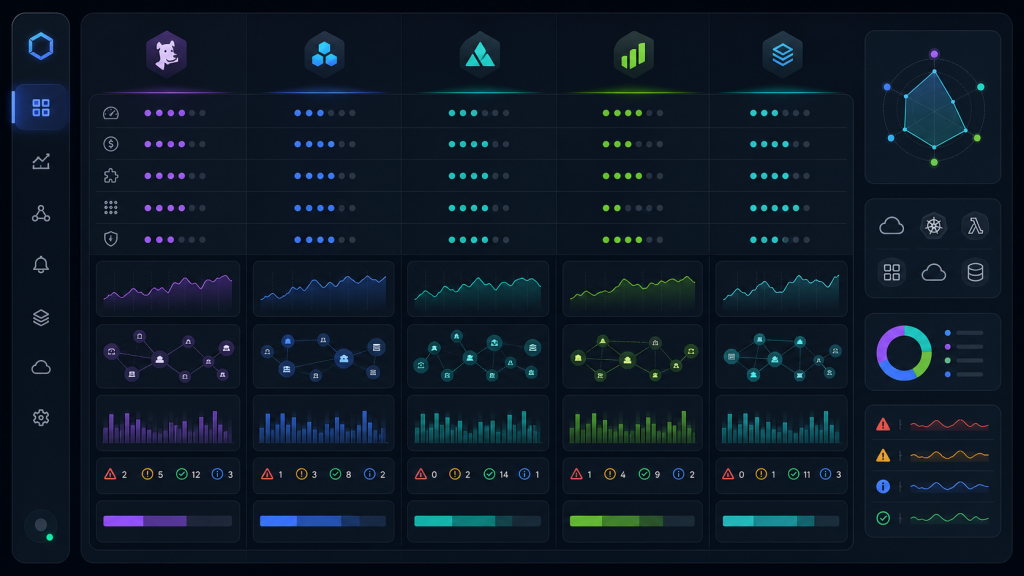
| Dimension | SigNoz | Grafana Cloud | New Relic | Better Stack |
|---|---|---|---|---|
| ,,,,,- | ,,,,- | ,,,,,,,- | ,,,,,- | ,,,,,,, |
| Pricing model | Self-host free; Cloud $0.30/GB logs+traces, $0.10/M metric samples, base $199/mo | Free tier: 10K metric series + 50GB logs + 50GB traces; Pro $19/user/mo + usage | Free 100GB/mo ingest; overage $0.40/GB; Full Platform seat $349/user/mo (annual) | Free tier: 3GB logs + 10 monitors; Responder $29/user/mo (annual); logs €0.10/GB ingest (EU) |
| Deployment | Self-hosted (Docker/K8s) or SigNoz Cloud | Fully managed SaaS; open-source stack (Mimir+Loki+Tempo) available for self-hosting | Fully managed SaaS | Fully managed SaaS (EU/US-East/US-West/Singapore) |
| Feature coverage | APM + Logs + Traces + Metrics + Alerts + Error Tracking; OpenTelemetry-native | Metrics (Mimir) + Logs (Loki) + Traces (Tempo) + Profiling (Pyroscope) + k6 load testing | APM + Logs + Metrics + Browser RUM + Mobile + AI troubleshooting + Synthetics; 50+ capabilities | Logs + Uptime + Traces + Metrics + Error Tracking + Status Pages + On-call |
| Learning curve | Medium: self-host requires K8s ops experience; UI is straightforward, OTel SDK onboarding is standardized | Steep: multi-component assembly (Prometheus + Loki + Tempo), config spread across tools | Low: out-of-the-box, one-click agent install, AI-guided root cause analysis | Low: clean product design, SQL-based log queries, 5-minute setup |
| Integrations | OpenTelemetry-native, all OTel SDK languages; ClickHouse storage with direct SQL access | 700+ data sources; full Prometheus community coverage; mature Terraform provider | 400+ integrations; flexible NRQL query language; deep Kubernetes, AWS, Azure support | 100+ integrations; Terraform provider; can import Datadog/Grafana dashboards; AI SRE agent |
| Data retention | Self-host: unlimited (disk-bound); Cloud default 15 days, extendable | Free tier 14 days; Pro pay-per-use up to 13 months | Standard 8 days; Data Plus $0.60/GB extends to 90 days | Free tier 3 days; paid 30 days+; archive to your own S3 |
| Alerting | Built-in multi-condition alerts + notification channels (Slack/PagerDuty/Webhook) | Grafana Alerting unified rule engine; cross-datasource alerts | AI-driven anomaly detection + Errors Inbox + workflow automation | Anomaly detection + unlimited phone/SMS notifications + on-call scheduling + auto-escalation |
Deep Dive: Each Platform
SigNoz: The Open-Source Contender
SigNoz is a full-stack observability platform built on ClickHouse, with first-class OpenTelemetry support. The self-hosted Community edition is free with no data caps and no user limits.
Pricing in practice. 20 hosts generating 50GB of logs per day: self-hosting costs $200-400/month in ClickHouse node infrastructure. On SigNoz Cloud at $0.30/GB, the same workload runs about $450/month, roughly 60% cheaper than equivalent Datadog coverage.
Where it shines. A single platform handles APM, logs, traces, and metrics without stitching together separate tools. ClickHouse delivers fast full-text search and handles high-cardinality queries without breaking a sweat. SigNoz ships a Datadog migration tool that batch-converts dashboards.
Where it falls short. Self-hosting means your team maintains ClickHouse clusters. For a 5-person team without dedicated platform engineers, that operational burden adds up. Cloud data centers are in the US and India, which means higher latency for teams in other regions. The integration catalog is smaller than established vendors.
Best fit. Engineering teams of 10-50 with Kubernetes ops capability who want data sovereignty and cost control. Try SigNoz Cloud free for 30 days.
Grafana Cloud: The Natural Upgrade for Prometheus Users
Grafana Cloud bundles Mimir (metrics), Loki (logs), Tempo (traces), and Pyroscope (profiling) into a managed platform. The free tier includes 10,000 active metric series, 50GB logs, 50GB traces, and 3 user seats, which covers many small projects entirely.
Pricing in practice. Pro tier costs $19/user/month plus usage fees (metrics at $6.50/thousand series, logs at $0.40/GB ingested). A 5-person team monitoring 30 hosts lands around $300-500/month. The catch: Grafana bills across 7+ dimensions, and real invoices often come in 2-5x higher than initial estimates.
Where it shines. The entire backend is open source (Mimir, Loki, Tempo). If the managed service stops working for you, self-hosting remains an option. Existing Prometheus dashboards and alert rules transfer directly. Visualization quality is best-in-class.
Where it falls short. Multiple components mean scattered configuration. Loki’s log query capabilities lag behind ClickHouse-based solutions for complex queries. Enterprise support response times have frustrated users, with some reporting 3-week waits for pricing quotes.
Best fit. Teams already running Prometheus + Grafana who want managed infrastructure without re-learning their stack. Get started with Grafana Cloud free tier.
New Relic: The Enterprise Pick for Teams That Value Simplicity
New Relic restructured pricing in 2020 around data ingest volume plus user seats. The permanent free tier gives you 100GB/month of ingest and one Full Platform user, enough for small teams to run indefinitely at zero cost.
Pricing in practice. Beyond free limits, data costs $0.40/GB (standard) or $0.60/GB (Data Plus with 90-day retention). The real expense is seats: Pro at $349/user/month (annual). The strategy is to limit Full Platform seats to 5 or fewer engineers and give everyone else free Basic seats. That keeps monthly costs in the $2,000-3,000 range for full-stack observability.
Where it shines. Feature coverage is the broadest here: APM, browser RUM, mobile monitoring, Synthetics, AI-assisted troubleshooting, all under one roof. NRQL is a remarkably flexible query language. Install the agent and everything works with zero infrastructure management.
Where it falls short. Seat pricing hits mid-size teams hard. Standard data retention is only 8 days. Contracts auto-renew, and cancellation is immediate (no pro-rated refunds). Access from certain regions can be inconsistent.
Best fit. Engineering organizations of 50+ that want comprehensive observability without running any infrastructure. Sign up for the New Relic free tier.
Better Stack: European DNA, Privacy-First
Better Stack (Czech Republic) combines uptime monitoring, log management, traces, on-call scheduling, and status pages in one product. The log engine runs on ClickHouse with SQL query support.
Pricing in practice. Responder plan at $29/user/month (annual), logs in the EU region at €0.10/GB ingest plus €0.05/GB/month storage. A 5-person team with 100GB logs/month pays about $160/month. Pricing is transparent with no hidden dimensions.
Where it shines. European data residency by default makes GDPR compliance straightforward. The product is minimal and functional, with most teams productive within 5 minutes. A built-in AI SRE agent investigates root causes automatically. Dashboard import supports both Datadog and Grafana formats. They offer a 60-day money-back guarantee.
Where it falls short. APM depth does not match New Relic, particularly for code-level tracing. The community is small, so you rely on official support. The Singapore region costs 3x more ($0.35/GB), making it expensive for Asia-Pacific teams.
Best fit. Teams with European compliance requirements who want a lightweight all-in-one solution without deep APM needs. Start with Better Stack free tier.
Decision Framework
Budget under $500/month. SigNoz self-hosted gives you near-zero marginal cost if your team can handle ClickHouse operations. Grafana Cloud’s free tier works well for teams already on Prometheus with no migration effort. SigNoz Cloud Teams at $199/month is the managed option that fits this budget.
Enterprise requirements with flexible budget. New Relic is the lowest-friction choice. Keep Full Platform seats under 5 (Pro tier), assign Basic seats to everyone else, and you get wall-to-wall observability for $2,000-3,000/month.
European or privacy compliance is the priority. Better Stack is the only vendor with default European data residency. Logs stored in EU nodes at the lowest ingest cost (€0.10/GB). Grafana Cloud also offers EU regions but requires more configuration.
Already invested in Prometheus. Grafana Cloud is the path of least resistance. Your existing PromQL queries, alert rules, and dashboard JSON files migrate without modification to the collection layer.
Migrating Away from Datadog: Key Steps
Step 1: Data export. Datadog has no native bulk export, but its API lets you pull recent metrics and logs programmatically. SigNoz provides an automated migration tool that translates Datadog dashboards into SigNoz format. Both Better Stack and Grafana support Datadog Dashboard JSON imports.
Step 2: Switch the collection layer. Replace the Datadog Agent with OpenTelemetry Collector (native support in SigNoz and Grafana Tempo) or the target platform’s agent (New Relic Agent, Better Stack’s Vector integration). Run both in parallel for 1-2 weeks in a staging environment to confirm data completeness.
Step 3: Rebuild dashboards. Migration tools handle roughly 80% of panels automatically. The remaining 20% require manual query syntax adjustments because Datadog’s query language differs significantly from PromQL, NRQL, and SQL. Budget 1-2 sprint cycles for this work.
Step 4: Migrate alerts. Export your Datadog Monitor configurations, rewrite alert rules in the new platform’s syntax, run old and new alerts in parallel for one week, and shut down Datadog monitors only after confirming no missed incidents.
The Bottom Line
Datadog alternatives in 2026 are production-ready tools, not compromises. SigNoz delivers open-source performance that rivals commercial products. Grafana Cloud’s free tier eliminates cost for small teams. New Relic’s free ingest allowance makes lightweight usage permanently free. Better Stack differentiates with European compliance and clean design. No single option is perfect for every team, but none of them require you to keep paying Datadog prices for observability you can get elsewhere.
Related Reading
- Observability on a Startup Budget: 5 Datadog Alternatives That Actually Work in 2026
- Best Datadog Alternatives for Observability in 2026: SigNoz vs Grafana Cloud vs New Relic vs Better Stack
Stay updated with our latest AI insights