At 2 AM, a SaaS founder stares at a technical decision doc. His product just closed a seed round, the team is four people, the stack is Next.js and React. The login feature has been blocked for two weeks. Not because it’s hard to build, but because it’s hard to choose.
Open Okta’s docs: SAML, SCIM, Universal Directory, lifecycle policies. It feels like walking into an armory designed for Fortune 500 IT departments. Open Clerk’s homepage: a React code snippet, five lines to render a login form, plus a user management dashboard that looks like it was designed by the Stripe team.
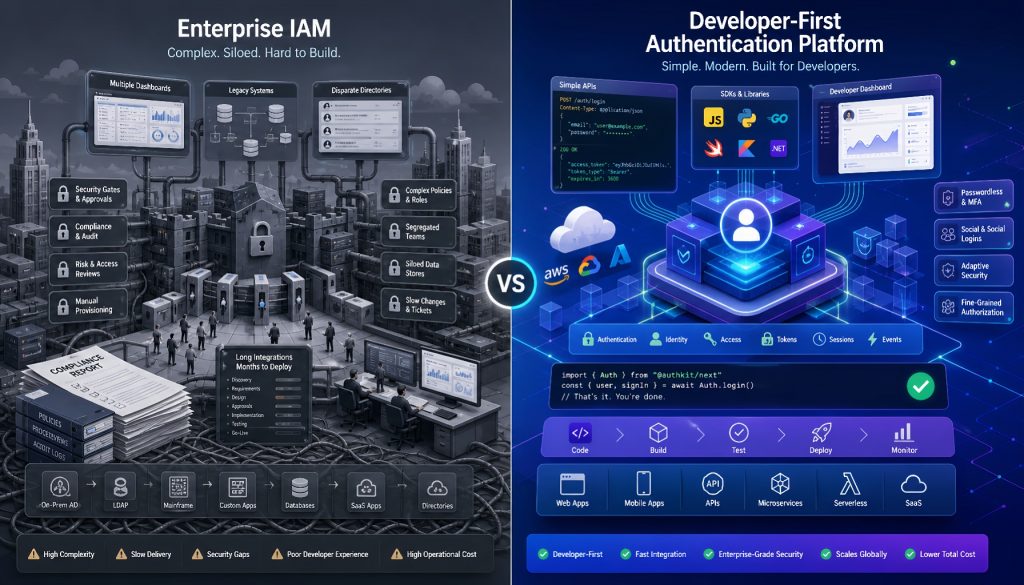
This is not a “which one is better” question. These two products answer fundamentally different questions about identity.
Where They Come From
Okta traces back to 2009. Todd McKinnon and Frederic Kerrest left Salesforce and founded SaaSure (later renamed Okta) on a simple thesis: enterprises were moving everything to the cloud, but identity management was still stuck in on-premise Active Directory. Someone needed to move that layer to the cloud too.
Seventeen years later, Okta is a public company with annual revenue approaching $3 billion, over 6,000 employees, and contracts with two-thirds of Fortune 100 companies. In 2021, Okta acquired Auth0 for $6.5 billion, absorbing the “customer identity” market (helping developers add auth to their own products). Today Okta spans two worlds: Workforce Identity (managing employee access) and Customer Identity (essentially Auth0 under new branding).
Clerk is much younger. Colin and Braden Sidoti founded it in San Francisco in 2019. Their starting observation was practical: why is adding login to a React app still so painful? Auth0’s docs read like a novel. Firebase Auth’s UI felt neglected. Building from scratch meant dealing with password hashing, session management, and OAuth callback plumbing.
Clerk’s answer: make authentication an embeddable UI component. Developers drop a
By late 2025, Clerk closed a $50 million Series C led by Menlo Ventures and Anthropic’s Anthology Fund, bringing total funding past $130 million. The team sits between 100 and 200 people, serving thousands of customers including Vercel.
One is a seventeen-year-old public company. The other is a six-year-old venture darling. They both work in identity, but they answer different questions.
The Core Split
Okta answers: How does a company with 5,000 employees securely manage access to every system for every person?
That means SSO, SCIM (automated user provisioning and deprovisioning), lifecycle management (auto-grant access on hire, auto-revoke on termination), device trust, privileged access management, and compliance audit logs. Every one of those terms maps to a real pain point inside enterprise IT departments.
Clerk answers: How does a three-person team ship secure, good-looking login in a single day?
That means prebuilt React/Next.js components, out-of-the-box social login, a built-in user management dashboard, multi-tenant organization support, and the kind of developer experience where you paste code and it works.
Once you internalize this split, every comparison that follows makes sense.
Developer Experience
Adding authentication to a Next.js project with Clerk looks roughly like this: install @clerk/nextjs, wrap your layout in useUser(), useAuth(), and useOrganization() that feel native to the React ecosystem.
Beyond Next.js, Clerk provides framework-specific SDKs for React Router, Astro, Remix, and Expo. Server-side helpers like auth() and currentUser() work as first-class citizens in the App Router pattern.
On Okta’s side, the picture depends on which product you’re using. Auth0 (Okta’s customer identity offering) has solid developer experience, and that reputation was earned long before the acquisition. But if you’re working directly with Okta Workforce Identity APIs, you’re dealing with a system designed for enterprise IT admins. The documentation is full of SAML metadata XML, OIDC discovery endpoints, and SCIM connector configurations.
This is not a flaw. It reflects the customer base. An enterprise IT architect doesn’t need “five-minute setup.” They need every security policy to be precisely configurable. But for an indie developer or early-stage startup, that complexity is a wall.
Feature Comparison
| Capability | Okta (including Auth0) | Clerk |
|---|---|---|
| Email/password login | Yes | Yes |
| Social login | Yes, dozens of providers | Yes, major platforms |
| MFA | Adaptive MFA, hardware keys | TOTP, SMS, Passkeys |
| Passkeys / WebAuthn | Yes | Yes |
| Enterprise SSO (SAML/OIDC) | Core strength | Available from Pro plan (1 connection included) |
| SCIM provisioning | Full support | Not supported |
| User lifecycle management | Automated onboarding/offboarding | Out of scope |
| Multi-tenant organizations | Via Auth0 Organizations | Built-in Organization model |
| Prebuilt UI components | Auth0 Lock exists but less flexible | Core selling point |
| Privileged access management | Yes | No |
| API access management | Standalone product | Basic JWT verification |
| Compliance certifications | SOC 2, HIPAA, FedRAMP, ISO 27001, CSA STAR | SOC 2 (Business plan and above) |
| AI Agent identity | Launched 2026 | No |
| Framework integration depth | Broad but shallow | Deep Next.js/React integration |
| M2M tokens | Yes | Added 2026 |
Three points worth expanding:
Enterprise SSO and SCIM are the dividing line. If your B2B customers are large organizations, their IT departments will require SAML SSO and SCIM automated provisioning. This is Okta’s home turf. Clerk supports SAML SSO (via the EASIE protocol) but does not support SCIM. Large enterprise IT admins cannot use their standard tooling to manage user accounts through Clerk.
Compliance certifications create a second gate. Okta holds FedRAMP authorization (required for US federal government use), HIPAA compliance (healthcare access), ISO 27001, SOC 2 Type II, and CSA STAR Level 2. In 2026, Okta even brought AI Agent lifecycle management within its FedRAMP boundary. Clerk provides SOC 2 reports for Business plan customers and above, but hasn’t reached Okta’s compliance breadth.
Prebuilt UI is Clerk’s strongest differentiator. Auth0 has Universal Login and the Lock widget, but these are redirect-based: users get sent to an Auth0-hosted page to complete authentication. Clerk’s components are embedded directly in your application, rendering inline without breaking the user flow. This difference is most visible in consumer-facing products where design continuity matters.
Pricing: Two Philosophies
Clerk’s pricing fits in one paragraph. The free plan includes 50,000 monthly active users. The Pro plan starts at $25/month, with overage at $0.02 per user per month. Organizations: first 100 free, then $1/month each. Enterprise SSO connections: first one free, additional at $75/month each (volume discounts available).
This linear, transparent pricing works well for developers. The 50,000 free-user allowance is enough to reach product-market fit without spending anything on auth. Even at 100,000 users, monthly cost is around $1,000, which is manageable for any SaaS with revenue.
One hidden cost to watch: if your B2B product creates many “organizations” (one per customer), the per-organization charge past the free tier can exceed user costs for multi-tenant SaaS products.
Okta’s pricing is more complex, split across two product lines.
Workforce Identity charges per user per month, billed annually. The 2025-2026 restructuring introduced tiers: Starter Suite at $6/user/month, Essentials Suite at $17/user/month, with Professional and Enterprise requiring sales conversations. The annual minimum spend is $1,500, which effectively means teams under 21 people aren’t the target customer.
Customer Identity (Auth0) charges by monthly active users: 7,500 free MAU, B2C Essentials starting at $35/month, B2B Essentials at $150/month, Professional at $240/month. Enterprise pricing requires negotiation.
A concrete comparison: a SaaS product with 50,000 users pays nothing on Clerk’s free tier. On Auth0, you’d need at least a Professional plan, with monthly costs in the hundreds, and once SSO and enterprise features enter the picture, you’re quickly in “contact sales” territory.
But flip the scenario. If you need to manage 1,000 employees accessing 200 SaaS tools, Clerk isn’t even in this market. Okta Workforce Identity’s Essentials Suite would run approximately $17,000/month. That sounds expensive until you compare it to hiring a three-person IT security team to handle provisioning, device trust, and privileged access manually.
When to Choose Clerk
Clerk is the stronger choice when:
Your stack is React or Next.js. Your team is under ten people. Your product is pre-PMF or just past it. Your users are consumers or SMBs who won’t ask about SCIM support. You want the login experience to feel like part of your product, not a redirect to a third-party page. You want auth costs to be zero early on and linear as you grow.
The sweet spot: indie developer side projects, seed-to-Series-A SaaS startups, developer tools, consumer applications, and MVPs that need rapid iteration.
Clerk has also been moving upmarket. It added enterprise SSO support, M2M tokens, API key management, and even Stripe billing integration. For a B2B SaaS growing from zero to mid-scale, Clerk can carry you further than its early reputation suggests.
When to Choose Okta
Okta is the more appropriate (and sometimes the only viable) choice when:
Your customers are large enterprises whose procurement checklists require SAML SSO and SCIM. Your product needs SOC 2, HIPAA, FedRAMP, or other compliance certifications, and your identity provider’s compliance status directly affects your own audit outcomes. Your company has 500+ employees who need unified access management across dozens of SaaS tools. Your product isn’t a pure React frontend: it might be cross-platform, multi-language, or requires complex authorization policies.
There’s also a subtler scenario: your product is transitioning from “startup” to “real company,” signing six-figure enterprise contracts. At that point, a customer’s IT department asks what you use for identity. If the answer is a startup they haven’t heard of, building trust takes longer. Okta carries implicit credibility in enterprise procurement because two-thirds of the Fortune 100 already use it.
Migration Cost: The Lock-In Tax
One factor that’s easy to overlook during selection: switching authentication platforms is expensive.
Password hashes, OAuth bindings, session policies, MFA configurations. These don’t transfer by changing an API endpoint. Industry consensus puts migration timelines at 4 to 12 weeks of engineering time. The largest cost is often not technical but experiential: you may need every user to reset their password.
This means if you choose Clerk today and discover three years later that enterprise customers need SCIM, migrating to Okta/Auth0 is a non-trivial project. Conversely, if you choose Okta today and want better developer experience and React integration three years later, that’s not a few lines of code either.
The better question isn’t “which is better today” but “who is my customer in the next 12 months.” If your roadmap says “land the first enterprise deal, pass a security audit,” starting with Okta on day one may save future migration pain. If your roadmap says “ship the MVP fast, find product-market fit,” Clerk lets you put all engineering effort into the core product rather than authentication plumbing.
A Blurring Boundary
These two companies are converging from opposite directions.
Clerk upgraded its enterprise capabilities significantly in 2026: the free user allowance jumped from 10,000 to 50,000, M2M tokens and API key management arrived, and enterprise SSO got tiered pricing. The Anthropic investment adds another signal. AI agents are becoming a new type of “user,” and the identity layer for agents is still open territory.
Okta is working to improve developer experience. Auth0, as its customer identity product line, continues iterating on developer tooling. In 2026, Okta became the first identity platform to support AI Agent lifecycle management within a FedRAMP environment. When your AI assistant needs to call APIs on behalf of a user, someone has to define its permission boundary. Okta is staking a claim on that problem.
The authentication market is expanding from “authenticate human users” to “authenticate every principal”: people, machines, APIs, AI agents. In that trajectory, Okta’s enterprise governance capabilities and Clerk’s developer ergonomics might eventually meet in the same product.
But that’s a future story. Today, the selection decision comes down to a straightforward question: Is your next customer an enterprise employee who files an IT ticket in Jira to get account access, or an indie developer who clicks “Sign in with Google” and is inside your product in three seconds?
The answer points you to the right platform.
Related Reading
- Okta vs Auth0 vs Clerk: Choosing SaaS Authentication in 2026
- Okta vs Auth0 vs Clerk in 2026: Which SaaS Authentication Provider Actually Fits Your Stage?
Stay updated with our latest AI insights