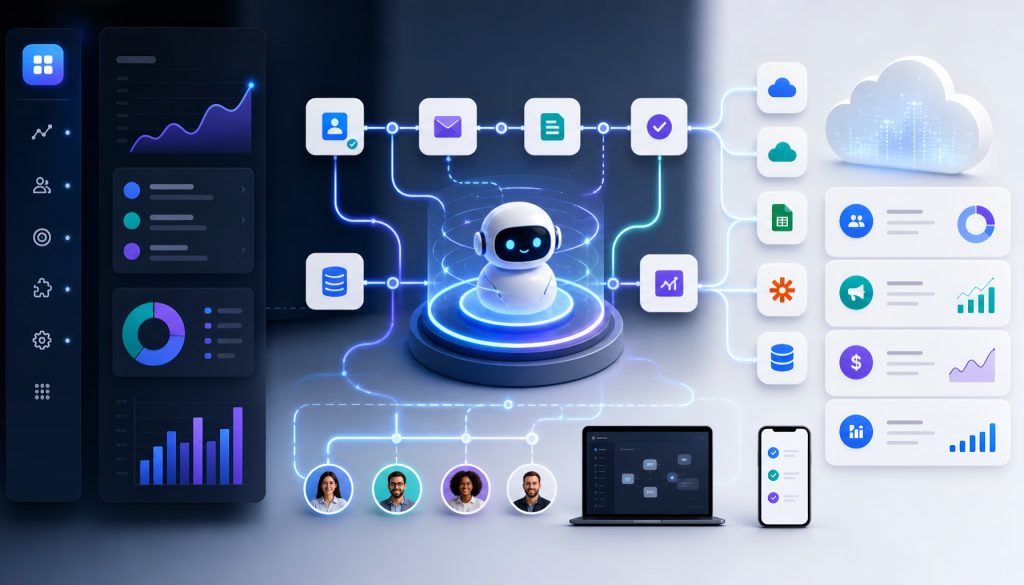
In 2024, enterprise AI looked like this: open ChatGPT in a browser tab, paste in a customer email, copy the draft reply back into Outlook. The model sat in a sidebar, disconnected from actual work.
In 2026, the model reads your Gmail directly, pulls the customer’s order history, checks recent CRM interactions, drafts a reply with a calendar link attached, and drops it into your Outlook drafts folder. You see the output, not the process. Google demonstrated this at I/O 2026 under the “agentic Gemini era” banner, and it represents how enterprise AI deployment actually works now.
OpenAI crossed $25 billion in annualized revenue. Anthropic is approaching $19 billion. That money comes from enterprises paying to embed AI into workflows, not from chatbot subscriptions. Legal, retail, logistics, sports: industries that discussed “AI transformation” in slide decks during 2024 are executing it at the task level in 2026. The SaaS software stack is being physically rearranged.
Three Shifts: From Chatbot to Workflow Participant
The interaction model moved from Q&A to delegation
The 2024 AI interaction pattern was chat. You ask, it answers. The model waits for instructions.
The 2026 pattern is delegation. You state an objective; the system executes. Salesforce’s Agentforce, HubSpot’s Breeze, Microsoft’s Copilot Studio: none of these products center on a chat box. They expose a set of agents that execute autonomously. You say “handle today’s customer inquiries” and the system classifies tickets, prioritizes them, drafts responses, and escalates to humans when necessary.
This reshapes what enterprise software competes on. For years, SaaS companies fought over UI quality. Better interface, more customers. That logic breaks when humans are no longer the primary operators. AI agents don’t need attractive buttons. They need clean APIs and stable tool-calling interfaces.
Access expanded from tool-level to system-level
In 2024, AI was a text-in, text-out tool. It couldn’t see your email, read your calendar, or write to your database.
In 2026, AI operates as a system. Through MCP (Model Context Protocol) and Agent2Agent protocols, models can traverse Gmail, Notion, Slack, CRM, and ERP simultaneously. They read everything and write selectively. Anthropic’s Computer Use, OpenAI’s Operator, Google’s Project Mariner aren’t features added to existing products. They represent a different model entirely: the AI treats your entire digital work environment as its operating surface.
Enterprise IT teams now manage agent permissions alongside employee permissions. The SOC 2 audit question shifted from “who logged in” to “which agent used what token to call which API.” When an agent can batch-modify records across systems, the risk profile looks nothing like a human accidentally deleting a file.
The business model shifted from copilot pricing to outcome pricing
The 2024 commercial logic was copilot-style: assist the human worker, charge per seat. Microsoft Copilot at $30/month/user, GitHub Copilot at $19/month/user. Both assume a human employee with an AI assistant attached.
The 2026 logic is outcome-based. Sierra (Bret Taylor’s AI customer service company) charges per resolved ticket. Decagon charges on deflection rate. Harvey charges per completed legal review. The pricing model implies something specific: the AI isn’t assisting a person, it’s replacing one. If an agent independently resolves a support ticket end-to-end, per-ticket pricing makes more sense than per-seat.
For traditional SaaS, this is existential. Zendesk sells customer service platform seats. If a company uses Sierra to automate 70% of tickets, it needs 70% fewer Zendesk seats. Revenue drops proportionally.
Which SaaS Categories Get Eaten First
Not every SaaS product faces replacement, but several categories are already exposed.
Customer support automation. Zendesk, Intercom, and Freshdesk sell ticket management interfaces. But AI agents can process tickets directly without a human operating the UI. Sierra (backed by Anthropic) hit a $4 billion valuation in 2026. Decagon signed Notion and Duolingo. Forethought and Ada both repositioned from “support assistant” to “autonomous support agent.”
Content generation. Jasper, Copy.ai, and Writesonic were copywriting tools in 2024. By 2026, ChatGPT and Claude produce better output than these specialized products. When the general-purpose model outperforms the niche tool, the niche tool loses its reason to exist. Jasper’s valuation was cut in half during 2025. Copy.ai pivoted to an enterprise GTM platform.
Data analytics. Looker, Tableau, and Power BI were built for analysts who write SQL and build dashboards. AI can now take a spoken question, generate the query, and produce the visualization. Power BI Copilot, Databricks Genie, and ThoughtSpot Sage shift the user from analyst to business operator. The market for “BI tools designed for analysts” shrinks.
Sales outreach. Apollo, Outreach, and Salesloft sell sales execution platforms. Clay, Common Room, and Unify are AI-native alternatives that generate leads, write emails, and manage follow-ups directly. Traditional sales execution SaaS must embed AI at the deepest level of the product or face marginalization.
Simple workflow automation. Zapier and Make connect two tools with no-code drag-and-drop. AI agents understand natural language instructions and call APIs directly, bypassing the node-based interface entirely. Zapier acknowledged this by launching its Agents product. Basic “A triggers B” automation is being absorbed by AI.
Which SaaS Categories Benefit
Workflow AI isn’t a universal threat. For infrastructure and data layers, it’s a growth accelerator.
Databases and data warehouses. More agents means more reads and writes. Snowflake, Databricks, and PostgreSQL-based systems see query volumes spike. Snowflake reported 28% year-over-year growth in fiscal 2025, driven by AI workloads. Serverless databases like Supabase, Neon, and PlanetScale benefit from the same dynamic: more deployed agents, more database calls.
Observability. AI agents are new “users” that enterprises must monitor. Datadog, Grafana, and Better Stack invested heavily in LLM observability. Newer companies like Langfuse, Helicone, Braintrust, and Weave build monitoring specifically for AI workflows. The more agents you deploy, the more observability you need.
Identity and authentication. Every agent needs tokens, permissions, and audit trails. Auth0, Clerk, and WorkOS have structural advantages in agent identity. WorkOS launched AgentOS in 2026, positioning it as an identity system designed for agents, and signed over 200 customers in six months.
API gateways. LLM gateways (Portkey, LiteLLM, Helicone) emerged as a new infrastructure layer. Enterprises won’t let every agent connect directly to OpenAI. They need a gateway for caching, rate limiting, cost control, and model routing. This product category barely existed in 2024.
Security and compliance. Agents with permissions create risk. Snyk, Wiz, and Lacework are building agent security capabilities. Startups like Lasso Security and Strong Intelligence raised funding specifically for agent-layer protection: permission boundaries, data leak prevention, compliance auditing.
How Enterprise Purchasing Decisions Changed
The 2024 SaaS buying process: CIO watches a demo, compares feature lists, picks the tool with the friendliest UI, signs the contract.
The 2026 buying question is different. CIOs now ask: “Can my AI agents call this product’s API? Does it integrate with my agent orchestration platform? Does it expose an MCP server?”
This cuts both directions. Traditional SaaS must build APIs and MCP servers to pass procurement evaluation. Products with attractive UIs but mediocre APIs lose points under the new scoring criteria.
Snowflake, Databricks, and Salesforce all shipped their own agent platforms in 2025-2026. The goal isn’t selling agent tools. It’s occupying the “source of agent calls” position in the ecosystem. If your agents all run on Salesforce’s Agentforce, switching away from Salesforce becomes harder. This is a platform war, not a product war.
For smaller SaaS companies, two survival paths exist. First: become agent-friendly by opening APIs, providing MCP servers, and making the product easy for agents to call. Second: focus on work that agents can’t do well yet, like relationship-building, complex judgment calls, and compliance approvals. The dangerous middle ground is a product with closed APIs, an average UI, and no defensible moat. Those products will be marginalized through 2026 and 2027.
Predictions Through 2027
| Category | Outlook |
|---|---|
| Simple AI writing tools (Jasper, Copy.ai model) | Business model no longer viable. Must pivot to enterprise GTM platforms or shut down. |
| Mid-market traditional BI (Tableau, Looker for SMBs) | Replaced by AI-native analytics (Power BI Copilot, Databricks Genie). Only high-end custom deployments survive. |
| Simple workflow automation (Zapier’s SMB customers) | Large-scale customer loss to AI agents. Zapier’s Agents product is the survival play. |
| Basic customer service SaaS (Zendesk, Freshdesk SMB tier) | Significant SMB customer shrinkage. Enterprise accounts hold but growth slows. |
| AI writing plugins (Grammarly Premium, Otter.ai) | Features absorbed by native AI in host applications. |
Winners: infrastructure and data layers (Snowflake, Databricks, PostgreSQL ecosystem, Cloudflare), AI-native tools (Cursor, Lovable, Sierra, Decagon, Clay), agent orchestration platforms (Salesforce Agentforce, Microsoft Copilot Studio, ServiceNow AI Agents), observability and security (Datadog, Grafana, Langfuse, WorkOS, Wiz).
The Redefinition of SaaS
By 2027, the term “SaaS” will mean something different. Today it means “web application plus subscription pricing.” Tomorrow it may mean “a set of APIs plus a set of agents plus outcome-based billing.” The UI will still exist, but as one output channel among several, not as the core product surface.
If you’re building or investing, the entry point for the next wave is clear. Stop building tools for humans to operate. Build infrastructure that agents consume, or build services where AI delivers the result directly. The first is a platform play. The second is a moat. The middle layer, the one that depends on human operators clicking through interfaces, is collapsing.
Related Reading
- Composable Data Stack vs Traditional CDP: B2B SaaS Reality Check
- Your SaaS Stack Will Lose Half Its Logos by 2027. Here Is Which Half.
Stay updated with our latest AI insights