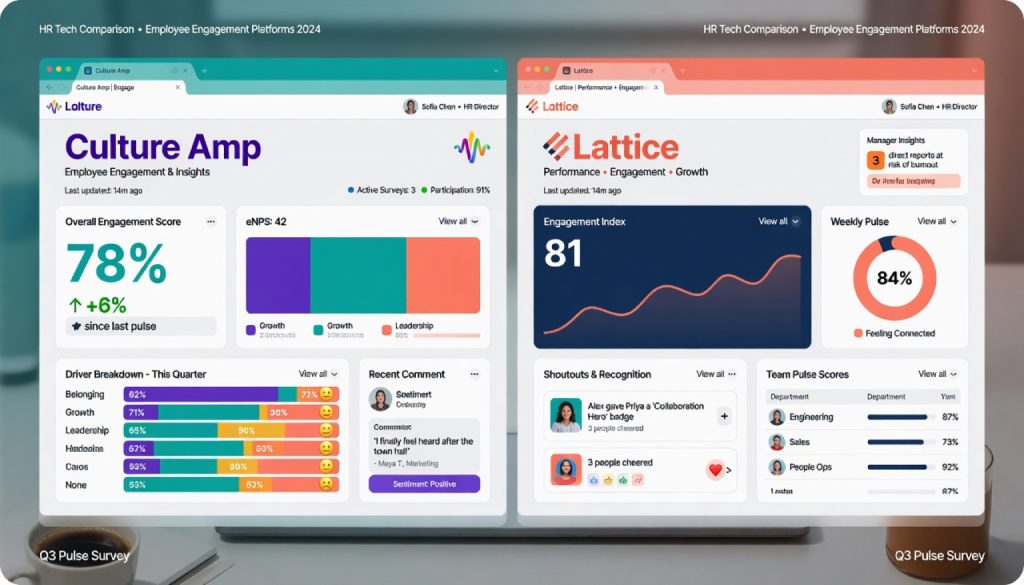
If you are evaluating employee engagement platforms in 2026, Culture Amp and Lattice will show up on every shortlist. Both handle surveys, performance reviews, 1-on-1s, and goal tracking. But their DNA is different, and that difference shapes everything from analytics depth to day-one usability.
Culture Amp started as a survey tool in 2013. It added performance management later. Lattice launched in 2015 as a performance review platform and bolted on engagement surveys after 2020. Picking the wrong one means either your survey insights stay shallow or your performance workflows feel half-baked.
This comparison breaks down where each platform excels, where it falls short, and which type of organization gets the most value from each.
Product Philosophy
Culture Amp is built around what the company calls “People Science.” A team of 40+ organizational psychologists designs survey instruments, maintains benchmark datasets, and publishes research. The benchmark library includes over 1,100 industry segments. You can compare your engagement scores against “US tech companies with 1,000+ employees” or “education sector, Australia.” Culture Amp updates these benchmarks every six months.
Lattice is built around performance operations. Its OKR engine supports cascading goals from company objectives down to team and individual key results. Performance reviews support 360-degree feedback, calibration sessions, multi-round scoring, and direct links to compensation decisions. The UI feels closer to a project management tool: employees update goal progress weekly, managers track real-time completion on dashboards.
In short, Culture Amp is an analytics-first platform. Lattice is a workflow-first platform.
This distinction matters more than feature lists. An analytics-first tool assumes your HR team wants to dig into data and form hypotheses. A workflow-first tool assumes your HR team wants processes to run on schedule with minimal manual intervention. Both assumptions are valid. The question is which one matches your org today.
Employee Surveys
Culture Amp’s survey module is the industry benchmark. It ships with 200+ question templates covering engagement, attrition risk, DEI, onboarding experience, and more. Each template is backed by peer-reviewed research. The platform applies psychometric validation automatically, flagging straight-line responses and suspiciously fast completions.
The standout feature is driver analysis. Culture Amp calculates the correlation coefficient between each survey question and overall engagement. If “career development opportunities” shows a 0.72 correlation while “pay satisfaction” shows 0.43, you know exactly where to invest your budget.
Lattice Engagement launched after 2020. It offers pulse surveys and preset templates, but the benchmark database is noticeably smaller. Where Lattice wins: survey data and performance data live in the same system. You can filter for employees with engagement scores below 3 and performance ratings below 2 stars, then run targeted interventions without exporting anything.
Performance Management
Lattice’s performance module is more mature. It supports annual, quarterly, project-based, and probation reviews. Each template allows custom scoring dimensions, weight assignments, and reviewer scopes. The 360-degree feedback system supports both anonymous and attributed reviews. Managers control which feedback gets shared with the employee.
Calibration sessions are where Lattice stands out. Multiple managers compare score distributions across their teams in a shared view, reducing the “lenient vs. strict grader” problem that plagues most review cycles.
Lattice also includes a compensation module. You can set rules like “5-star rating = 10% raise, 4-star = 5%, 3-star = no raise” and track total compensation budget consumption in real time.
Culture Amp added performance reviews in 2019. It covers basic review workflows, but lacks the depth of Lattice’s calibration and compensation features. Culture Amp has no built-in compensation module. If you need to translate performance scores into raise decisions, you will export to a spreadsheet or integrate a third-party comp tool.
Goal Management (OKR)
Lattice supports full goal cascading. Company-level objectives break into department key results, which break into individual goals. The platform generates alignment maps showing how each person’s work connects to company strategy. Goal progress updates can be automated through integrations with Jira and Asana.
Culture Amp supports SMART goals and OKRs, but without complex cascading logic. Its goal module works more like a personal task list than a strategic alignment tool.
1-on-1s and Feedback
Both platforms support shared agendas, meeting notes, and action items for 1-on-1 meetings.
Lattice integrates 1-on-1s deeply with performance records. Managers can give instant feedback (praise or constructive) during a 1-on-1, and that feedback auto-archives to the employee profile for reference during annual reviews.
Culture Amp takes a lighter approach. It focuses on continuous conversation rather than performance documentation. The system prompts managers with context like “Last time you discussed career development; consider following up.”
Both platforms support public recognition walls. Lattice lets you tag recognition to company values (“teamwork,” “customer first”), and HR can report on which values get the most recognition activity.
Feature Comparison Table
| Feature | Culture Amp | Lattice |
|---|---|---|
| Employee Surveys | Industry-leading (200+ templates, driver analysis) | Functional (pulse surveys, basic benchmarks) |
| Benchmark Database | 1,100+ industry segments | Smaller dataset |
| Performance Reviews | Basic workflows | Full-featured (calibration, multi-template, 360) |
| OKR / Goal Management | Basic (no cascading) | Advanced (cascading, alignment maps, auto-sync) |
| Compensation Management | Not available | Built-in (rules-based raises, budget tracking) |
| 1-on-1 Management | Lightweight, conversation-focused | Deep integration with performance records |
| Real-time Feedback | Supported | Supported, with value tagging |
| Analytics Depth | Deep (driver analysis, heatmaps, NLP comment analysis) | Operational dashboards (completion rates, progress) |
| HRIS Integrations | Workday, BambooHR, Gusto, ADP, SAP SuccessFactors | Rippling, BambooHR, Workday, ADP, Gusto |
| Collaboration Tools | Slack, Microsoft Teams | Slack, Microsoft Teams, Jira, Asana, Google Workspace |
| Mobile App | Full-featured | Full-featured with push notifications |
| Time to Proficiency | 2-3 weeks for advanced features | ~1 week for core workflows |
| Pricing (annual, full suite) | ~$10-$15 per employee | ~$216-$264 per employee |
| Minimum Contract | Typically 100-200 employees | No stated minimum |
Analytics Capabilities
Culture Amp’s analytics are its primary differentiator:
- Driver analysis: Automatic correlation between survey questions and engagement scores
- Heatmaps: Score distribution by department, level, and region for quick problem identification
- Trend analysis: Compare results across survey cycles to track movement
- Comment analysis: NLP-powered theme extraction from open-ended responses
- Benchmark comparison: Contextualized scoring against similar organizations
- Board-ready exports: PDF and PowerPoint reports with auto-generated action recommendations
Lattice’s analytics lean toward operational metrics:
- Review completion rates: Track self-assessment and manager scoring progress
- Goal progress distribution: Identify on-track vs. overdue objectives
- 1-on-1 frequency: Flag managers below the company’s meeting cadence requirement
- Feedback activity: Measure recognition and feedback volume by team
Lattice can cross-reference survey data with performance data in one view. For example: “Do our top 20% performers also score highest on engagement?” Culture Amp can answer the same question, but it requires a data export and manual merge.
Pricing Breakdown
Neither platform publishes fixed pricing. Both require a sales conversation. Based on user reports and procurement data from 2026:
Culture Amp:
- Engage (surveys only): $5-$8 per employee/year
- Perform (reviews only): $6-$10 per employee/year
- Full platform: $10-$15 per employee/year
- Volume discounts start at 1,000+ employees
Lattice:
- Talent Management (performance + goals): $11 per employee/month ($132/year)
- Engagement add-on: $4-$6 per employee/month
- Compensation add-on: $4-$6 per employee/month
- Full platform: $18-$22 per employee/month ($216-$264/year)
Key pricing note: Lattice’s full-suite cost is significantly higher than Culture Amp’s. If you only need surveys, Culture Amp is cheaper. If you only need performance reviews without the engagement add-on, Lattice’s base tier is still $132/year per employee vs. Culture Amp’s $6-$10 range for Perform alone.
Also worth knowing: Lattice is discontinuing its standalone HRIS product after July 31, 2026. The company is refocusing entirely on performance and engagement.
Integration Ecosystem
Culture Amp connects to major HRIS platforms (Workday, BambooHR, ADP, SAP SuccessFactors, Gusto) with bi-directional sync. Employee data flows in automatically, and survey results can be segmented by any HRIS field. Syncs run daily or on-demand.
Lattice integrates with the same HRIS tier (Rippling, BambooHR, Workday, ADP, Gusto) plus project management tools. The Jira and Asana integrations auto-update goal progress when linked tasks complete. Lattice’s Slack integration goes deeper than Culture Amp’s: employees can send recognition, update goals, and manage 1-on-1 agendas directly from Slack. Culture Amp’s Slack integration is limited to survey reminders and report links.
Who Should Pick Culture Amp
Culture Amp fits organizations where:
- Employee listening is a strategic priority, not a checkbox exercise
- HR leadership has a background in organizational psychology or people analytics
- Benchmark comparisons matter for board reporting and executive buy-in
- Performance review needs are straightforward (no complex calibration or comp linkage)
- Headcount is 200+ (the minimum contract threshold)
Typical customers: tech companies focused on culture, consulting firms, universities, nonprofits.
Who Should Pick Lattice
Lattice fits organizations where:
- Performance management standardization is the primary pain point
- Compensation decisions need a direct link to review outcomes
- OKR cascading is central to how the company executes strategy
- The HR team wants fast deployment without a steep learning curve
- Survey needs are periodic rather than continuous
Typical customers: high-growth startups, sales-driven orgs, companies scaling from 50 to 500 employees.
Can You Use Both?
Technically yes, but it rarely makes sense. Feature overlap exceeds 60%, and running two systems creates confusion for employees and data silos for HR. The more practical approach: pick one as your primary platform and supplement with a lightweight point solution if one specific capability falls short (e.g., Qualtrics for advanced survey research, or 15Five for lightweight check-ins).
What About Smaller Teams?
If your headcount is below 50, neither platform is a strong fit. Culture Amp’s minimum contract typically requires 100+ employees. Lattice has no stated floor, but the per-seat cost is hard to justify for small teams.
Alternatives for sub-50 teams:
- 15Five: Lightweight performance management, $4-$10 per employee/month
- Officevibe: Simple engagement surveys, $3.50-$5 per employee/month
- Google Forms + spreadsheets: Free, sufficient for seed-stage startups
Revisit Culture Amp or Lattice when you cross the 100-200 employee mark. At that stage, the complexity of managing performance cycles and engagement data manually starts to outweigh the subscription cost, and the benchmark data becomes statistically meaningful for your own organization.
Bottom Line
Culture Amp wins on survey science, benchmark depth, and analytics sophistication. Lattice wins on performance workflow maturity, compensation integration, and speed to value. Your decision should follow your primary use case: if understanding employee sentiment drives your people strategy, start with Culture Amp. If standardizing and automating performance cycles is the urgent need, start with Lattice.
Both platforms offer free demos. Book calls with both sales teams, specify whether your priority is surveys or performance, and request a 30-day pilot with real users before committing.
During the pilot, pay attention to two things: how quickly managers adopt the tool without being asked, and how useful the default reports are without customization. Manager adoption speed tells you whether the UX fits your culture. Report usefulness out of the box tells you how much ongoing HR labor the platform will require. These two signals predict long-term satisfaction better than any feature checklist.
Related Reading
- Best Culture Amp Alternatives in 2026: Lattice, 15Five, Leapsome, Quantum Workplace & Officevibe Compared
- 5 Culture Amp Alternatives That Actually Save You Money in 2026
Stay updated with our latest AI insights