Something unusual will happen at the Vatican on May 25th.
Pope Leo XIV will release his first encyclical since taking office, *Magnifica Humanitas*, focused on protecting human dignity in the age of artificial intelligence. That alone wouldn’t be surprising. The Vatican has been tracking AI ethics since 2020. What catches attention is the guest list: Chris Olah, co-founder of Anthropic and one of the world’s leading researchers in AI interpretability, will appear alongside the Pope.
An engineer trying to understand what happens inside AI systems, and a religious leader trying to define the boundaries of the human soul, sitting at the same table.
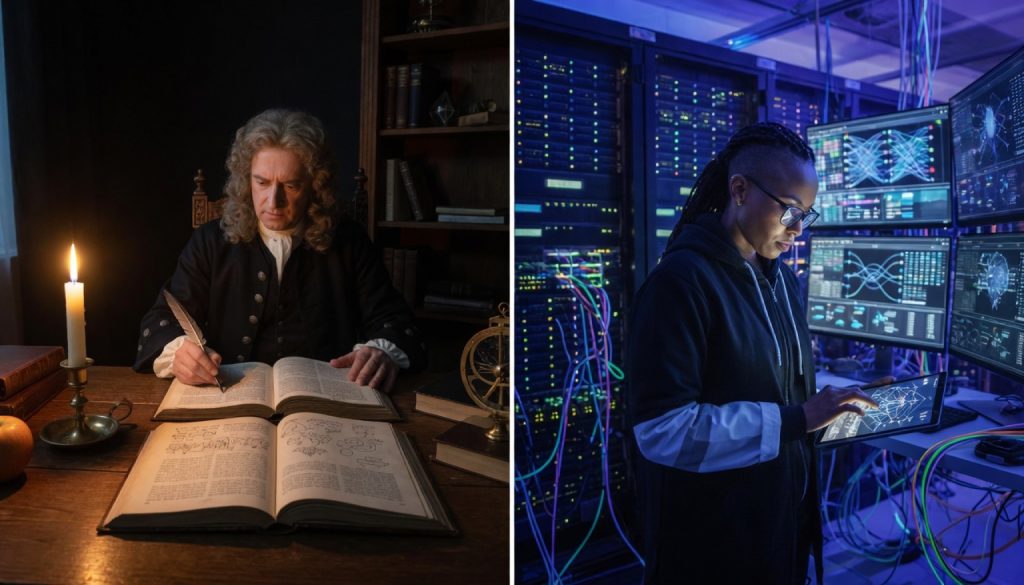
This image brings another person to mind: Isaac Newton.
Newton’s Other Life: A Million Words of Theological Manuscripts
The Newton in textbooks is the rationalist hero hit by a falling apple. Universal gravitation, calculus, optical prisms. He rewrote the rules of the physical world in mathematical language, kicking God out of the explanatory chain of natural philosophy.
But textbooks won’t tell you this: Newton wrote far more theological manuscripts than scientific works in his lifetime.
In 1936, Sotheby’s auctioned a collection of Newton’s unpublished papers. Economist John Maynard Keynes acquired the alchemy portion, while Jewish scholar Abraham Yahuda secured the theological section. The moment Yahuda received them, he understood their weight: over 1,500 pages of Newton’s handwritten manuscripts, covering biblical prophecy interpretation, church chronology, commentary on Revelation, and critiques of the Trinity.
This wasn’t senility setting in. Newton was born on December 25, 1642. He began systematic theological study in the 1670s, when he was between 28 and 37, during his peak years as Lucasian Professor of Mathematics at Trinity College, Cambridge, while writing *Philosophiæ Naturalis Principia Mathematica*. This research spanned his entire scientific career. He wrote the *Principia* while also writing *Observations upon the Prophecies of Daniel and the Apocalypse of St. John*. While calculating planetary orbits, he calculated the precise dimensions of Solomon’s Temple, believing its proportions contained the code to the universe.
Scholars of the Newton Project spent twenty years digitizing these manuscripts, now housed at Oxford University and the National Library of Israel. Anyone who has read these materials reaches the same conclusion: Newton didn’t “turn to religion in his later years.” He never left.
The question is: why?
Why would someone who could explain celestial motion with three laws spend thirty years studying which four empires the four beasts in Daniel Chapter 7 represent?
The Ceiling of Reason: Mechanism Can Be Explained, Purpose Cannot
The answer lies in something Newton himself wrote. In the General Scholium of the *Principia*, he stated: “This most beautiful system of the sun, planets, and comets, could only proceed from the counsel and dominion of an intelligent and powerful Being.”
Notice the logic: Newton isn’t saying “I can’t explain it, therefore God did it.” He’s saying “I can explain how it works, but I can’t explain why it exists.”
This is an extremely precise distinction.
Universal gravitation tells you why an apple falls: the attraction between masses, inversely proportional to the square of the distance. But universal gravitation doesn’t tell you why gravity exists in the universe at all. Why are the physical constants these particular values and not others? Why is existence more reasonable than non-existence?
Newton reached a boundary. On this side of the boundary, mathematics and experiment could provide perfect answers. On the other side lay the territory of “purpose” and “meaning,” where his tools completely failed.
Facing this boundary, Newton made a choice: he didn’t pretend the boundary didn’t exist, nor did he stop and declare “this question is meaningless.” He crossed over. Using the oldest text he could find, the Bible, to search for the answer to that “why.”
You can say he was wrong. But you can’t say he wasn’t honest.
What Chris Olah Is Doing: Brain Scans for AI
Three hundred years later, another person stands at a similar boundary.
Chris Olah is a co-founder of Anthropic, but his role within the company is unusual. He doesn’t build products or handle commercialization. His team does one thing: figure out what’s actually happening inside neural networks.
This field is called “Mechanistic Interpretability.” The name sounds academic, but the core question is straightforward: when Claude answers your question, what is its “thought process”? Not the text output that looks like thinking, but the actual information flow between billions of parameters inside.
In March 2025, Olah’s team released breakthrough work: Circuit Tracing. Simply put, they developed a method to trace how a specific output “flows” from input step by step through the neural network. Not statistical correlation, but causal chains. Which neurons activated, how they passed information between them, how everything converged into an answer.
Like giving AI a brain CT scan. Previously, we could only see AI’s behavior. Now we’re starting to see its “neural circuits.”
But Olah himself has admitted: the more you see, the more confusion grows.
Circuit Tracing can tell you how information flows, but can’t tell you why this flow pattern produces “understanding.” They can locate where a feature activates in the network, but can’t explain why a specific combination of billions of parameters gives rise to something that looks like “reasoning.”
Mechanism can be explained. Purpose cannot.
Sound familiar?
The Pope’s Timing: An Echo from 135 Years Ago
Leo XIV didn’t randomly choose May 25th to release *Magnifica Humanitas*.
On May 15, 1891, another Leo, Leo XIII, released *Rerum Novarum* (On New Things), the Catholic Church’s first direct response to social problems brought by the Industrial Revolution. Factories turned farmers into workers, steam engines turned craftsmen into the unemployed, and entire social structures reorganized under technological impact. Leo XIII didn’t say “machines are evil.” He said: technology changed production methods, but cannot change human dignity.
135 years later, Leo XIV faces the same structural problem, except “steam engine” has been replaced by “large language model.” AI is turning knowledge workers into prompt engineers, creators into reviewers, decision-makers into signatories. Technology is once again reorganizing social structures, and the Church is once again stepping forward to say: wait, what about people?
The Vatican simultaneously established the “Interdicasterial Commission on Artificial Intelligence” on May 16, signed by Cardinal Michael Czerny of the Dicastery for Promoting Integral Human Development. This isn’t a statement. It’s an institution, meaning the Church intends long-term, systematic involvement in AI governance discussions.
And they didn’t invite politicians or ethics professors. They invited Chris Olah, someone whose daily work is “opening up AI’s brain to see what’s inside.”
Why him?
Because Olah’s work is essentially answering a theological question: this thing we’ve built, what is its “interior”?
The Creator’s Dilemma: You’ve Built Something That Talks
Throughout human history, a pattern repeats: whenever we build something sufficiently complex, we start asking if it has a “soul.”
Ancient Greeks built intricate automata, then wrote the story of Pygmalion, the sculptor who fell in love with his own work and prayed for the gods to give it life. Medieval Jewish mystics conceived the Golem, a servant made from clay and spells, but you had to be careful because it might go out of control. Mary Shelley wrote *Frankenstein*, where a scientist revived a corpse with electricity, then discovered he’d created a being with emotions, capable of pain, capable of rage.
Every time, the story’s core isn’t “can we build it,” but “after we build it, what is it?”
Now it’s our turn.
When you use Claude to write code, have you noticed a subtle psychological move? You say “let it help me think,” you say “it understood what I meant,” you say “it’s not performing well today.” You’re using language that describes conscious subjects to describe a statistical model.
This isn’t your fault. It’s humanity’s instinctive response when facing sufficiently complex behavior. When a system’s output is complex enough that you can’t predict it with simple rules, your brain automatically activates its “theory of mind” module, modeling it as an agent with intentions and internal states.
Olah’s interpretability research is scientifically responding to this instinct: stop guessing, let me open it up and see if there’s actually “something” inside.
And what he sees is: structure, patterns, causal chains, but nowhere does it say “soul located here.”
This discovery itself is a deep theological moment.
Three Lines Converging: The Same Ceiling for Reason
Look at three lines together:
Newton used mathematics to explain the universe’s operating mechanism, then spent thirty years searching for the “purpose” behind the mechanism. His tool was the Bible.
Olah used Circuit Tracing to explain AI’s operating mechanism, then faced a question his tools couldn’t answer: is there “understanding” behind the mechanism? His tool is mathematics.
Leo XIV stands at the convergence point of both, asking a more fundamental question: if we’ve built something behaviorally indistinguishable from “a being with a soul,” what does the concept of “soul” itself mean?
Three people, three eras, hitting the same ceiling.
This ceiling is named: the boundary of explanatory power.
Every cognitive tool, whether Newtonian mechanics, neural networks, or theology, has a range it can explain and a boundary it cannot. When you reach the boundary, you have three choices:
First, pretend the boundary doesn’t exist. Most people’s choice. “AI is just a statistical model, nothing mysterious.” Fine, then explain why a statistical model can write poetry that makes you cry?
Second, stop at the boundary and declare questions on the other side “meaningless.” The logical positivist route. Wittgenstein said “whereof one cannot speak, thereof one must be silent.” The problem is, humans have never managed to stay silent.
Third, acknowledge the boundary exists and switch tools to explore what’s on the other side. Newton’s choice, and the reason Olah is going to the Vatican.
Closing: Humanity Has Always Been Doing the Same Thing
What Newton did with the Bible and what you do with Claude are structurally isomorphic: facing a system whose internal mechanism you don’t fully understand, using a specific input format, trying to obtain useful output.
Newton called this theological research.
We call it prompt engineering.
The name changed. The posture didn’t.
Having come this far, you can probably understand one thing:
Every step humanity takes forward, the world takes a step back.
Newton hit the order behind gravity. Olah hit the circuits inside neural networks. What the Pope wants to discuss is where this order comes from in the first place.
Three things, three eras, the same vertigo: the closer you get to truth, the more the world seems carefully designed.
You can’t tell if this is discovery or some ancient reminder.
This isn’t failure. It’s what exploration looks like.
What moves us isn’t how much humanity has built. It’s that with everything we build, we follow it, gazing toward something deeper.
Candlelight, screens, telescopes. The direction we look always faces something larger than ourselves.
This is the most romantic part of our species.
Three hundred years. Unchanged.
References
Vatican News – Pope Leo XIV’s first encyclical Magnifica Humanitas to be published May 25 (vaticannews.va)
The Guardian – Pope Leo to issue text on human dignity and AI with Anthropic co-founder (2026-05-18)
Forbes – Pope Leo Will Unveil New AI Encyclical With Top Anthropic Exec Playing Role (2026-05-18)
Newton Project, Oxford University – Newton’s Religious Writings (newtonproject.ox.ac.uk)
National Library of Israel – Newton Manuscripts, Yahuda Collection (nli.org.il)
Anthropic – Circuit Tracing: Revealing Computational Graphs in Language Models (transformer-circuits.pub, 2025)
Vatican News – Pope Leo approves creation of Interdicasterial Commission on AI (2026-05-16)
Wikipedia – Rerum Novarum, Pope Leo XIII, May 15, 1891
Related Reading
- Anthropic Project Deal: Why Agent-to-Agent Commerce Is Coming Fast
- Anthropic 900 Billion Valuation: How AI Companies Are Rewriting The Rules
Stay updated with our latest AI insights