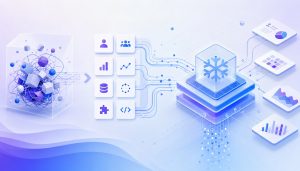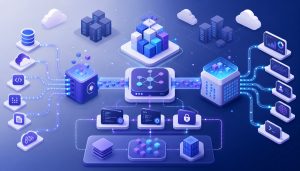
In January 2026, Salesforce, ServiceNow, and HubSpot shed over 10% of their market cap in a single day. The trigger wasn’t a missed quarter. It was a collective realization that AI agents are dismantling the economic logic behind most SaaS categories. Gartner now forecasts a $58 billion restructuring of the productivity software market by 2027, the first serious disruption to this segment in 35 years.
But “agents will replace SaaS” is a lazy thesis. The real question is structural: which categories of software are vulnerable to agent-native alternatives, and which ones remain untouched?
What “Agents Replacing SaaS” Actually Means
The phrase gets thrown around in pitch decks without precision, so let’s be specific.
Traditional SaaS sells you a persistent application with a UI, a data model, and workflow logic. You pay per seat, per month, for access to that application. An AI agent, by contrast, is a stateless (or lightly stateful) process that receives a goal, decomposes it into steps, calls APIs or models to execute those steps, and returns a result.
When people say “agents will replace SaaS,” they mean something narrow: for certain categories of software, the value proposition collapses when an autonomous process can accomplish the same outcome without a dedicated UI, without per-seat licensing, and without the user ever logging into a dashboard.
This does not mean all software disappears. It means the *packaging* changes. A BI tool doesn’t vanish from existence. It stops being a standalone product you buy from Tableau and becomes an embedded capability inside your data warehouse. The functionality persists; the commercial wrapper dissolves.
Publicis Sapient already cut 50% of their SaaS licenses in 2025, replacing Adobe and other creative tools with AI-native workflows. Automation Anywhere reports that AI service agents now resolve over 80% of internal IT support requests, cutting ITSM license costs in half. These aren’t pilot programs. They’re production deployments running at scale.
The Replacement Timeline
Not every SaaS category faces the same pressure, or the same speed of disruption. Here’s where things stand:
| SaaS Category | Traditional Tool | Agent-Native Approach | Disruption Timeline |
|---|---|---|---|
| , – | , – | , – | , – |
| Customer Support | Zendesk, Intercom, Freshdesk | Kore.ai, Sierra, custom LLM agents with RAG over knowledge bases | Already happening (2025-2026) |
| Business Intelligence | Tableau, Power BI, Looker | Agentic BI embedded in Databricks Genie, Snowflake Cortex Analyst | Mid-transition (2026-2027) |
| Content & Creative | Adobe Creative Cloud, Canva Pro | Midjourney, Runway, Jasper, model-native generation pipelines | Already happening (2025-2026) |
| Marketing Automation | HubSpot, Marketo, Mailchimp | Salesforce Agentforce, AI-native campaign agents | Early transition (2026-2028) |
| CRM (task layer) | Salesforce, HubSpot CRM | AI agents handling lead scoring, outreach sequencing, follow-ups | Mid-transition (2026-2027) |
| CRM (system of record) | Salesforce, HubSpot CRM | Remains as data layer underneath agents | Persists indefinitely |
| Security & Compliance | Palo Alto, CrowdStrike, Vanta | Stays independent; gains new “agent governance” category | Resistant |
| Infrastructure & DevTools | AWS, Datadog, GitHub, Terraform | Stays; agents consume these tools via API | Resistant |
| Collaboration | Slack, Teams, Zoom | Stays; agents embed *inside* these platforms | Resistant |
| ERP & Finance | SAP, NetSuite, Oracle | Stays; regulatory requirements prevent autonomous replacement | Resistant |
Which Categories Fall First
Customer support is already over. The economics are brutal. A Zendesk seat costs $55-150/month per agent. An AI agent handling Tier 1 and Tier 2 tickets costs pennies per resolution at scale. Gartner predicts that by 2027, 50% of enterprises will use AI agents as their primary customer interaction layer. The remaining human agents handle escalations, not routine volume.
The reason support falls first: its core value (fast response, knowledge retrieval, multi-channel routing) maps directly to what LLMs do well. A support ticket is a bounded problem with a retrievable answer. You don’t need general intelligence. You need good retrieval, reasonable language generation, and API access to your order management system.
BI tools are next. The pain point is obvious to anyone who has watched a product manager wait three days for a dashboard update from the analytics team. Traditional BI requires SQL fluency, data model knowledge, and dashboard configuration. Agentic BI collapses that into a natural language query: “Which product line had the highest margin last quarter?” Databricks Genie and Snowflake Cortex Analyst already do this in production. The standalone BI license becomes redundant when the capability lives inside your data warehouse.
Content and creative tools are splitting. For routine asset generation (social posts, ad variations, product descriptions, blog drafts), AI agents are faster and cheaper than Adobe workflows by an order of magnitude. But for brand-level creative work, complex video production, and design systems, the tools persist. The mid-market creative SaaS (Canva, later-stage Jasper competitors) faces compression from both sides: foundational models getting better at generation, and enterprise platforms like Adobe embedding AI natively.
Marketing automation is slower to fall. The reason: marketing isn’t just content generation. It’s audience segmentation, multi-touch attribution, compliance (CAN-SPAM, GDPR), and integration with ad platforms. An AI agent can draft email copy, but orchestrating a full campaign across Google Ads, Meta, email, and retargeting requires deep platform integrations that take time to build. Salesforce Agentforce is the most serious attempt here, but adoption is still early.
Which Categories Resist
Security and compliance tools survive because accountability can’t be delegated. No CISO will sign off on an AI agent autonomously configuring firewall rules or approving SOC 2 controls. The human-in-the-loop requirement isn’t a technical limitation; it’s a legal and organizational one. In fact, agent proliferation *creates* demand for new security tooling. Palo Alto Networks and Obsidian Security already ship “SaaS Agent Security” products that monitor what AI agents are doing inside your environment.
Infrastructure persists because agents need somewhere to run. AWS, GCP, Azure, Kubernetes, Datadog, Terraform: these tools provide the compute, networking, storage, and observability that agents themselves depend on. AI might change *how* you write Terraform (Copilot writes your IaC), but it doesn’t eliminate the need for infrastructure management. The UK’s National Cyber Security Centre explicitly notes that IaaS and PaaS are unlikely to be displaced by agents.
Collaboration tools survive because their value is human connection. Slack and Teams aren’t task-automation platforms. They’re communication substrates. Agents will embed inside them (Slack’s AI features, Teams Copilot), but the platform itself remains. You don’t replace “the place where people talk” with an autonomous process.
ERP and finance systems survive because of regulatory gravity. Financial data carries audit requirements, compliance obligations, and legal exposure that make autonomous replacement untenable. AI agents will automate reconciliation, flag anomalies, and generate reports inside NetSuite or SAP. But the system of record stays. The switching costs alone (data migration, retraining, audit trail continuity) protect incumbents for a decade or more.
Why 40% of Agent Projects Will Still Fail
Gartner’s prediction that over 40% of AI agent deployments will be cancelled by end of 2027 deserves attention. The failure rate for AI projects jumped from 17% in 2024 to 42% in 2025. The causes are predictable:
Cost underestimation. A customer support agent looks simple until you account for continuous model tuning, edge case handling, data pipeline maintenance, and the engineering team required to keep it running. The marginal cost per inference is low; the fixed cost of building a reliable agent is high.
Integration complexity with legacy systems. Most enterprises run on software architectures designed 15-20 years ago. These systems expose inconsistent APIs (or no APIs), store data in proprietary formats, and have undocumented business logic embedded in stored procedures. Connecting an AI agent to this environment is an integration project, not a product deployment.
Governance gaps. An agent with broad API access and autonomous decision-making authority can leak sensitive data, violate compliance requirements, or generate runaway costs through recursive API calls. Without permission controls, audit logging, and cost caps, deployments get killed after the first incident.
These failures don’t invalidate the trend. They act as a filter. The companies that clear these hurdles are the ones cutting their SaaS spend in half.
What SaaS Builders Should Do Now
If you’re building or running a SaaS product, the strategic question is whether your product is “task-shaped” or “system-shaped.”
Task-shaped products deliver value by completing a specific job: answering a support ticket, generating a report, writing marketing copy, scoring a lead. These are directly in the path of agent disruption. If your product’s core loop can be expressed as “receive input, apply logic, produce output,” an agent can replicate it.
System-shaped products deliver value by providing persistent infrastructure: storing data, enforcing security policies, enabling communication, maintaining audit trails. These are durable because agents depend on them rather than competing with them.
If you’re building a task-shaped product, you have three options:
- Become the agent. Rebuild your product as an agent-native service with usage-based pricing instead of per-seat licensing. Intercom is attempting this with Fin. The risk is cannibalizing your existing revenue before the new model scales.
- Become the platform agents run on. Shift from delivering outcomes directly to providing the orchestration layer, data access, and governance that agents need. Salesforce’s Agentforce strategy is this play: instead of fighting agents, become the place where enterprises deploy and manage them.
- Go vertical and own the data. Horizontal SaaS (generic CRM, generic BI, generic support) is most vulnerable because agents can replicate horizontal workflows easily. Vertical SaaS with proprietary data, domain-specific models, and deep workflow integration is harder to displace. A healthcare-specific EHR agent needs FDA-grade data pipelines that a generic LLM can’t replicate overnight.
What you should not do: bolt “AI features” onto your existing product and call it a strategy. Adding a chatbot to your dashboard isn’t an agent-native architecture. It’s a feature that buys you 18 months before a purpose-built agent makes it irrelevant.
The Recomposition
The right mental model isn’t “agents kill SaaS.” It’s “agents recompose the software stack.” The functions that SaaS products perform don’t disappear. Customer support still happens. Data analysis still happens. Content still gets created. What changes is the packaging: standalone applications with dashboards and per-seat pricing give way to embedded capabilities orchestrated by agents, billed by usage, and invisible to end users.
By 2028, a mid-market company’s software budget will probably look like this: 30-50% fewer SaaS licenses, a significant new line item for AI infrastructure (model inference, vector databases, orchestration platforms), and a mandatory investment in agent governance tooling that didn’t exist two years prior. Total spend may be flat. The allocation shifts dramatically.
The winners in this transition aren’t the companies that move fastest. They’re the companies that correctly identify which parts of their stack are task-shaped (and ripe for agent replacement) versus system-shaped (and worth keeping). Getting that classification wrong in either direction is expensive: replacing a system-shaped tool with an agent creates reliability risk; keeping a task-shaped tool when an agent can do it better burns budget on declining value.
The 2027 deadline isn’t arbitrary. It’s the point where agent reliability crosses the threshold for mainstream enterprise adoption in the vulnerable categories. If you’re a SaaS founder in one of those categories, you have about 18 months to decide whether you’re building the agent or being replaced by one.
Stay updated with our latest AI insights