Most people picture AI’s future the same way: one super robot that walks, talks, and understands you.
That vision feels natural. It’s compelling. But I think it misses the point.
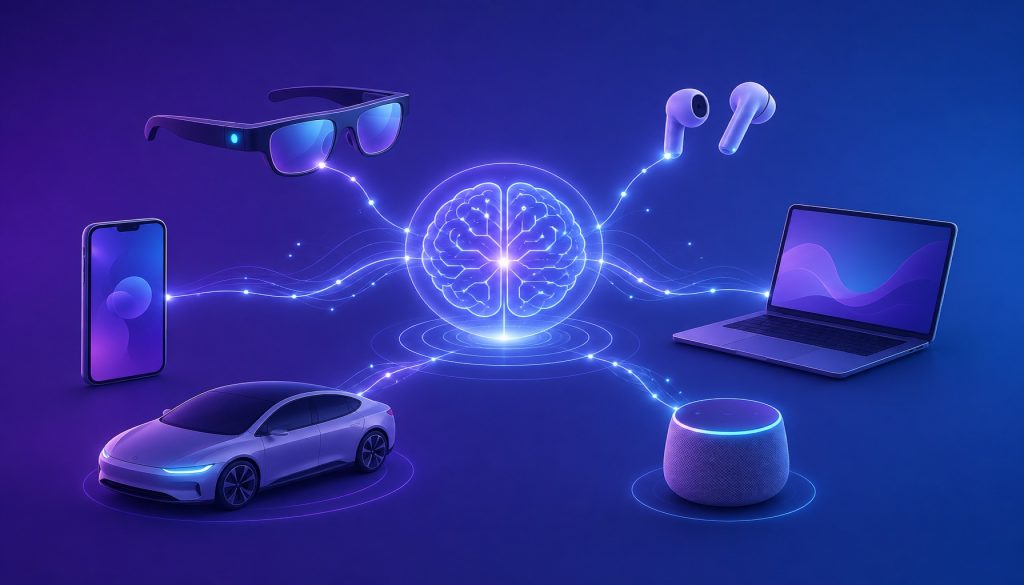
The real shift won’t be adding one powerful device to your life. It will be when all your devices start sharing one Agent brain.
Your car becomes its legs. Your glasses become its eyes. Your earbuds become its ears and voice. Your phone handles identity and payments. Your computer runs complex work. Home devices give it fixed touchpoints in space.
It looks like a bunch of separate products. But what matters is the Agent behind them, running continuously across all of them.
This piece isn’t about whether AI will enter the physical world. That’s already clear. This is about what happens next: when AI moves beyond apps and spreads into real devices, the competition shifts from individual hardware capabilities to shared memory, identity, context, and task continuity across devices.
The conclusion upfront
If you want the core argument first:
The main character in AI’s next phase probably won’t be an all-purpose robot. It will be a personal Agent that exists across devices.
What separates good from great won’t be which device is smarter. It will be whether the same Agent can move between devices without losing context.
Single-device AI is just a feature upgrade. Multi-device shared brain looks more like the next operating system.
Cars, glasses, earbuds, phones, computers won’t each grow their own brain. They’ll become different organs of the same brain.
The hardest problems ahead aren’t about model inference. They’re about memory, identity, permission, and handoff.
We default to imagining one super device
Humans compress the future into concrete images.
The steam age imagined bigger machines. The internet age imagined super portals. The AI age defaults to one super robot.
This vision isn’t wrong. But it’s too influenced by industrial product thinking.
We ask: What’s the next strongest device? What becomes the new iPhone? Which hardware will eat the others?
But Agent era questions need rewriting. An Agent isn’t a static product. It’s a cognitive layer that keeps running.
It doesn’t need to live in one shell. It can flow, switch hosts, relay across devices.
So the future might not produce one super hardware that eats all terminals. More likely: one super Agent that eats device boundaries.
What matters isn’t which device is strongest, but which Agent is most continuous
This gets underestimated.
Many AI devices today appear to be growing brains. Phones have AI. Computers have Copilot. Earbuds have voice assistants. Cars have smart cabins. Glasses are becoming AI interfaces.
But most still sit at an early stage: every device has AI, but they aren’t the same AI.
This creates a familiar fragmentation. Context from your computer doesn’t reach your phone. Preferences set on your phone don’t transfer to your car. Intent spoken into your earbuds doesn’t connect to your glasses.
You switch between devices that can talk, but they don’t inherit from each other. That’s not intelligence. It’s just multiple entry points.
The next phase needs continuity. Can the same Agent preserve the same memory, goals, personality, and task state when devices switch?
Without this, more AI entry points just means scattered smarts.
Why shared brain is more realistic than super robot
Super robots are cool. But treating them as the only endpoint makes you miss the faster path happening now.
The reason is simple. A useful humanoid robot has to solve the complete body problem: movement, grasping, power, safety, cost, home environment adaptation, long-tail task generalization. Each piece is hard enough.
Multiple devices sharing one Agent brain solves a different class of problems. It doesn’t require one shell to do everything at once. It just requires different devices to connect to the same cognitive system at their physical strong points.
This path resembles how the internet expanded, not how science fiction arrives. It fits real-world device division better.
Phones already own identity, payments, notifications. Computers already own work and production. Cars already own mobile space. Glasses sit closest to first-person view. Earbuds sit closest to continuous voice. Home devices naturally occupy fixed environments.
These devices aren’t waiting to be replaced by one new species. They’re more likely to be reorganized by one Agent.
So the most valuable development might not be who builds the most human-like robot first. It might be who first makes these existing devices coordinate like one body.
The real difficulty is four things
Many people assume that once models get strong enough, multi-device shared Agents will just happen. Not quite.
The real challenge isn’t stuffing a large model into every terminal. It’s these four layers.
1. Memory: Does it remember the same you?
If memory breaks when you switch devices, it’s not the same Agent. It’s just several entry points reusing one model.
Real shared brain means it knows who you are, what you’ve been doing recently, your preferences for getting things done, which long-term tasks remain unfinished.
More importantly, this memory can’t just be chat logs. It needs task state, environment context, authorization scope, behavior history, relationship networks, even what you don’t want it to do.
This is where AI moves from “can chat” to “can coordinate long-term.”
2. Identity: Is it the same person across devices?
Today most device account systems still follow App-era logic. Every device gets a login. Every platform gets its own permissions. Every system is an identity island.
But Agent-era identity isn’t just authentication. It’s more like a portable, verifiable, inheritable behavioral subject.
When you tell your computer “send this proposal to that client” and say the same thing in your car, it must be the same Agent taking the task, not two assistants who don’t recognize each other. Otherwise it can’t carry real continuous task responsibility.
3. Permission: What can it do and not do?
This is easiest to skip in demos and first to break in reality.
One Agent across multiple devices means it touches more real permissions: camera, microphone, location, payments, door locks, car controls, calendar, email, messages, file system.
The valuable part isn’t just “can it do this.” It’s “under what conditions can it do this.”
If permissions are too tight, it’s not useful. If they’re too loose, it will eventually crash.
So shared brain competition isn’t just about intelligence. It includes permission design. Whoever makes authorization both fine-grained and not annoying looks more like they’re building the next system.
4. Handoff: Can tasks relay without pain?
This might be the most critical and most overlooked layer.
You start a research task on your computer. When you leave, your earbuds continue reading key points. In the car, the system picks up where you left off. At the office, your computer automatically restores to where you were before leaving.
That’s an Agent.
If every device switch requires re-explaining everything, that’s not handoff. That’s disaster.
The real premium experience won’t be one particularly stunning moment. It will be barely noticing the switches. Because in your view, you’re changing devices. In the Agent’s view, the task never stopped.
Devices will increasingly resemble different organs of one brain
Once you see this, a lot of hardware competition makes more sense.
Why do glasses matter? Not because they’ll replace phones. Because they sit closest to the Agent’s first-person input.
Why do earbuds matter? Not because they play voice. Because they’re best suited for low-friction, continuously online voice layer.
Why are cars increasingly critical? Not because they’re just bigger screens. Because they’re among the few devices that already have sensing, execution, and high-value time scenarios in mobile space.
Why won’t computers disappear? Because for the next several years, they remain the main battlefield for complex production tasks.
Seen this way, devices aren’t in a replacement relationship. They’re in organ division of labor. The question isn’t “who will win.” It’s “who can first connect to the same nervous system.”
This changes where competition focuses
If the future is shared Agent brain rather than single super hardware, then competition shifts tracks.
Before, everyone fought for entry points. Whichever app got opened more frequently was stronger.
Later, everyone fought for devices. Whoever sold more terminals had more opportunity.
But what matters next might be these four capabilities:
Who controls long-term memory. Who occupies unified identity. Who gains cross-device permission orchestration rights. Who builds the most natural handoff experience.
These four things are harder than single-response quality, and they have deeper moats. Once they form, they bring very strong switching costs.
You’re not swapping a chat tool. You’re swapping an Agent brain that’s already embedded in your life workflow.
At that point the model itself becomes more like the underlying engine: important, but not necessarily where final brand belonging sits.
What this really means for regular people
Many people ask how close this is.
My judgment: it won’t arrive as “one day it suddenly appears.” It will seep in through many small continuities.
For example: things you did on your computer, your phone automatically knows the next step. Reminders you gave your earbuds, your car automatically continues. Places you frequent, people you contact regularly, routines you follow get quietly orchestrated by the Agent into default paths. You stop frequently “opening apps to work” and increasingly “call the same person to keep going” across different scenarios.
Notice this isn’t pure automation. Automation is preset workflow. An Agent is more like ongoing collaboration. Automation fears exceptions. An Agent needs to learn to handle exceptions.
So human capabilities will probably shift too. You won’t just learn which tool to use. You’ll need to learn how to train, constrain, authorize, and correct the Agent that follows you long-term.
This will become a new basic digital life skill, like how we manage phone settings, account systems, and cloud sync today.
For entrepreneurs and product people: stop only staring at “making an entry point”
If you’re still viewing AI with App-era thinking, it’s easy to keep asking old questions.
Can I make a stronger assistant? Can I occupy a new entry point? Can I make an AI hardware hit product?
These questions aren’t wrong. But if you only focus on these, it’s easy to get stuck in single-point product competition.
More worth asking: Is your product providing a capability, or plugging into an Agent lifecycle? Is your device delivering a function, or becoming an organ of a shared brain? Does your service have a chance to occupy one of these layers: memory, identity, permission, handoff?
Because many future products won’t die from weak models. They’ll die from only being smart in one scenario. They look like they can talk. But they can’t catch real life.
Final judgment
AI’s next stage isn’t just moving from apps to physical interfaces. It will also move from “every device has its own assistant” to “all devices share one Agent brain.”
When that happens, what really defines experience won’t be who makes the flashiest single hardware. It will be who first builds an Agent system that doesn’t drop connection, can migrate, can relay, and understands division of labor.
Super robots will probably come. But before they spread widely, a shared brain distributed across glasses, earbuds, phones, computers, cars, and home devices will likely become reality first.
And it looks more like the real future.
FAQ
What does shared Agent brain mean?
Not that every device installs an AI, but that multiple devices share the same set of memory, identity, permissions, and task state. When you switch devices, you’re picking up the same Agent, not starting over.
Why might super robots not come first?
Because humanoid robots must simultaneously solve movement, manipulation, safety, cost, and generalization problems. In contrast, letting existing devices connect to one Agent brain has a shorter engineering path and fits real device division better.
What’s the hardest technical point for multi-device shared Agent?
Not single inference, but long-term memory, unified identity, fine-grained permission, and seamless handoff. Missing any layer breaks the experience.
Will glasses, earbuds, phones, and cars be in replacement relationships?
More likely division relationships. Glasses lean toward first-person view, earbuds toward continuous voice, phones toward identity and payments, cars toward mobile scenarios, computers toward complex production. They’ll increasingly resemble different organs of one brain.
What’s the biggest change for regular users?
You’ll increasingly stop “opening a certain app to complete a certain task” and increasingly “let the same Agent continue the same task” across different scenarios.
Related reading
- The Cognitive Dark Forest: Every Prompt You Write Feeds the Thing You Want to Escape
- Claude Code Silently Runs Git Reset Every 10 Minutes: How Much Should You Trust AI Coding Tools?
- From Incantations to Prompts: Humans Have Always Been Doing the Same Thing
Stay updated with our latest AI insights