A few months ago, an eight-person SaaS startup posted a question in their internal forum: “Do we actually need to build our own SSO?” At that point they had GitHub OAuth, Google login, and a hardcoded admin account in the dashboard. Things were moving fast and nobody considered it urgent. Then they landed a sales call with an enterprise prospect whose procurement checklist opened with: “SAML 2.0 single sign-on required.”
That scenario plays out constantly in teams under twenty people. Authentication either gets deferred indefinitely, or it gets outsourced to Auth0, Okta, or a similar SaaS, where the monthly bill climbs steadily with user growth and eventually becomes a fixed cost that’s hard to justify. The appeal of self-hosted open source is straightforward: deploy once, no per-MAU pricing, data stays on your own infrastructure.
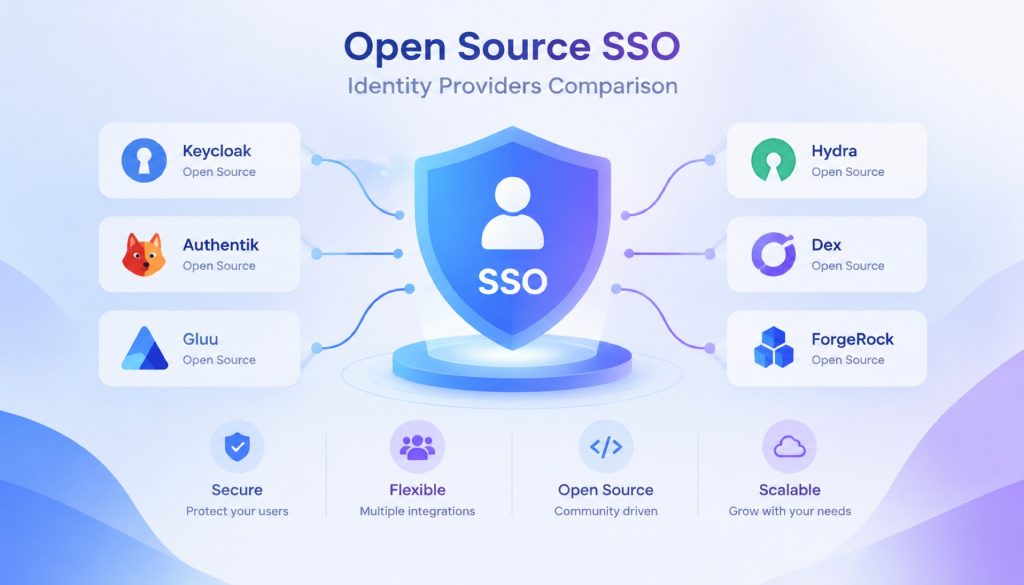
The problem is that open source SSO tools have multiplied. There are now half a dozen projects on GitHub with over a thousand stars, each with a different philosophy. Authentik gets the most mentions, but it’s not the right answer for every team. Keycloak has been around longer and covers more ground. Casdoor is built for lightness. Logto is newer and has made developer experience its whole identity.
Which one actually fits depends on team size, operational appetite, and what “good enough” means for your situation.
Keycloak: The Veteran That Comes with Baggage
Keycloak is the established name in this space. Red Hat has been developing it since 2014, and the feature surface is broader than Authentik’s: Active Directory integration, fine-grained authorization, multi-tenancy, and adapters for virtually every Java framework that exists.
The cost is weight. Keycloak runs on Java (the newer Quarkus distribution is meaningfully lighter than the old WildFly build, but it’s still Java), and idle memory usage typically falls between 500MB and 800MB before you add a database. Cold start time on constrained hardware is uncomfortable, and getting stable performance out of a low-resource deployment requires JVM tuning that most small teams would rather not learn.
The admin UI has long been criticized for looking dated. The redesigned interface that landed in 2023 is an improvement, but the configuration paths remain deep. Setting up a complete Realm with Clients and Role Mappings from scratch, without prior Keycloak experience, routinely takes two to three days before the mental model fully clicks.
Keycloak’s natural home is teams with a Java-heavy stack, an existing LDAP or Active Directory directory to integrate, or engineers who have used it before and already know where things live. For a team picking an SSO tool with no prior exposure, Keycloak’s learning curve rarely pays off compared to the alternatives.
—
Casdoor: Built in Go, Actually Light
Casdoor comes from a different starting point. It was built by the Casbin team, Casbin being a widely-used authorization policy engine in the Go ecosystem. Casdoor handles authentication, and when paired with Casbin it covers the full auth stack end to end.
Resource usage is where it stands apart. Single process, memory footprint typically between 100MB and 200MB, and no JVM cold-start lag. A 1-core, 1GB machine can run it without strain.
Protocol support covers OAuth2, OIDC, and SAML, with built-in social login connectors for GitHub, Google, and others. The UI is deliberately lean. Fewer configuration options than Authentik, which is a real advantage for teams that only need standard functionality and don’t want to navigate menus designed for enterprises with dedicated IAM engineers.
The tradeoff is ceiling. Casdoor’s enterprise-grade features, a programmable policy engine, sophisticated webhook triggers, complex attribute mappings, are less developed than Authentik’s. The community is smaller, which means fewer answered questions on GitHub Issues and Stack Overflow when you hit an edge case.
For teams whose requirements amount to “a working OAuth2/OIDC SSO that supports a few hundred internal users without demanding ongoing maintenance,” Casdoor is consistently underestimated.
—
Logto: Developer Experience as a First Principle
Logto is the youngest of the four, launched in 2022, but it has grown quickly. The explicit framing from the start was “open source Auth0 alternative,” which means developer experience has always been the primary design constraint.
The SDK coverage shows this. Front-end support for React, Vue, Next.js, and Angular; back-end libraries for Node.js, Python, Go, and Java; each with complete documentation and a working Quickstart. An engineer with no IAM background can have OIDC login working in their application within a couple of hours by following the guides.
The built-in login UI is practical in a way the other tools don’t offer. Rather than building a login page, you configure Logto’s hosted UI, swap in a logo and color scheme, and it’s ready. For teams in the MVP stage, that’s a meaningful reduction in front-end work.
Memory requirements sit in the middle of this group, around 300–500MB including PostgreSQL. The deployment experience is noticeably smoother than Authentik, with a first-run wizard in the admin console that guides initial setup clearly.
The area to watch is SAML. Logto’s SAML IdP implementation has been maturing since 2024, but if you have enterprise customers requiring older SP-initiated SAML flows, verify current support against your specific requirements before committing. SCIM automated provisioning is also relatively new and less battle-tested than in Authentik or Keycloak.
—
Side-by-Side Comparison
Putting the core dimensions together:
| Authentik | Keycloak | Casdoor | Logto | |
|---|---|---|---|---|
| Min. memory (with deps) | ~800MB | ~600MB | ~150MB | ~400MB |
| Deployment complexity | Medium | High | Low | Low–Medium |
| SAML support | Complete | Complete | Basic | Maturing |
| SCIM support | Yes | Yes | N/A | Yes (newer) |
| Developer SDKs | Limited | Limited | Limited | Comprehensive |
| Built-in login UI | Custom-built needed | Custom-built needed | Basic template | Built-in, customizable |
| Community size | Large | Large | Medium | Medium–Large |
| Learning curve | Medium–High | High | Low | Low–Medium |
This is a coarse grid. The right choice also depends on your specific integration requirements and what your team already knows.
—
Which Tool for Which Team
You’re closing an enterprise deal and they need SAML, and someone on the team is willing to spend time on configuration.
Pick Authentik. Its SAML implementation is the most complete, and when an enterprise SP has specific requirements around encrypted assertions or custom attribute mappings, Authentik’s documentation and community can support that. Hosting it on a dedicated small cloud instance adds only modest ongoing cost.
Resources are tight, or you need to fit SSO onto an existing server without adding much overhead.
Pick Casdoor. The Go binary is the smallest footprint here, and operational complexity is low. If the requirements are standard OAuth2/OIDC with no complex policy logic, Casdoor covers them without demanding ongoing maintenance investment.
The product is still in MVP stage, the team has no IAM experience, and you want login working quickly.
Pick Logto. The SDK docs are thorough, the developer experience is smooth, and the built-in login UI removes a chunk of front-end work. When the product scales and requirements sharpen, there’s enough information at that point to make a more informed migration decision.
Java-heavy stack, existing LDAP or Active Directory, or someone on the team has Keycloak history.
Pick Keycloak. Not because it’s universally better, but because the ecosystem match reduces friction. Java applications have the most complete Keycloak adapter support, and prior experience lets engineers skip most of the learning curve.
One additional consideration: if a team grows past fifty people, starts needing multi-tenancy, or needs granular permission grouping across users, Authentik’s Policy Engine and Group model scale more gracefully than Logto or Casdoor. The others can handle it, but Authentik’s design for that tier is more systematic and expands with less resistance.
—
There’s no universally correct answer in open source SSO selection. There is one reliable mistake: equating “most features” with “best fit.” Keycloak has the most features, but its learning curve and resource demands are not costs every team should pay. For a five-person team, a Casdoor instance that goes live today and runs quietly is worth more in practice than a Keycloak deployment that stays half-configured for six months.
Get the tool running first. Go deep after that.
Related reading
- n8n vs Activepieces: Choosing an Open-Source Workflow Automation Tool for Self-Hosted Teams
- One Developer, Seven Clones, and a Declaration That Software Is Over
- When Documents Pile Up: WeKnora and the Open-Source Platforms Trying to Make Knowledge Actually Useful
- OpenObserve vs SigNoz: Which Self-Hosted Observability Stack Fits a Small Team?
- Authentik Alternatives: Self-Hosted Identity Providers Compared (Authelia, Keycloak, Zitadel)
Stay updated with our latest AI insights