Most people think their AI writing problem is about the model not being good enough.
So they keep switching tools. ChatGPT today, Claude tomorrow, some new agent product next week. Prompts pile up. Tutorial bookmarks multiply. But the content stays inconsistent: maybe one solid piece here and there, never a sustained rhythm.
The model is not really the problem.
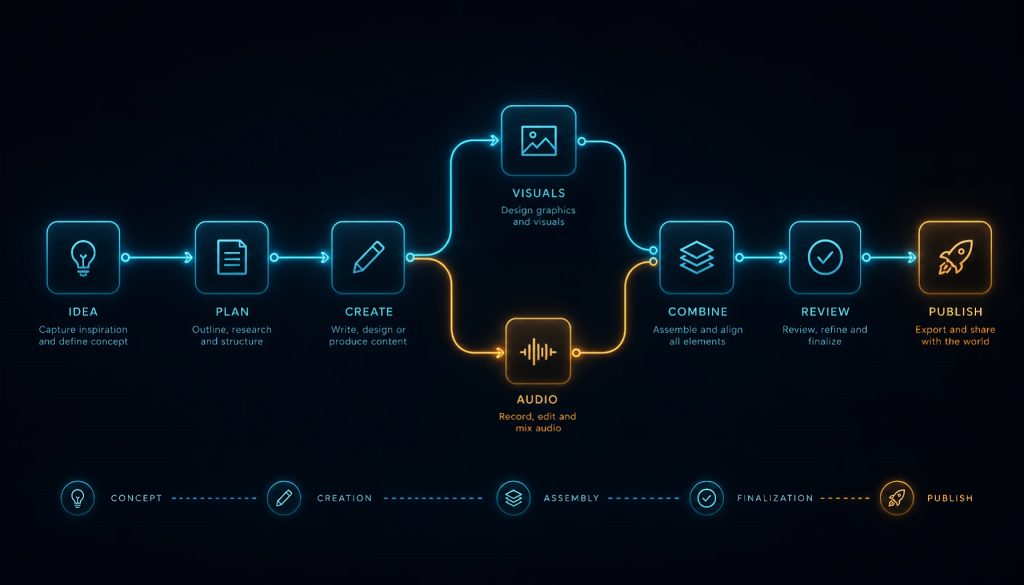
What most people lack is not a better writing AI. It is a repeatable pipeline that connects topic selection, material gathering, editorial judgment, structural framing, drafting, and publishing into one continuous flow. That pipeline has a name: agent content flow.
Models matter. Without a capable model, many writing tasks cannot even get started. But if your content system has no stable input upstream, no judgment layer in the middle, and no verification or feedback downstream, then even the strongest model just produces unstable drafts faster.
This piece is not about which model has more parameters or which prompt technique works best. It is about a more valuable question: why do so many people who already use AI still fail to build a working content system? And what does a sustainable agent content flow actually look like?
The Core Insight
Single-shot generation is not a content system. Asking AI to write one article does not mean you have continuous content capability.
Models handle individual writing actions (rewriting, summarizing, expanding, restructuring). They do not handle the expensive upstream decisions: what to write about, whether a topic is worth pursuing, where raw material comes from, which information is noise and which is signal, whether the same batch of material should become a trend piece, a comparison piece, or a decision guide.
Think of the model as a highly capable execution layer. It is not inherently an editorial system.
The most expensive part of content has never been writing speed. It is the chain of “knowing what to write, on what basis, and how to keep writing” that comes before any words hit the page.
Why People Get Stuck After the First Few Articles
The typical AI writing workflow looks like single-shot assistance. Open a chat window, toss in a topic, get an outline, a draft, a headline, a conclusion. The first ten minutes feel great. There is even a moment of illusion: I have integrated AI into my content production.
The problem surfaces the moment you shift from “write one piece” to “write ten, thirty, or maintain a column.” Topics start repeating. Material gets sampled from the same pool. Tone drifts. Arguments thin out. Headlines look polished but articles feel hollow.
This is not the model getting dumber. It is the absence of a system. You were never running a content pipeline. You were making a series of one-off requests.
The Five Layers of a Working Agent Content Flow
A minimum viable agent content flow needs at least five layers:
Acquisition layer handles stable collection of raw material. Without it, AI just recombines whatever limited context you feed in.
Filtering layer separates signal from noise and decides what is worth writing about. Information volume does not equal editorial clarity.
Framing layer determines how a topic should be presented. Same material can become a news summary, a trend analysis, a tool comparison, a misconception correction, or a decision guide. Without deliberate framing, models default to the safest, most averaged, least offensive writing. In other words, the least worth reading.
Drafting layer handles fast composition, expansion, and structural organization. This is what most people have. It is the part where AI generates text.
Publishing and feedback layer handles distribution, verification, and experience capture. Without it, content goes out but the system never improves.
Here is the uncomfortable truth: most people only have layer four. The drafting layer. Everything else is missing.
The Two Critical Gaps: Acquisition and Judgment
After watching dozens of content operations stall, the pattern is clear. They almost always break at the first two steps.
Without acquisition, AI becomes a glorified rewriter
Many people claim they have an AI content system. But ask where the content actually comes from, and the answers are vague. Maybe a pasted background paragraph. Maybe two related articles copied in. Maybe some verbal brainstorming dictated to the model.
A real acquisition layer means you can reliably obtain raw material relevant to your topics: blog posts, product changelogs, research papers, social media threads, video transcripts, official documentation, hands-on testing notes.
Without this layer, the model can only recombine whatever small context you provide. Over time, sentences might vary but judgments repeat, structures become templated, and information density drops toward zero.
Having material does not equal having judgment
The second break point is judgment. Many assume that collecting lots of material solves the problem. It does not. More information without editorial filtering just brings noise along for the ride.
The editorial judgments that actually cost something include: which information is worth building an article around, which works only as background, which enables a useful comparison, which would derail the piece, and which angle genuinely helps the reader.
AI can assist with organization here. But the core editorial call cannot be fully outsourced.
Why “Agent” Matters More Than “Model”
At this point, the value of the agent concept becomes concrete.
It is not a fancier word for chatbot. It is not marketing gloss. The actual utility is: allowing multi-step processes to maintain state, divide labor, and hand off between stages.
A simple flow might work like this: one node collects content, another distills core information, another converts it into a standard article skeleton, and finally a human makes the call on stance, sentence-level edits, conclusions, and whether to publish.
Once content production enters multi-step collaboration, the competitive question shifts from “who writes a prettier sentence” to “who can keep the full chain running smoothly.”
Building a Minimum Viable Flow
Many people hear “agent” and immediately imagine full automation: auto-select topics, auto-write, auto-publish.
That approach crashes fast. The most dangerous thing for a content system is not slowness. It is automating so much that errors become invisible.
A more realistic sequence: semi-automated first, then automated. Stabilize each layer before connecting them.
A practical MVP flow has six steps:
- Collect content from fixed sources
- Convert to readable format
- Human screening and selection
- Extract one core editorial judgment
- Apply a standard article skeleton for drafting
- Humanizer pass, SEO check, and publish verification
This flow is not flashy. But it upgrades “occasionally writing something” into “starting to write with rhythm.”
Which Steps Stay Human, Which Go to Agents
Some steps must retain human judgment:
- Topic selection and kills
- Final editorial stance
- Risk assessment
- Publish decisions
These steps are well-suited for agent automation:
- Collection and crawling
- Cleaning and formatting
- Structural organization
- First-draft expansion
- FAQ generation
- Post-publish basic verification
The healthiest agent content flow never means “let AI write everything.” It means handing mechanical labor to the agent and keeping judgment with the human.
The Bottom Line
Back to the opening question: why do so many people who use AI still fail to produce sustained content?
Because they obtained a tool that can write, but never built a system that can keep producing.
What separates content operations long-term is not who adopts the newest model first. It is who connects acquisition, judgment, framing, drafting, and publishing into a stable flow first.
So next time you evaluate your AI content setup, skip “which model is best.” Start with these questions instead:
- Where does your content actually come from?
- Who filters out the noise?
- What makes this specific article worth writing?
- After publishing, does your system get any stronger?
- As model capabilities converge, is your workflow design starting to differentiate?
Models determine how a single piece feels. Flow determines long-term output capacity. The first lets you occasionally write something good. The second is what actually keeps you writing.
FAQ
What is the difference between agent content flow and a regular writing workflow?
A regular workflow is a human checklist. Agent content flow emphasizes multi-node collaboration, state persistence across steps, and repeatable automated execution. It is not just “how to write” but “how to keep the entire chain running.”
Why is the key to AI writing not prompts?
Prompts primarily solve output quality at a single node. They cannot solve stable topic sourcing, material input, or editorial judgment. Writing one smooth article is not the same as running a content system.
Why is the acquisition layer so important?
Without it, AI can only recombine whatever context is currently available. Content inevitably becomes repetitive. Sustained production requires new material continuously entering the system.
Does a solo creator need agent content flow?
Yes, and arguably more so. Without a team to divide labor, you need process to connect collecting, editing, writing, and publishing. Otherwise every writing session starts from scratch, and the cost is prohibitive.
Should I pursue fully automated writing now?
No. Until input and judgment are stable, full automation typically produces low-quality content faster. The realistic path is semi-automation first: get acquisition, filtering, and framing working before connecting everything end to end.
Related Reading
- 2026 Agent Platform Landscape: The Four-Layer Split That Matters More Than the Hype
- When You Swap the Model, Is It Still Your Agent?
Stay updated with our latest AI insights