Cloud bills in 2026 are not growing. They are metastasizing.
Spendark’s latest report puts global cloud waste north of $100 billion, with compute resources accounting for 35% of that number. AWS started charging $3.65 per month for every public IPv4 address back in February. That sounds trivial until you’re running hundreds of load balancers and EC2 instances, at which point your bill jumped by tens of thousands overnight. Azure followed in July 2025. And AI workloads have made forecasting even harder: a single inference call can fan out into a dozen downstream requests, and GPU instance pricing swings at multiples of traditional compute.
Here is the counterweight. The FinOps Foundation’s 2026 report found that 98% of organizations now include AI spending in their FinOps practice. Two years ago that figure was 31%. AI is both the source of cost complexity and, increasingly, the mechanism for controlling it.
Three Directions for AI-Driven FinOps
From Recommendations to Execution
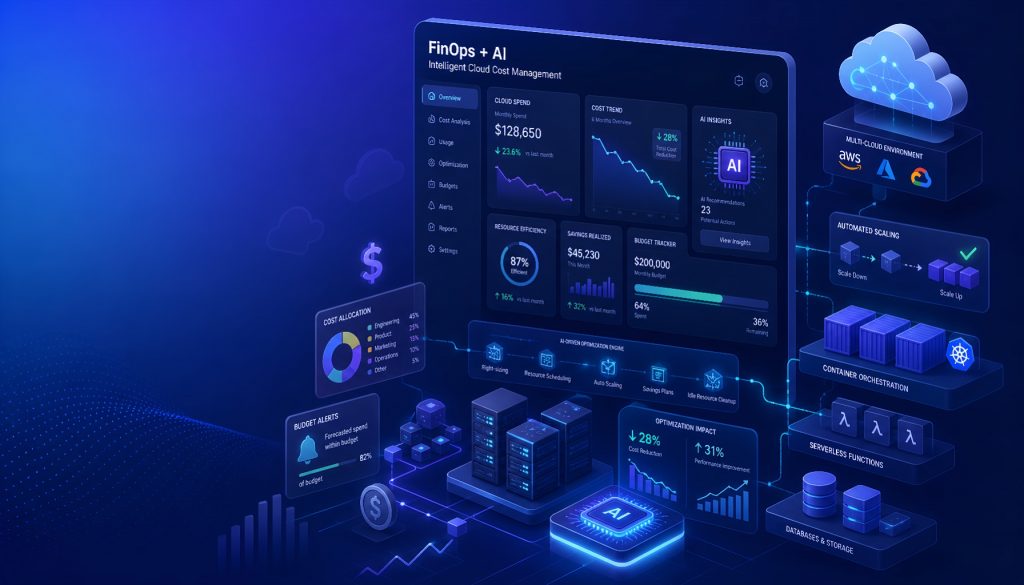
Legacy FinOps tools generate dashboards. They tell you an instance is oversized, then wait for a human to resize it. AI-native tools skip the waiting.
Rightsizing works differently now. Vantage’s FinOps Agent monitors actual utilization and identifies over-provisioned resources automatically. Kubecost does the same thing at the Kubernetes layer, providing container-level cost visibility and pod rightsizing recommendations that map to real workload patterns rather than static thresholds.
Spot instance management has become an AI problem. Spot.io (now part of NetApp) and Cast AI use algorithms to shift workloads between spot, on-demand, and reserved instances in real time. Spot instances save 60-80% compared to on-demand pricing, but the cloud provider can reclaim them at any moment. The AI’s job is to balance savings against availability risk, moving workloads before termination notices hit.
Commitment automation handles the buying side. ProsperOps and Usage.ai analyze historical usage, forecast future demand, and purchase Reserved Instances (1-3 year commitments saving 30-70%) or Savings Plans without human intervention. The math is too dynamic for quarterly reviews. These tools recalculate continuously.
Cloudchipr adds a multi-cloud layer on top of this, scanning AWS, Azure, and GCP for zombie resources: unattached disks, expired snapshots, orphaned load balancers. The kind of waste that accumulates invisibly because nobody owns the cleanup.
Predictive Analytics: Forecasting Bills Before They Arrive
Cost anomaly detection is table stakes in 2026. Oracle Cloud shipped its Cost Anomaly Detection feature in January, monitoring daily cloud spend and firing alerts when patterns deviate. The implementation combines time-series forecasting, clustering, and deep learning models that need to learn the “seasonal rhythm” of a business before they can flag real deviations from noise.
Vantage pushes real-time anomaly alerts through Slack, Teams, or email with root-cause analysis attached. Finout and Amnic go further with AI-agent-driven RCA that traces cost spikes to specific Kubernetes namespaces, AWS services, or individual API calls. When your bill jumps 40% on a Tuesday morning, knowing it was a misconfigured auto-scaling group in us-east-1 saves hours of manual investigation.
Forecast modeling is where CFOs pay attention. CloudZero and Ternary use ML to project future cloud spend weeks or months out. Budget planning falls apart when quarterly bills surprise the finance team by 40%. But predicting AI workload costs is particularly difficult because agentic architectures introduce non-deterministic execution paths. One prompt might trigger three API calls or thirty, depending on the agent’s reasoning chain.
Policy Execution: Machines Making Decisions
The most aggressive frontier is fully autonomous cost management.
Automated shutdown is straightforward in theory. Sedai and Cast AI detect idle resources and power them down. Development environments go dark between 8 PM and 8 AM, plus weekends. Most companies know they should do this but don’t because manual scheduling is tedious and error-prone at scale.
Dynamic volume management from Zesty auto-adjusts EBS volume sizes to match actual usage. Their Kompass product handles Kubernetes pod rightsizing and spot management. Storage is one of those costs that only grows because nobody tracks which volumes are 90% empty.
Autopilot purchasing is the endgame for commitment management. Vantage’s Autopilot buys Savings Plans without human intervention. nOps offers similar ML-driven optimization integrated with DevOps workflows. The pitch: engineers build product, AI optimizes the bill.
The New Guard vs. Legacy Platforms
Traditional enterprise FinOps tools from IBM (Cloudability), VMware (CloudHealth), and Flexera face pressure from startups built around AI-native workflows.
| Tool | Focus | Key Differentiator |
|---|---|---|
| Cloudchipr | Multi-cloud waste elimination | Scans AWS, Azure, GCP for unused resources; generates actionable cleanup plans |
| Vantage | Full-stack cost intelligence | 20+ native integrations including Snowflake, Databricks, Datadog, OpenAI, Anthropic; virtual tagging for inconsistent tag strategies |
| Kubecost | Kubernetes-native cost visibility | Namespace, deployment, and pod-level allocation; Prometheus integration; IBM’s 3.0 release targets AI workload visibility |
| Usage.ai | Commitment optimization | Solves the “commitment underspend” problem where low RI/Savings Plan coverage forces on-demand rates |
| Finout | Unified FinOps platform | Positions as a “FinOps OS” covering cloud, K8s, AI, SaaS, and shared costs in one view |
| Cast AI | Kubernetes cost automation | Real-time cluster optimization with spot management and automated rightsizing |
What unites these tools: they ship execution, not just reports. The older platforms generated analysis that required humans to act on. The new wave closes the gap between insight and action.
Where AI Cost Management Breaks Down
At FinOps X 2026, every vendor had an AI story. Not all of those stories hold up under production conditions.
Accuracy Requires History
ML models need to learn your business patterns. If your traffic spikes seasonally (e-commerce during Black Friday, tax software in April), the model needs at least a year of data to distinguish normal seasonal peaks from real anomalies. Before that, expect false positives that erode trust in the system.
Research presented at ICLR 2026 identified five core problems with AI agent architectures in production: latency from sequential API calls, token costs, error cascading, fragile topology, and poor observability. Gartner predicts that by end of 2027, more than 40% of agentic AI projects will fail or get cancelled due to rising costs, unclear business value, or insufficient risk controls.
Automation Can Bite Back
Autonomous cost optimization sounds appealing right up until it shuts down something you need.
Picture this: an automation tool detects zero weekend activity in a dev environment and powers it down. An engineer pulls a Saturday shift to fix a production incident and discovers the dev environment is gone. Or worse: the system migrates production workloads from on-demand to spot instances for cost savings, then spot gets reclaimed during a traffic spike.
This is why most organizations still run “AI recommends, human approves” for anything touching production or significant financial commitments. Full autonomy works for low-risk cleanup (zombie resources, expired snapshots). It fails when the blast radius includes customer-facing services.
Tool Sprawl Creates Its Own Cost
The FinOps tool market is crowded. Usage.ai’s framework identifies four categories of cloud cost problems, each addressed by different tool types: commitment overspend, idle/over-provisioned resources, Kubernetes cost allocation, and visibility/governance. Most teams run two or three tools in combination.
This creates friction: separate dashboards per environment, reconciliation work consuming analyst hours every week, and allocation models that lag behind organizational changes. Finout’s “FinOps OS” positioning attempts to unify everything, but consolidated platforms remain the exception. The tool stack itself becomes a cost management problem.
What Comes Next
The direction is clear. FinOps is migrating from human-driven processes toward systems and automation. nOps states it plainly: “2026 rewards teams that scale FinOps through systems and automation, because manual cost management cannot keep pace with the new shapes and velocity of cloud spending.”
But fully autonomous FinOps is still years away. The current reality is hybrid. AI handles data-intensive work: scanning thousands of resources, analyzing usage patterns, detecting anomalies, executing low-risk optimizations. Humans handle judgment-intensive work: setting risk tolerance, approving major changes, defining business priorities, deciding which cost is worth paying.
The FinOps Foundation’s data shows AI cost management is the most requested skill across organizations of all sizes. Even at the highest spend levels, FinOps teams stay lean. Automation is not optional when three analysts manage $50 million in annual cloud spend.
What to Do Now
For CTOs and CFOs building a 2026 FinOps strategy, the sequence matters.
Start with visibility. You cannot optimize what you cannot measure. Pick a platform that covers multi-cloud and Kubernetes: Vantage, Finout, or Cloudchipr as starting points. Make sure AI services (OpenAI, Anthropic, Databricks) are included in the cost view, not treated as a separate budget line.
Automate the safe stuff first. Unattached disks, expired snapshots, zombie load balancers. These cleanups are reversible and low-risk. Let the AI prove itself on operations where a mistake costs minutes of downtime, not revenue.
Build dedicated tracking for AI workloads. AI spending grows faster than traditional cloud compute. Establish unit-cost metrics early: cost per inference, cost per agent invocation, cost per training run. Without these, AI costs become an unattributed blob that nobody owns.
Invest in the skill gap. AI cost management is the most in-demand FinOps competency in 2026 according to the Foundation’s data. Train existing engineers on AI workload cost dynamics or hire people who already understand how token costs, GPU scheduling, and inference batching affect the bill.
Keep humans in the loop for high-stakes decisions. Autopilot modes work for commitment purchases and dev-environment scheduling. Anything that could disrupt production or lock in six-figure annual commitments should require human sign-off. The cost of a bad automated decision can exceed the savings from a year of good ones.
The organizations that get this balance right, machine speed on routine optimization plus human judgment on consequential calls, are the ones that will keep cloud costs predictable as AI workloads scale through 2026 and beyond.
Related Reading
- The FinOps Revolution: How AI Is Reshaping Cloud Cost Management in 2026
- The FinOps Revolution: How AI Is Reshaping Cloud Cost Management in 2026
Stay updated with our latest AI insights