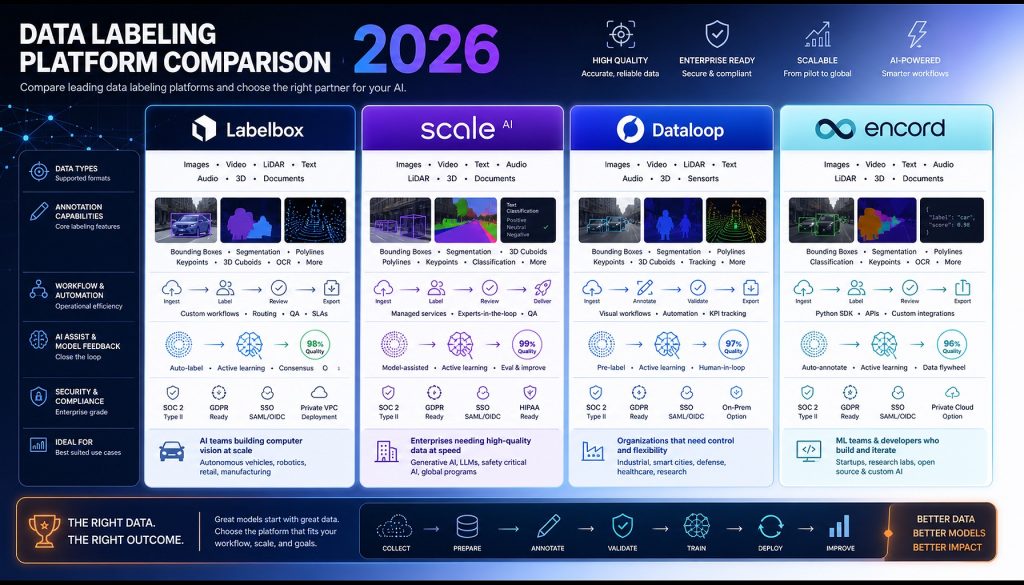
Data labeling in 2026 isn’t about who draws bounding boxes faster. The real differentiators now are workflow configurability, quality assurance loops, automation depth, workforce orchestration, multi-modal support, and whether you’re buying a platform or buying outcomes.
These four tools — Labelbox, Scale AI, Dataloop, and Encord — all sit in the “data labeling” category, but they sell fundamentally different value propositions. Picking the wrong one doesn’t just waste budget; it locks your ML pipeline into a workflow model that doesn’t match how your team actually operates.
Here’s the short version: Labelbox is the enterprise collaboration platform. Scale AI is the managed delivery engine. Dataloop is the workflow configuration layer. Encord is the modern multi-modal annotation workbench. The longer version matters more.
Quick Comparison Table
| Dimension | Labelbox | Scale AI | Dataloop | Encord |
|---|---|---|---|---|
| Core positioning | Enterprise labeling platform + collaboration & QA | Labeling delivery capability + platform + services | Recipe-driven workflow platform | Modern multi-modal annotation platform |
| Primary narrative | Internal team / vendor / labeling service collaboration | Scale Pro + engagement managers + SLA + production | Recipe defines workflow, tools, labels, validation | Multi-modal annotation + team workflows + QC |
| Strongest scenario | Mixed workforce orchestration | Predictable, high-quality data delivery at scale | Complex, highly configurable annotation pipelines | Point cloud, video, sensor fusion, medical imaging |
| Automation / AI | Model-assisted labeling, Foundry | Data Engine, GenAI Platform, managed pipelines | SDK-driven, recipe configuration, structured flows | Quality control automation, team workflows |
| Modality coverage | Image, video, text, documents, geospatial, audio, conversational, HTML, LLM preference | 3D, sensor fusion, GenAI, enterprise-scale documents | Image, video, audio, text, docs, LiDAR, geospatial, GenAI | Point cloud, image, image sequence, video, audio, documents, text |
| Best for | Enterprise data teams with mixed labeling workforces | Teams that need guaranteed output quality and SLAs | Platform engineering teams building custom pipelines | Teams handling complex visual and temporal data |
| Biggest limitation | Can feel heavy for small teams or simple tasks | Less flexible for teams wanting full pipeline control | Steeper learning curve than lightweight tools | Overkill for pure text classification or simple tasks |
Labelbox: The Enterprise Collaboration Layer
Labelbox positions itself as a complete annotation ecosystem, not just an editor. Its Annotate module lets internal teams, external vendors, and Labelbox’s own labeling service work simultaneously on the same projects. The editor covers images, video, text, documents, geospatial data, audio, conversational text, HTML, and even LLM human preference ranking.
Where Labelbox Excels
The platform treats labeling as an organizational problem, not just a UI problem. Workflows route tasks through review stages. Benchmarks and consensus scoring catch quality drift before it poisons your training data. The performance dashboard gives project managers visibility without requiring them to understand annotation ontologies.
Model-assisted labeling (MAL) pre-fills annotations using your existing models, which dramatically cuts human effort on iterative labeling rounds. For teams running active learning loops — label, train, deploy, find failure cases, re-label — this integration is table stakes.
Where It Falls Short
Labelbox’s comprehensiveness is also its weight. If you’re a 3-person ML team that just needs to label 10,000 images for a prototype, the platform’s project management overhead might slow you down more than it helps. The pricing model favors teams that will genuinely use the collaboration, quality, and workforce management features. If you won’t, you’re paying for capabilities that sit idle.
Ideal Team Profile
Enterprise ML teams (50+ annotators), organizations mixing internal labelers with BPO vendors, and companies that need audit trails and quality governance across multiple concurrent labeling projects.
Scale AI: When You’re Buying Outcomes, Not Tools
Scale AI’s documentation reads less like a product spec and more like a service proposal. Scale Pro offers dedicated Engagement Managers, production-volume SLAs, complex 3D and sensor fusion support, and promises the “highest model improvement per dollar ratio.” The pitch is clear: hand us the problem, get back high-quality labeled data.
Where Scale AI Excels
For teams that don’t want to build and manage a labeling operation, Scale AI removes that entire burden. You define quality requirements, they handle workforce recruitment, training, task routing, quality assurance, and delivery timelines. This is particularly valuable for autonomous vehicle companies, defense contractors, and large enterprises where labeling volumes are massive and quality requirements are non-negotiable.
The GenAI Platform and Nucleus add layers beyond basic annotation — data curation, model evaluation, and RLHF data generation all live within Scale’s ecosystem.
Where It Falls Short
Scale AI optimizes for delivery predictability, which means less flexibility for teams that want to experiment with annotation schemas, iterate rapidly on guidelines, or maintain tight feedback loops between ML engineers and annotators. If your labeling needs change weekly as your model evolves, the managed-service model can introduce latency that self-serve platforms avoid.
Pricing transparency is also limited. Enterprise contracts dominate, which makes it harder for smaller teams to evaluate cost-effectiveness before committing.
Ideal Team Profile
Organizations labeling at production scale (millions of items), teams building autonomous systems with complex sensor data, and enterprises that prefer buying outcomes over building infrastructure.
Dataloop: The Workflow Engine for Pipeline-Obsessed Teams
Dataloop’s differentiator is the Recipe — a first-class configuration object that defines how annotation, evaluation, and review workflows operate. Recipes control which tools are available, what labels exist, how validation runs, and how tasks flow between annotators and reviewers. They can be versioned, reused across datasets, overridden at the task level, and managed programmatically through the SDK.
Where Dataloop Excels
If your labeling workflow isn’t a straight line — if different data types need different annotation tools, if review has multiple stages, if evaluation criteria vary by project phase — Dataloop gives you the configuration surface to express that complexity without hacking around platform limitations.
Recipe types span GenAI/Multimodal, Image, Geospatial, Video, Audio, Text and Documents, and LiDAR. This breadth, combined with deep SDK access, makes Dataloop attractive to teams that treat labeling infrastructure as a core engineering problem rather than a procurement decision.
The platform also supports both annotation and evaluation workflows in a unified system, which matters for teams doing RLHF, model auditing, or continuous data quality monitoring.
Where It Falls Short
Configuration power comes with configuration complexity. Teams that just want to label data and move on will find Dataloop’s recipe system, SDK-driven management, and workflow design tools more overhead than they need. The learning curve is real, and the payoff only materializes if your labeling workflows are genuinely complex.
Ideal Team Profile
ML platform teams embedding labeling into larger MLOps pipelines, organizations with diverse annotation types requiring different workflows, and teams that want programmatic control over every aspect of the labeling process.
Encord: Built for the Hard Stuff — Multi-Modal and Complex Visual Data
Encord’s documentation leads with multi-modal support, large-scale annotation team management, and quality control. The platform explicitly supports point clouds, single images, image groups, image sequences, video, audio, documents, and text. For teams working with autonomous driving data, medical imaging, robotics, or industrial inspection, this breadth of native support matters more than any feature comparison spreadsheet can convey.
Where Encord Excels
Annotation tools for complex visual data — especially video and point cloud — require fundamentally different UX than image bounding boxes. Encord’s interface handles temporal data (video frame interpolation, sequence tracking), 3D spatial data (point cloud segmentation), and multi-file workflows (DICOM series, image groups) without forcing workarounds.
The quality control system is modern: automated checks, reviewer workflows, and team performance monitoring are built in rather than bolted on. For teams scaling from 5 to 50 annotators, this prevents the quality collapse that typically accompanies rapid workforce growth.
Where It Falls Short
If your labeling tasks are primarily text classification, sentiment analysis, or simple categorical tagging, Encord’s strengths in complex visual data don’t translate into value for your use case. You’d be paying for capabilities optimized for a different problem space.
Ideal Team Profile
Autonomous vehicle and robotics companies, medical imaging AI teams, industrial inspection and quality control applications, and any team where the primary challenge is annotating complex spatial or temporal data accurately at scale.
How to Choose: Start With What You’re Actually Missing
Don’t start with feature checklists. Start with this question: Are you trying to build a labeling production line, or are you trying to get high-quality labeled data back reliably?
These are different problems that lead to different tools.
Choose Labelbox if…
- You have a mixed workforce (internal + vendors + managed services)
- Quality governance and audit trails are requirements, not nice-to-haves
- You need a single platform that handles collaboration, quality, and delivery
- Your organization is large enough to benefit from platform-level controls
Choose Scale AI if…
- You want someone else to own the labeling delivery problem
- SLAs and predictable output timelines matter more than workflow flexibility
- Your data is complex (3D, sensor fusion, multi-sensor) and volume is high
- You’d rather negotiate a service contract than build labeling infrastructure
Choose Dataloop if…
- Your annotation workflows are genuinely complex and multi-stage
- You want programmatic control over labeling configuration via SDK
- Your team has platform engineering capacity to design and maintain recipes
- You run both annotation and evaluation workflows in the same system
Choose Encord if…
- Your data is primarily video, point cloud, medical imaging, or multi-modal
- You need native support for temporal and spatial annotation (not workarounds)
- You’re scaling an annotation team and need built-in quality controls
- The complexity of your data, not your workflows, is the main challenge
The Bigger Picture: Data Labeling in 2026
The market has shifted. In 2022, choosing a labeling tool was mostly about annotation interface quality and per-label cost. In 2026, the decision factors are:
- Workflow architecture — Can the tool express your actual process?
- Quality assurance — How does it prevent and detect label errors at scale?
- Automation integration — Does it connect to your model training loop?
- Workforce flexibility — Can it handle the mix of humans you need?
- Modal coverage — Does it natively support your data types?
No single platform wins across all five dimensions. The right choice depends on which dimension is your bottleneck.
FAQ
What’s the biggest difference between Labelbox and Scale AI?
Labelbox is primarily a platform you operate — it gives your team the tools to manage labeling workflows, quality, and collaboration. Scale AI is primarily a service you buy — it takes ownership of delivering labeled data to your specifications. The tools overlap, but the operating model is fundamentally different.
Why would a team choose Dataloop over simpler labeling tools?
Dataloop’s recipe system lets teams codify complex annotation and evaluation workflows as reusable, versionable configurations. If your labeling process has multiple stages, different tool requirements per data type, and needs programmatic management, recipes eliminate the manual coordination that simpler tools require.
When does Encord make more sense than Labelbox?
When your primary data types are point clouds, video sequences, or medical imaging. Encord’s annotation tools are purpose-built for temporal and spatial data, while Labelbox optimizes for breadth of collaboration across simpler annotation types. If your data complexity is the main challenge (not workforce complexity), Encord is likely the better fit.
Can small teams justify enterprise labeling platforms?
It depends on what you actually need. A 5-person ML team doing straightforward image classification probably doesn’t need Labelbox’s workforce management or Scale AI’s engagement managers. But a 5-person team handling complex medical imaging annotation might genuinely benefit from Encord’s specialized tools. Match the tool to your bottleneck, not your team size.
Are these platforms still relevant with GenAI and foundation models?
More relevant than ever. Foundation models increased demand for RLHF data, human preference labeling, model evaluation datasets, and multi-modal training data. The labeling task has gotten more complex — not simpler — and platforms that support these newer annotation types (preference ranking, conversational evaluation, multi-modal review) have become essential infrastructure for serious AI teams.
Related Reading
- Data Integration Tools for Startups 2026: Fivetran vs Airbyte vs Hevo vs Stitch
- Choosing Your Data Integration Platform in 2026: Fivetran, Airbyte, Hevo, and Stitch Compared
Stay updated with our latest AI insights