After Botpress Studio updated its interface, many users found the learning curve suddenly steep. Developers need to understand flows, cards, hooks, and a bunch of concepts, while product managers wanting to quickly build a support bot have to read docs for hours first. Self-hosting offers data security, but configuring PostgreSQL, Redis, and deployment environments is another hurdle. If your team is looking for Botpress alternatives, this article compares five options—Voiceflow, Rasa, Chatbase, Typebot, Flowise—covering needs from non-technical teams to AI engineers. Four selection criteria: ease of use, pricing transparency, AI capabilities, integration ecosystem.
Botpress: Strengths and Limitations
Botpress is a leading open-source chatbot builder, supporting 100+ languages and deployable to any cloud environment. Enterprise users appreciate its data sovereignty. So what’s the problem?
The new Botpress Studio (post-V12) turned flow design into code-like configuration, making the visual editor feel like an auxiliary tool. For teams without dev background, this design is counterintuitive. Self-hosting requires setting up PostgreSQL databases, configuring environment variables, handling CORS issues—the technical barrier isn’t low. Enterprise support is only available in paid plans, and the open-source community’s response speed can’t match commercial competitors.
Voiceflow’s drag-and-drop experience, Chatbase’s 5-minute deployment, Rasa’s complete control—the following five alternatives each have their strengths.
1. Voiceflow: Best for Product Managers and Non-Technical Teams
Voiceflow turned conversation design into a Figma-style collaborative canvas. You drag “question cards,” “branch logic,” and “API calls” onto the canvas, connect them with lines to define flows—no code or docs required. Team members can comment, annotate, and co-edit in real-time, letting product managers and designers directly participate in bot design.
Integrating ChatGPT, Claude, or Gemini only requires pasting an API key. Voiceflow auto-handles prompt optimization, context management, and fallback strategies. Prototype testing is powerful: click “Run” in the top-right to chat in the simulator, debug each branch’s logic in real-time without deploying to production.
Pricing ranges from free plan (2 projects, 1,000 conversations) to Pro $40/month (unlimited projects, 20,000 conversations, team collaboration). Enterprise version supports SSO and private deployment. Great for customer service automation, product demos, sales assistants—scenarios requiring rapid iteration.
Compared to Botpress? Voiceflow sacrifices self-hosting capability in exchange for the industry’s smoothest visual experience. If your team lacks dedicated developers or needs non-technical people to participate in bot design, this is the top choice.
2. Rasa: Best for Developers Needing Complete Control
Rasa is a pure code-driven open-source framework, 100% Python implementation, with data and models completely under your control. Banks, healthcare, government projects use Rasa for one simple reason: compliance requirements don’t allow data to leave local environments.
You can customize NLU (natural language understanding) training data, adjust intent classification thresholds, plug in your own trained language models (supports Hugging Face Transformers), even modify the dialogue management engine’s source code. Deployment flexibility is extreme: Docker containers, Kubernetes clusters, private clouds, even Raspberry Pi can run it. Python ecosystem advantage means you can easily integrate Pandas, SQLAlchemy, FastAPI, and other tools.
The cost is technical barrier. You need to understand YAML config file structure, write stories (conversation samples), train pipelines, debug action servers. Official docs are detailed, but newbies need at least two weeks from zero to production. Open-source version is free, Rasa Pro provides enterprise analytics and version management, pricing requires contacting sales.
Rasa is more low-level than Botpress. Botpress still provides a Studio interface, Rasa is basically VSCode + YAML files. If you have a dedicated Python dev team needing ultimate data control and customization capabilities, Rasa is the better choice.
3. Chatbase: Fastest GPT-Powered Chatbot Deployment
Chatbase compressed “upload docs → train bot → embed in website” to 5 minutes. You upload PDFs, Docx, web links, or plain text. Chatbase auto-extracts content, vectorizes it, builds a knowledge base, then generates answers based on GPT-4 or Claude. No need to write rules, define intents, or design conversation flows—AI automatically answers user questions based on document content.
Supports 80+ languages, auto-detects user input language and switches. Embed code is just two lines of JavaScript—copy-paste into your website’s <head> tag and you’re live. Answer quality depends on your document quality and chosen LLM model (GPT-4 > GPT-3.5 > Claude).
Pricing ranges from free plan (20 messages/month, 1 chatbot) to Hobby $19/month (2,000 messages, 5 chatbots), Standard $99/month (10,000 messages, unlimited chatbots). Perfect for document Q&A, support assistants, internal knowledge bases—scenarios based on existing content.
Chatbase sacrifices Botpress’s flow control capability. You can’t design “first collect email → then recommend products” multi-turn dialogue logic—AI free-styles. If you just want to quickly solve “user asks doc-related questions → bot gives answers,” Chatbase is the easiest solution.
4. Typebot: Most Flexible Open-Source No-Code Chatbot Builder
Typebot is the open-source version of Typeform + chatbot combined. Visual editor lets you drag in “text messages,” “multiple choice buttons,” “conditional branches,” “variable assignments,” and other modules, connecting lines to define logic. Supports complex scenarios: like user selects product type → shows different prices based on choice → collects email → sends to Google Sheets → triggers Zapier automation.
Integration capability is strong: Webhook (send HTTP requests to any API), Google Sheets (write directly to spreadsheet), Zapier/Make (connect 5,000+ apps), OpenAI API (call GPT to generate answers). Self-hosting only needs Docker Compose one-click deployment, database uses PostgreSQL, code fully open-source.
Pricing splits between open-source version (free, self-hosted) and cloud-hosted version ($39/month+, includes hosting, custom domain, removes watermark). Perfect for form collection, market research, lead qualification, booking systems—scenarios requiring structured data collection.
Typebot’s visual editor is more intuitive than Botpress, but AI capabilities are weaker. It’s more “conversational form” than “intelligent support.” If you need to collect user information and trigger follow-up automation, Typebot is the best open-source option.
5. Flowise: Best Visual Tool for LangChain Developers
Flowise is a visual editor for LangChain. If you’re familiar with LangChain concepts (chains, agents, tools, memory), Flowise lets you build these workflows with drag-and-drop, no Python code required.
Supports multiple LLMs: OpenAI GPT-4, Anthropic Claude, open-source models (Llama, Mistral), locally deployed Ollama. Integrates vector databases: Pinecone, Weaviate, Qdrant, Supabase Vector. You can build RAG (retrieval-augmented generation) apps: upload docs → chunk → vectorize → store in database → retrieve relevant fragments when user asks → feed to LLM to generate answer.
Fully open-source, simple Docker deployment, supports self-hosting. Flowise Cloud is still in beta, open-source version is free. Perfect for document Q&A, AI agent prototypes, knowledge base search—scenarios requiring RAG capabilities.
Flowise leans more toward AI engineers than Botpress. If you’re building complex LLM applications (multi-step reasoning, tool calling, knowledge base retrieval), Flowise is the fastest prototyping tool. But if you just want a simple support bot, Flowise’s learning curve isn’t lower than Botpress.
Comparison Table
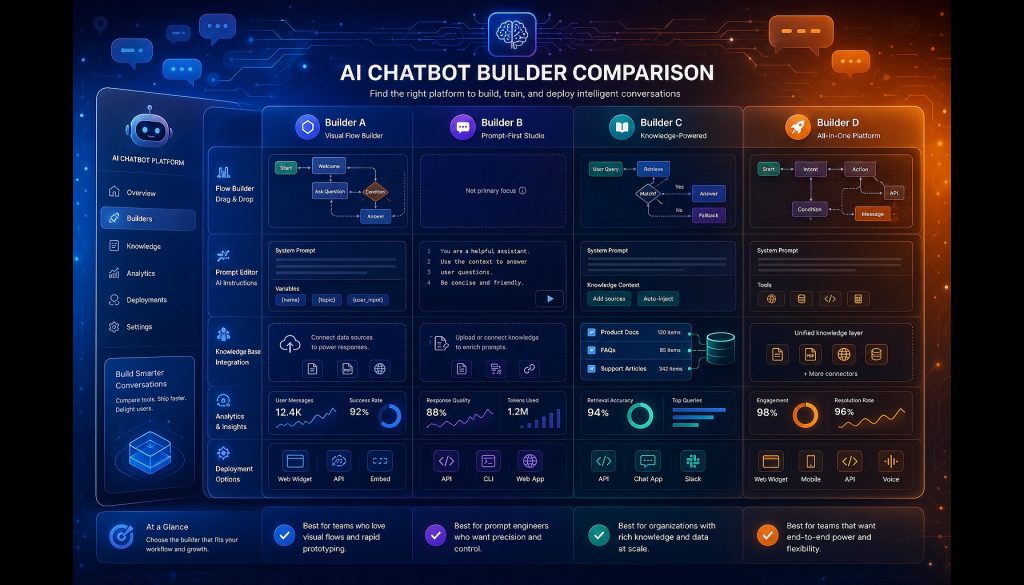
| Tool | Starting Price | Learning Curve | Self-Hosting | AI Model Support | Best User Persona | Integration Ecosystem |
|---|---|---|---|---|---|---|
| Voiceflow | Free / Pro $40/mo | Low (drag-drop) | ❌ | GPT/Claude/Gemini | Product managers, non-technical teams | ⭐⭐⭐⭐⭐ |
| Rasa | Free (open-source) | High (code-driven) | ✅ | Custom NLU | Python developers | ⭐⭐⭐⭐ |
| Chatbase | Free / $19/mo+ | Very Low (upload and use) | ❌ | GPT-4/Claude | Teams needing fast deployment | ⭐⭐⭐ |
| Typebot | Free (open-source) / $39/mo | Low (visual) | ✅ | OpenAI API | Market research, form collection | ⭐⭐⭐⭐ |
| Flowise | Free (open-source) | Medium (needs LangChain knowledge) | ✅ | Multiple LLMs | AI engineers | ⭐⭐⭐⭐⭐ |
How to Choose
Decision tree is simple:
Non-technical team, need quick onboarding: Choose Voiceflow. Industry-best visual editor, strong team collaboration, no dev background required.
Need complete data control, have dev team: Choose Rasa. 100% open-source, deployable anywhere, suitable for finance, healthcare, and other industries with strict data security requirements.
Just want quick document Q&A: Choose Chatbase. Upload docs and go, GPT-4 based answers are high quality, 5-minute deployment.
Need open-source + visual, don’t want to learn Botpress: Choose Typebot. Intuitive drag-drop editor, great for form collection and lead qualification, Docker one-click deployment.
Building complex RAG apps, familiar with LangChain: Choose Flowise. Visually build LangChain workflows, supports multiple LLMs and vector databases, perfect for AI engineers’ rapid prototyping.
Bottom Line
Botpress remains a strong player in open-source chatbot builders, especially for enterprise scenarios requiring self-hosting and multi-language support. But if your team prioritizes ease of use (Voiceflow), data control (Rasa), fast deployment (Chatbase), form collection (Typebot), or AI engineering capabilities (Flowise), these five alternatives excel in their respective domains.
Related Reading
- 5 Best Botpress Alternatives for Building AI Chatbots in 2026
- AI Customer Support Chatbot Builders in 2026: Chatbase vs Voiceflow vs Intercom Fin vs Tidio vs Botpress
Stay updated with our latest AI insights