Friday afternoon, 4 PM. A frontend engineer drops a message in the Slack channel: “CMS is down again.”
Not a catastrophe, but if you’ve lived through a WordPress site gasping for air during traffic spikes, or waited fifteen seconds for a Drupal admin panel to load, you know the quiet exhaustion behind those words. We’re in 2026. Managing content shouldn’t feel like this anymore.
Headless CMS has shifted from “bleeding edge” to “table stakes.” And in this space, two names keep surfacing in technical discussions: Contentful and Sanity. One has been chasing enterprise deals since 2012. The other emerged from Oslo in 2015 with a different playbook.
Both solve the same core problem: decouple content from presentation so you can feed the same article to your website, mobile app, smart speaker, and car dashboard. But the way they solve it reflects two fundamentally different philosophies about how software should work.
Two Approaches to the Same Problem
Think about renovating a house.
Contentful is like hiring a full-service renovation company. You pick a package, customize within preset options. The cabinets come in three colors, countertops in five materials. Benefit: turnkey delivery, warranties, support contracts. Tradeoff: if you want a window that’s not in the floor plan, that’s outside the service agreement.
Sanity hands you professional tools and raw materials. You can build whatever space you imagine. Want a climbing wall in the living room? Go ahead. Japanese soaking tub where the bathroom used to be? Your call. The cost is that you need to know what you’re doing, or find people who do.
This isn’t about better or worse. It’s about fit.
Contentful runs as fully managed SaaS. You sign up, open the dashboard, start building content models and publishing. Its 700+ data source integrations and 500+ marketplace apps mean most common needs get solved without writing code. For teams where marketing outnumbers engineering, that out-of-the-box experience is worth its weight.
Sanity calls itself a “content operating system.” The label sounds ambitious until you use it for a while. Then it clicks. Sanity Studio, the editing interface, is built entirely in React and fully open source. You can deploy it anywhere, modify any component, even embed it as a module inside your own product.
The Editor Experience: Who Gets Priority
This dimension gets underrated by engineers but determines success or failure in daily use.
Contentful’s editing interface treats non-technical users kindly. Rich field types, drag-and-drop ordering, a rich text editor that’s not true WYSIWYG but functional enough for a marketing intern to learn in ten minutes. It includes a preview function so editors can see how content will look on the frontend before publishing. Setting that preview up requires frontend coordination, but at least the capability exists.
Sanity’s story takes a different path. Its Portable Text is a structured rich text format so powerful you can embed custom components directly in the content flow: an interactive chart, a code playground, a mini-game. But it doesn’t offer a traditional WYSIWYG editor. For editors accustomed to formatting in Word, this requires a mental shift.
Sanity has one ace card: real-time collaboration.
Not the fake kind where you save, I refresh, and see your changes. The Google Docs kind. You see your colleague’s cursor moving in the document. You watch their words appear letter by letter as they type. For newsrooms and multi-person marketing teams, this experience gap is qualitative, not incremental.
Contentful launched collaborative editing in late 2025, but the experience remains “you edit, I see a lock icon” mode. It’s not the fluid multi-person simultaneous editing that Sanity delivers natively.
Developer Workflows: Configuration vs Code
If you’re a developer, your daily interaction with the CMS might look like this:
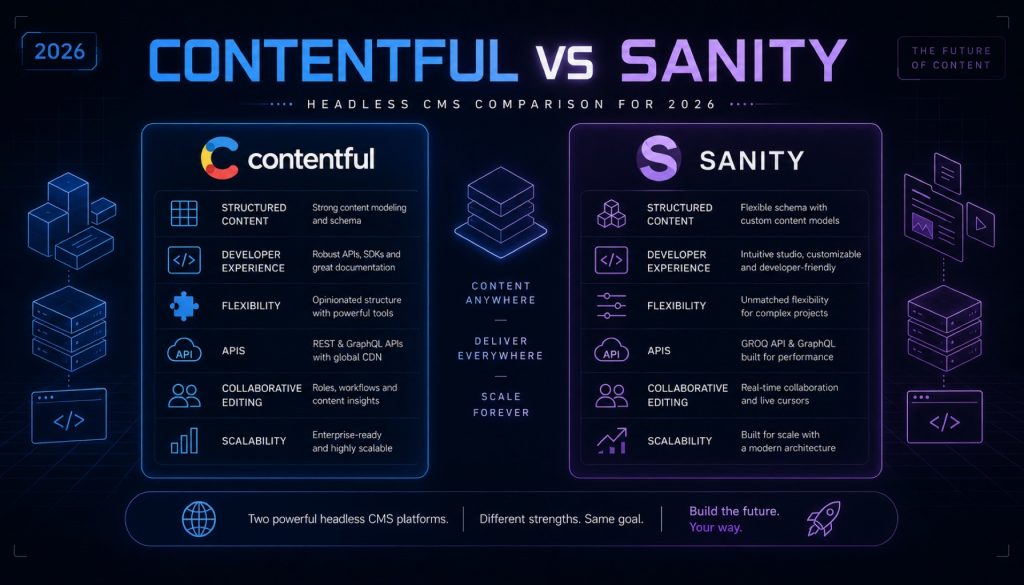
With Contentful, you spend most of your time clicking through admin interfaces. Create a Content Type, add fields, set validation rules, configure webhooks. Code mainly enters the picture when consuming the API on the frontend. Contentful provides both REST and GraphQL APIs with clear documentation and SDKs for major languages. The whole experience is “configuration-driven”: you define rules in the interface, the system executes them.
With Sanity, your content model is code. A schema file written in JavaScript or TypeScript, version control friendly, code review friendly, CI/CD friendly. When your colleague changes a field type, that change shows up in your Git diff. You can review it, discuss it, roll it back. For teams with “infrastructure as code” in their DNA, this feels right.
Then there’s the query language difference.
Contentful’s Content Delivery API uses standard REST with reasonably powerful filtering and nesting parameters. It added GraphQL support in 2023. Solid, predictable, no surprises, no gotchas.
Sanity invented its own query language: GROQ (Graph-Relational Object Queries). First-time reactions usually split two ways: either “why reinvent the wheel” or “wait, this is actually better than GraphQL.” GROQ’s syntax resembles JavaScript array method chaining, with a gentler learning curve than GraphQL. And it can do projections, filtering, sorting, and joins in a single query without requiring you to predeclare every possible query path at the schema level like GraphQL does.
Example: you want all posts in the “tech” category, sorted by publish date descending, returning only title and author name.
“`groq
*[_type == “post” && category == “tech”] | order(publishedAt desc) {
title,
“authorName”: author->name
}
“`
Compare to GraphQL, which requires defining query types and resolvers first:
“`graphql
query {
postCollection(where: {category: “tech”}, order: publishedAt_DESC) {
items {
title
author {
name
}
}
}
}
“`
GROQ is shorter and more intuitive. But it also means lock-in. This is Sanity-specific language. Your team needs to learn it. If you migrate later, all this query logic needs rewriting.
The Money Question
The most concrete dimension in CMS selection.
Contentful’s pricing starts at $300/month for the Basic plan. Sounds reasonable, right? The devil lives in the details. Every additional locale (language version): cost goes up. Every additional environment (dev, test, staging): cost goes up. API calls over quota: cost goes up. Many mid-sized teams report median annual spend around $33,000, and that number accelerates as the business grows.
A friend running multilingual e-commerce put it this way: “Managing content for 12 language markets on Contentful burns nearly $200,000 a year just on the CMS. And every time we add a new market, we renegotiate the contract.”
Sanity’s pricing logic works completely differently. The free tier is already generous, enough to run real projects for small teams. The Growth plan costs $15/user/month. Seats, not usage tiers. The crucial difference: locales don’t cost extra. Environments don’t cost extra. For teams building 10 or 20 language markets, Sanity’s cost advantage can be 3x to 5x. That’s not hyperbole, that’s based on real case calculations.
Of course, Sanity’s “cheapness” comes with conditions. The Studio requires developers to build and maintain it. That labor cost doesn’t show up on the SaaS invoice, but it’s real. If your team has no frontend engineers, or engineering resources are stretched thin, the subscription savings might not cover the development overhead.
Core Capabilities at a Glance
| Dimension | Contentful | Sanity |
|---|---|---|
| Architecture | Fully managed SaaS | Self-hostable + cloud data layer |
| Content modeling | UI configuration | Code-defined (JS/TS) |
| Editor | WYSIWYG-like Rich Text | Portable Text (structured) |
| Query language | REST + GraphQL | GROQ (+ GraphQL support) |
| Real-time collaboration | Limited (field-level locking) | Native real-time (multi-cursor sync) |
| Plugin ecosystem | 500+ Marketplace apps | Smaller, community-driven |
| Multilingual support | Native but charged per locale | Flexible, no extra charge |
| Enterprise certifications | SOC 2, optional HIPAA | SOC 2 (more recent) |
| Free tier | Community (limited) | Free (relatively generous) |
| Starting price | $300/month | $15/user/month |
Real-World Decision Patterns
Moving past the spec sheet, here are actual decision scenarios.
Scenario one: a 50-person SaaS company with 8 marketers and 3 engineers.
Marketing publishes 5 blog posts weekly, updates product pages, manages help docs. Engineering is already underwater building the core product. No capacity to maintain a custom CMS backend.
Contentful fits better here. Marketing can self-serve. Engineers handle initial setup and occasional model adjustments. The $300/month entry price is trivial for a 50-person company. The engineering time saved is worth far more.
Scenario two: a cross-border e-commerce company selling to 15 countries in 12 languages.
With Contentful, the cost of 12 locales will make the CFO frown. And each market might need different content structures: the Japan site needs more product detail fields, the European site needs GDPR compliance disclaimers. That kind of differentiation doesn’t fit neatly into Contentful’s unified model.
Sanity’s code-based schemas can define different content variants per market. Locales don’t cost extra. Real-time collaboration lets editors across multiple time zones work seamlessly. Initial development investment is higher, but long-term operational cost advantages are significant.
Scenario three: a technical content platform where engineers are the editors.
Think developer documentation site or technical blog. The people writing content are engineers. They don’t need a pretty admin panel. They need Git workflows, Markdown support, flexible content structures.
Sanity is tailor-made for this scenario. Schema as code, GROQ queries, fully customizable Studio. For developers, these aren’t learning costs. They’re productivity tools.
Scenario four: a traditional enterprise undergoing digital transformation, with security compliance as top priority.
Finance, healthcare, government. In these sectors, the first CMS question isn’t “is it good,” it’s “does it pass audit?”
Contentful has deeper credentials here. SOC 2 Type II certification for years, mature HIPAA compliance options, rich data residency choices (you can specify which region stores your data). Its App Marketplace includes mature permission management, audit logging, and content approval workflow plugins.
Sanity has made rapid progress on enterprise security in the past two years and earned SOC 2 certification, but ecosystem maturity and enterprise customer trust need more time. If your CIO asks “which Fortune 500 companies use this,” Contentful can provide a long list. Sanity’s list is still growing.
Ecosystems and Future Directions
The headless CMS market in 2026 has moved beyond “store content, expose API.” AI integration, content workflow automation, omnichannel publishing orchestration are becoming the new competitive dimensions.
Contentful moved early on AI assistance. Its AI Content Generator is integrated directly into the editing interface, helping editors generate drafts, translations, and summaries. Its Composable Content Platform positioning signals a shift toward “enterprise content hub,” not just CMS but the central node connecting all content sources and consumption endpoints. The 700+ data source connectors reflect this strategy.
Sanity’s direction leans more toward “developer platform.” It launched Content Lake 2.0 in 2025, pushing underlying storage performance and flexibility higher. Its AI strategy isn’t to embed AI features in the product but to make it easy for developers to integrate any AI service (OpenAI, Anthropic, self-hosted models) into content workflows. This “we don’t do AI, we make it easy for you to integrate AI” approach aligns with its consistent “tools, not solutions” philosophy.
The plugin ecosystem gap is real. Contentful’s Marketplace has 500+ apps covering everything from analytics to translation to DAM (digital asset management). Sanity’s community plugins number around one-third of Contentful’s, with variable quality. But Sanity’s advantage: if the plugin you need doesn’t exist, you can write it yourself, and doing so is simpler than developing a Contentful App (because the entire Studio is React, you’re just writing React components).
Migration Realities
An often-overlooked question: if you choose wrong, how hard is it to switch?
Migrating from Contentful to Sanity is relatively straightforward. Content models can be converted via scripts, content itself exported through APIs and imported. Sanity’s community includes plenty of Contentful migration guides and tools.
Migrating from Sanity to Contentful is messier. GROQ queries need rewriting as REST/GraphQL calls, Portable Text needs conversion to Contentful’s Rich Text format (this conversion isn’t lossless), and custom Studio components have no equivalents.
But honestly, any CMS migration is major surgery. This shouldn’t drive the decision, but it’s worth having realistic expectations going in.
Final Thoughts
Choosing a CMS is like choosing a programming language. There’s no absolute right or wrong, only what fits.
Contentful is a well-crafted Swiss Army knife. Full-featured, ready to use out of the box, backed by a mature ecosystem and enterprise support. You don’t need to be a blacksmith to get work done.
Sanity is a workbench full of precision tools. Higher ceiling, more possibilities, but you need to know what you’re doing. If you enjoy the feeling of “building from scratch, total control,” it delivers deep satisfaction.
The 2026 reality: more teams are shifting from Contentful to Sanity, driven primarily by cost (especially multilingual scenarios) and developer experience. But just as many teams evaluate Sanity and return to Contentful because their editorial teams need an interface “you can use without reading docs.”
The deciding factor isn’t on the technical spec sheet. Ask yourself: what’s your team composition? How complex is your content? What’s your growth trajectory? Where do you want to stand on the spectrum between “flexibility” and “ease of use”?
The answer is with you, not in any comparison article.
Related Reading
- Contentful vs Sanity: A 2026 Headless CMS Decision Guide That Actually Helps You Choose
- Contentful vs Sanity in 2026: Which Headless CMS Fits Your Team
Stay updated with our latest AI insights