Culture Amp Alternatives: Lattice, 15Five, Leapsome, Quantum Workplace, Officevibe – Which Fits Your Team in 2026?
TL;DR
Culture Amp is solid but expensive — base pricing starts at $5-9/person/month, and enterprise deals can push past $100. If budget matters, look at Leapsome ($3/person/month) or Officevibe ($3.50/person/month). For a full performance management suite, Lattice is the most mature option. Small teams that want fast deployment should consider 15Five or Officevibe. Large orgs that need deep survey analytics — Quantum Workplace has no equal there.
Why I Moved Away from Culture Amp
I ran Culture Amp for about 14 months across a 120-person org. The product itself? Fine. Good survey templates, solid benchmarking, decent analytics dashboard. But the friction points added up:
- **Opaque pricing.** Every renewal turned into a negotiation. No self-serve pricing page, no transparency. Slack’s HR team reportedly ran into the same issue when evaluating enterprise engagement tools in 2024 — you never know what you’re actually paying until the contract lands.
- **Feature bloat for smaller teams.** We were paying for advanced analytics modules that maybe three people in the company ever opened.
- **Integration gaps.** Connecting Culture Amp to our existing HRIS and Slack workflows required more custom work than expected. Shopify’s people ops team has talked publicly about how integration depth was a deciding factor when they evaluated engagement platforms.
- **Long contract lock-ins.** Wanted to downgrade mid-year? Good luck. Annual commitments with no flexibility.
- **Customer success turnover.** Three different CSMs in one year. Each time, we re-explained our setup from scratch.
The base tier looks reasonable at $5-9/person/month. But add performance reviews, manager tools, and advanced analytics — suddenly you’re at $15-20+. For a 200-person company, that’s $36,000-48,000 annually before implementation costs.
If any of this sounds familiar, here are five alternatives I’ve evaluated seriously. I’ll break down features, pricing, deployment complexity, and where each one actually fits.
Lattice: The All-in-One Contender
Lattice is probably the closest thing to a true unified people management platform on the market right now. Companies like Reddit, Slack, and Monzo have used it — and for good reason.
What it does:
- Performance reviews (360-degree feedback, custom review cycles)
- OKR and goal management
- Employee engagement surveys (pulse surveys + eNPS)
- Compensation management
- Career development pathing
- 1:1 meeting tools, real-time feedback
Pricing:
The base Performance + OKR package runs $11/person/month. Engagement is an add-on at $4/person/month. Career development: another $4. Compensation: $6. Full stack comes to roughly $25/person/month. Annual billing, minimum spend thresholds apply.
Who it’s for:
Mid-size to large companies (200-5,000 people), especially HR teams that want performance, engagement, and compensation in one system. The modular pricing means you can start with core performance management and layer on engagement or comp later.
My take:
Lattice’s product maturity shows. The UI feels modern — noticeably more polished than Culture Amp’s slightly dated interface. The real win is workflow integration: a manager opens one page and sees their team’s OKR progress, engagement scores, and pending reviews. No tab-switching, no context loss.
Airbnb’s people team has spoken about the value of unified people platforms — when engagement data lives next to performance data, you catch patterns that siloed tools miss. A team with dropping engagement scores AND missed OKRs tells a different story than either signal alone.
The downsides: full-stack pricing isn’t cheap. Small teams may hit minimum spend floors. And engagement surveys are a paid add-on — not included in base. If all you need is pulse surveys without performance management, Lattice is overkill.
15Five: Built for Managers Who Need Help Managing
15Five has a specific thesis: most engagement problems are actually management problems. Instead of top-down HR surveys, it builds feedback into the daily rhythm of management.
What it does:
- Weekly check-ins (employees spend 15 minutes writing, managers spend 5 minutes reading — that’s where the name comes from)
- Engagement surveys + eNPS
- OKR tracking
- Performance reviews
- 1:1 meeting templates
- Built-in manager training content (microlearning courses)
Pricing:
Three tiers, clearly laid out:
- Engage: $4/person/month (engagement surveys only)
- Perform: $10/person/month (performance + OKR + 1:1s)
- Total Platform: $16/person/month (everything)
Who it’s for:
Growth-stage companies (50-500 people), particularly those where management capability is uneven. The manager training content is a genuine differentiator — no other platform in this category offers it.
My take:
Here’s what makes 15Five different: it actually tries to make managers better, not just measure how employees feel about them. The built-in microlearning isn’t generic leadership fluff. It’s contextual — if a team’s eNPS drops, the system pushes relevant communication skills content to that specific manager.
The $4/person/month Engage plan is genuinely compelling for pure engagement measurement. That’s less than half what Culture Amp charges for comparable survey functionality. The weekly check-in cadence also solves a real problem — annual surveys have terrible signal-to-noise ratios. Weekly lightweight check-ins catch issues in weeks, not quarters.
HubSpot has talked publicly about the value of continuous feedback loops over annual surveys. 15Five’s architecture is built around that philosophy.
The catch: the Engage plan doesn’t include performance reviews. If you want the full package, $16/person/month for Total Platform isn’t a huge savings over Lattice. And the manager training only comes with Total Platform — you can’t buy it separately.
Leapsome: The Underpriced European Powerhouse
Leapsome is a Berlin-based company with strong market share across Europe. Feature coverage rivals Lattice, but pricing undercuts it significantly.
What it does:
- Performance reviews (continuous feedback and cycle-based)
- Goal/OKR management
- Engagement surveys
- Learning & development
- Compensation management
- Meeting management
Pricing:
Modular pricing starting at $3/person/month. Buy individual modules or bundle them. Full platform runs roughly $8-14/person/month depending on company size and module selection. Free trial available.
Who it’s for:
Companies from 50 to 2,000 people. Particularly strong for organizations with European teams or strict data privacy requirements. Leapsome is GDPR-compliant with European server infrastructure — a genuine advantage over US-headquartered competitors.
My take:
The $3 entry point is real, and it’s not a stripped-down teaser plan. You get functional modules at that price. Full platform at $8-14/person/month delivers roughly the same feature breadth as Lattice at $25 — that’s a significant gap.
Leapsome’s learning and development module deserves specific attention. It supports custom learning paths and skill matrices — features that usually live in separate LMS products. For companies trying to consolidate their HR tech stack without spending Lattice money, this matters.
The survey template library covers engagement, onboarding, exit, DEI, and manager effectiveness — comparable depth to Culture Amp’s research-backed templates. Companies like Spotify and Mercedes-Benz have used Leapsome, which speaks to its enterprise readiness despite the lower price point.
The trade-off: lower brand recognition in North America means fewer English-language community resources, case studies, and implementation partners. Integration depth with US-centric HRIS platforms (Workday, ADP, Rippling) exists but isn’t as polished as Lattice’s connectors. If your HR stack is primarily US tools, factor in some integration friction.
Quantum Workplace: The Survey Analytics Heavyweight
Quantum Workplace started as a pure employee engagement survey company over 20 years ago. That heritage shows — its survey and analytics capabilities are the deepest in this comparison by a wide margin.
What it does:
- Annual engagement surveys + pulse surveys + lifecycle surveys (onboarding, exit, milestone)
- AI-powered action planning (generates specific improvement recommendations from survey data)
- Performance reviews
- Goal management
- Employee recognition
- Turnover prediction analytics
Pricing:
No public pricing — you’ll need to talk to sales. Third-party data suggests small teams (10 people) start around $300/month, and 100+ person organizations land in the $2,500+/month range. That works out to roughly $25-30/person/month.
Who it’s for:
Mid-to-large enterprises (500+ employees) that treat employee engagement as a strategic priority, not a checkbox exercise. Quantum Workplace’s industry benchmarking database is its killer feature — you can compare your scores against companies of similar size, industry, and geography.
My take:
If your primary need is “understand what’s really happening with our workforce and prove it to the C-suite with data,” Quantum Workplace is unmatched. The analytics go deep — cross-slice by department, location, tenure, level, demographic. Track the same cohort’s engagement trajectory over time. Identify which specific drivers (growth opportunities? manager relationship? compensation?) are dragging scores down in which groups.
The AI action planning is practical, not gimmicky. It doesn’t just say “engagement is low in Engineering.” It says “Engineering’s engagement dropped 12 points on ‘growth opportunities’ — here are three specific interventions similar companies implemented, with their measured impact.” That’s the kind of output that gets budget approved.
Turnover prediction deserves mention too. Based on survey response patterns and historical data, it flags employee populations at elevated flight risk. Deloitte’s 2025 Human Capital Trends report highlighted predictive people analytics as a top-five priority for enterprise HR — Quantum Workplace actually delivers on that promise.
The downsides are real though: opaque pricing, long deployment cycles (4-8 weeks with dedicated implementation consultants), and ongoing administrative overhead. You need someone whose partial job is managing this tool. Under 100 people, you won’t use 80% of its analytical depth.
Officevibe (Workleap): Fastest Path to Employee Pulse Data
Officevibe — now part of the Workleap family — is purpose-built for small and mid-size teams that want engagement insights without complexity.
What it does:
- Automated pulse surveys (5 questions pushed weekly, covering 10 engagement dimensions)
- eNPS tracking
- Anonymous feedback channel (two-way anonymous conversations between employees and managers)
- Manager dashboard with AI-powered insights
- 1:1 meeting support
Pricing:
Refreshingly simple. Essential plan runs $3.50-5/person/month — all core features included. No module upsells, no confusing tier matrix. Annual billing gets a discount. Free plan available for teams up to 10 people.
Who it’s for:
Startups and SMBs (10-200 people). First-time engagement tool buyers. Teams that want something running today, not in four weeks.
My take:
Officevibe wins on time-to-value. Sign up in the morning, run your first pulse survey by afternoon. Employees click a link in their email, answer five questions in two minutes, done. No app downloads, no separate account creation, no training required.
The anonymous feedback channel is genuinely clever. Employees submit anonymous feedback anytime. Managers see it and can respond — also anonymously. This creates a “safe conversation” dynamic that’s more natural than survey open-text boxes. Buffer — a company famous for radical transparency — has talked about how continuous anonymous feedback mechanisms surfaced issues that quarterly surveys missed entirely.
The free tier (up to 10 people) is enough for a small startup to validate whether engagement measurement matters to them before spending anything.
At $3.50-5/person/month with all features included, there’s no pricing surprise. What you see is what you pay.
The limitation is clear: no performance reviews, no OKRs, no compensation management. Officevibe measures sentiment — it doesn’t manage performance. If your need evolves beyond “understand how people feel” into “drive accountability and growth,” you’ll outgrow it. Think of it as the right first engagement tool, not the last one.
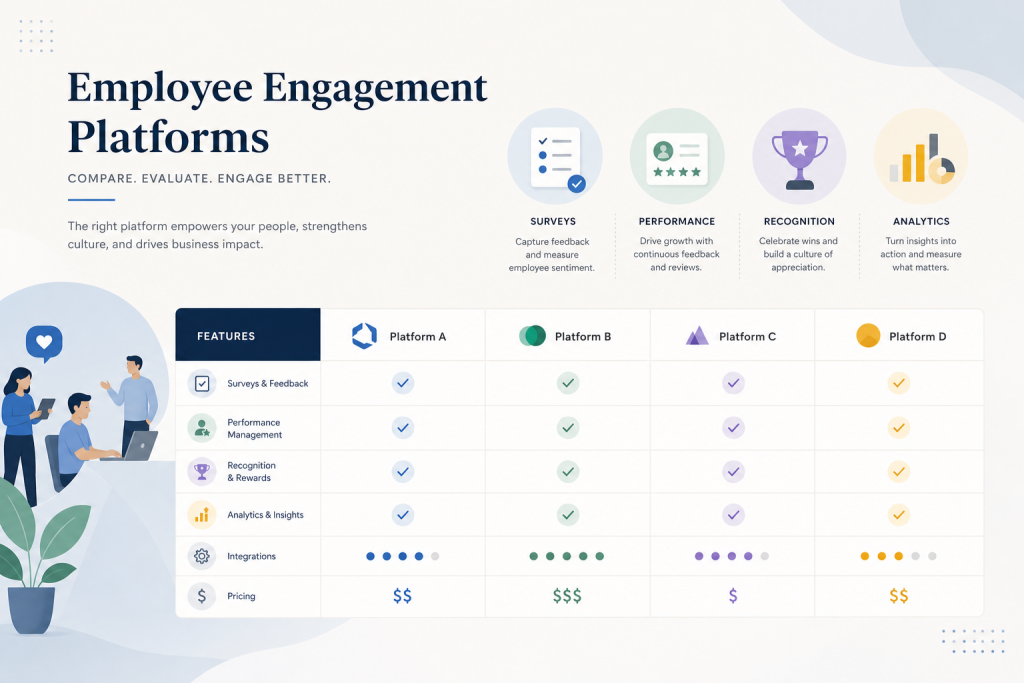
Head-to-Head Comparison
| Dimension | Lattice | 15Five | Leapsome | Quantum Workplace | Officevibe |
| Entry price | $11/person/mo | $4/person/mo | $3/person/mo | ~$25/person/mo (sales) | $3.50/person/mo |
| Full platform | ~$25/person/mo | $16/person/mo | ~$8-14/person/mo | ~$30/person/mo | $5/person/mo |
| Engagement surveys | ✅ (add-on) | ✅ | ✅ | ✅ (core strength) | ✅ (core strength) |
| Performance reviews | ✅ | ✅ | ✅ | ✅ | ❌ |
| OKR/Goals | ✅ | ✅ | ✅ | ✅ | ❌ |
| Compensation mgmt | ✅ | ❌ | ✅ | ❌ | ❌ |
| Manager training | ❌ | ✅ (unique) | ❌ | ❌ | ❌ |
| AI analytics | ✅ | ✅ | ✅ | ✅ | ✅ |
| Free tier | ❌ | ❌ | Free trial | ❌ | ✅ (≤10 people) |
| HRIS integrations | Workday, BambooHR, Rippling | BambooHR, Gusto, ADP | Personio, BambooHR, Workday | ADP, Workday, UKG | BambooHR, Gusto |
| Best fit (team size) | 200-5,000 | 50-500 | 50-2,000 | 500+ | 10-200 |
| Deployment time | 2-4 weeks | 1-2 weeks | 1-3 weeks | 4-8 weeks | Same day |
Pricing Breakdown: What You’re Actually Paying
Let me cut through the noise:
Cheapest entry points: Leapsome ($3/person/month) and Officevibe ($3.50/person/month). Both meaningfully cheaper than Culture Amp’s $5-9 base.
Best value for money: Leapsome. Starting at $3 but delivering feature coverage comparable to Lattice’s $11 base tier. If you need performance + engagement + OKRs bundled, Leapsome at $8-14/person/month saves roughly 50% over Lattice’s $25 full stack.
Most expensive but most specialized: Quantum Workplace. No public pricing signals “we’re not competing on cost.” This is for organizations with real budget allocated to people analytics.
Hidden costs to watch:
- Lattice has minimum annual spend thresholds — small teams might pay for seats they don’t use
- Quantum Workplace charges implementation consulting separately, and the 4-8 week deployment means lost productivity during setup
- 15Five’s manager training (their best feature) only comes with the $16 Total Platform tier
- Culture Amp’s “base” price balloons fast once you add modules — a pattern Lattice also follows
For a 200-person company comparing annual costs:
- Officevibe: $8,400-12,000/year
- Leapsome (full): $19,200-33,600/year
- 15Five (full): $38,400/year
- Lattice (full): $60,000/year
- Quantum Workplace: $60,000-72,000/year
- Culture Amp (estimated full): $48,000-72,000/year
Which One Fits Your Situation
You’re a startup under 50 people:
Go with Officevibe. Deploy it today, start collecting pulse data this week. The free tier works for tiny teams. When you grow past it, $3.50-5/person/month won’t strain your runway. Don’t overcomplicate this — you need signal, not a platform.
You’re a growth-stage company (50-200 people):
Choose between 15Five and Leapsome. If your biggest pain is “our managers don’t know how to manage” — and this is surprisingly common in fast-scaling startups — 15Five’s training content addresses that directly. If you want broader HR tooling at a lower price, Leapsome gives you more coverage per dollar.
You’re a mid-size org (200-1,000 people):
Lattice is the safe choice. Modular design lets you start with performance management and add engagement and compensation over time. Integration ecosystem is the most mature — it’ll connect to whatever HRIS you’re running. The downside is cost, but at this size you probably have budget allocated for people tools.
You’re enterprise (1,000+ people):
Quantum Workplace or Lattice. If your C-suite wants rigorous engagement analytics with industry benchmarks and predictive modeling, Quantum Workplace’s depth is unmatched. If you need a unified platform that covers performance, engagement, compensation, and career development in one system, Lattice scales better.
You have European teams or strict data privacy requirements:
Leapsome. German-headquartered, GDPR-native, European data centers. If your legal team asks where employee survey data is stored, “Frankfurt” is a better answer than “Virginia.”
The Bottom Line
Culture Amp isn’t bad — it’s just no longer the only serious option, and it’s overpriced for what most teams actually use. The market has caught up.
My advice: get clear on your primary need first. Pure engagement measurement? Cost-efficient full suite? Manager development? Deep analytics? Enterprise-grade performance management?
Once you know that, the choice narrows fast:
- **Budget-conscious, full features** → Leapsome
- **Quick start, small team** → Officevibe
- **Manager capability building** → 15Five
- **Enterprise analytics depth** → Quantum Workplace
- **Unified platform, mature ecosystem** → Lattice
Don’t try to buy everything at once. Pick the tool that solves your most pressing problem, get it running, prove value, then expand. The worst outcome is spending six months evaluating platforms and another three months implementing — while your team’s engagement quietly erodes.
Stay updated with our latest AI insights