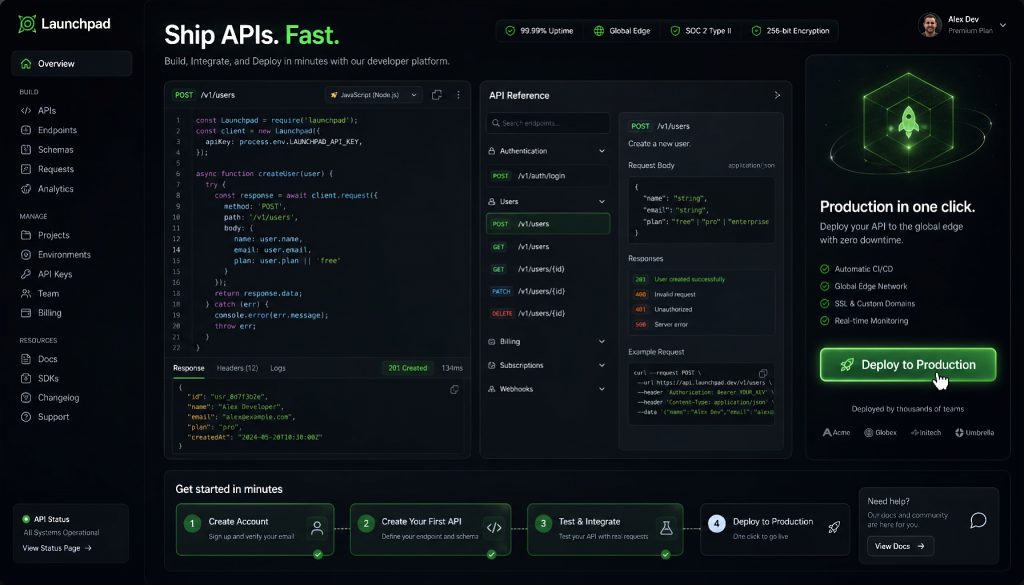
Last fall, a three-person startup went from zero to live product in 72 hours. Authentication through Clerk, database on Neon, deployed to Vercel. None of them were backend engineers. Five years ago this would have been impossible. Just configuring OAuth flows in AWS Cognito would have eaten a senior engineer’s entire week.
This isn’t an outlier. In nearly every infrastructure category in 2026, tools that prioritize developer experience are eating the incumbents alive. Not through sales teams. Not through pricing wars. Through something quieter and more durable: making developers unable to go back to the old way.
How a category starts to crack
Okta was the undisputed king of authentication. After acquiring Auth0 in 2021, the moat looked unbreachable. Enterprise customers locked into multi-year contracts, migration costs sky-high, game over.
Then Clerk did something that seemed small: it let developers get a working login flow running in five actual minutes. Not “five minutes after you read the docs.” Five minutes from npm install to a rendered sign-in screen.
The gap between these products isn’t captured by the word “simple.” Okta’s integration requires understanding OIDC protocols, configuring an Authorization Server, handling token refresh logic, and manually managing sessions. Clerk collapses all of that into a single
By mid-2026, Clerk’s paying customer count exceeded Auth0’s pre-acquisition peak. Okta’s developer product line got reclassified as a “mature business” in their latest earnings call. That’s Wall Street code for “growth has flatlined.”
The database war is even more telling
Amazon RDS dominated managed databases for a decade. Stable, reliable, feature-complete. But every developer who has used RDS knows the friction: spinning up an instance takes minutes, connection strings require manual copy-paste from the console, local dev environments never quite match production, and shared staging databases turn into data-contamination nightmares during branch development.
Neon made PostgreSQL behave like Git. Every branch gets an isolated database copy, created in milliseconds. Connection strings come straight from the CLI. Environment variables inject automatically. The killer feature is database branching: you create a database branch the same way you create a Git branch. Every PR gets its own isolated data environment.
What does this mean in practice? A five-person team stops fighting over a shared staging database. Each feature branch carries its own complete database snapshot. No interference. Branches auto-clean after merge. The whole workflow becomes so frictionless that developers forget the database exists. And that’s the point.
Neon crossed $100M ARR in late 2025. RDS is obviously much larger in absolute terms, but its growth rate is bleeding to Neon, PlanetScale, and Supabase collectively.
Deployment and the generational split
The Vercel versus traditional cloud comparison might be the most extreme case. AWS Amplify, Google Cloud Run, Azure App Service can all deploy frontend applications. Feature-for-feature, some are more capable. But ask any indie developer or small team what they use, and the answer is almost always Vercel or Netlify.
The reason is straightforward: git push and you’re done. Preview deployments generate a shareable URL for every PR. Domain configuration, HTTPS certificates, CDN distribution, ISR caching strategies: all automatic.
AWS Amplify can technically do similar things. The experience is completely different. You click through seven or eight console pages, configure IAM roles, write a Build Spec, manually associate a CloudFront Distribution. Each step has a dozen options. Each option can break something. This experience works fine for companies with dedicated DevOps teams. For a developer trying to ship a side project on a Sunday evening, it’s hostile.
The generational split comes down to design philosophy. The old guard exposes every knob and lets the user figure it out. The new generation picks good defaults but still lets you reach every knob. This looks like a minor product philosophy difference. It determines who captures the next generation of developers.
How Supabase is pulling developers away from Firebase
Firebase’s problem isn’t missing features. It’s that Firebase locks developers into a proprietary universe. Firestore’s query syntax is custom-built. Cloud Functions deployment is Google-specific. Once a project scales, migration becomes nearly impossible.
Supabase made a bet: standard PostgreSQL at the core. Every extension (real-time subscriptions, Row Level Security, Edge Functions) builds on open standards. The knowledge developers accumulate is transferable SQL and PostgreSQL expertise, not a single vendor’s private API.
Short-term, this looks like a disadvantage. Supabase can’t do the deep end-to-end optimizations Firebase offers. Long-term, it eliminates developers’ deepest fear: lock-in. A team on Supabase knows that in the worst case, they can dump their data and run it on any PostgreSQL-compatible service. That safety valve is more persuasive than any feature list.
By 2026, Supabase’s developer community activity has surpassed Firebase’s. GitHub stars are a crude but directional signal: Supabase’s main repo sits near 80K stars. Firebase’s open-source SDKs combined don’t reach half that.
What a DX moat actually consists of
The obvious question: if developer experience matters this much, why can’t incumbents just copy it? Can’t Okta build a five-minute onboarding component? Can’t AWS simplify Amplify?
Surface-level simplicity is the tip of the iceberg. A real DX moat has three layers, each extremely difficult to replicate.
Layer one: design consistency across every touchpoint. Good DX isn’t a “Quick Start” tutorial bolted onto an existing product. It’s coherent API design, helpful error messages, thoughtful CLI output, logical SDK structure, and well-organized docs. Clerk’s error messages tell you “you probably forgot to add authMiddleware() in your middleware file.” They don’t just return a bare 401 Unauthorized. Building this requires treating DX as a core product metric from day one. Copying it means rewriting the entire product.
Layer two: the community flywheel. Once enough developers adopt a tool, tutorials, open-source templates, Stack Overflow answers, and YouTube videos form a self-reinforcing content network. A beginner searching “how to add auth to Next.js” finds three Clerk tutorials on the first page. That’s not Clerk’s SEO team at work. It’s thousands of developers producing content independently. A competitor shipping an equally good product still faces empty search results.
Layer three: workflow entrenchment. Once a tool gets embedded in CI/CD pipelines, CLI habits, and IDE integrations, switching costs become enormous. Not because migration is technically impossible, but because muscle memory and team habits have calcified. A developer who types vercel deploy ten times a week isn’t going to learn AWS CDK’s YAML configuration voluntarily. Same reason Vim users don’t switch editors.
The economics flip completely
The traditional SaaS acquisition model: hire a sales team, spend months on POCs, sign annual contracts, pray customers don’t churn. Customer acquisition cost for an enterprise deal might run 1.5x the annual contract value. Year one is a loss. You need renewals to break even.
DX-first tools invert this. Clerk didn’t pitch CTOs with slide decks. It reached the engineer building a side project on Sunday night. That engineer integrated Clerk in five minutes, liked it, and used it in a team project on Monday. The team tried it for a month, found it saved real time, and upgraded to a paid plan. No salesperson touched the deal.
The bottom-up adoption model produces absurdly low CAC. Vercel’s early growth came almost entirely from Next.js community word-of-mouth. Neon’s most effective acquisition channel is developers posting “I migrated from RDS to Neon” threads on Twitter. Supabase’s initial user base was entirely organic, driven by developers fed up with Firebase lock-in.
There’s a nonlinear relationship here: each step-function improvement in developer experience produces disproportionate word-of-mouth growth. Developers share good tools instinctively. Recommending a sharp tool signals taste and awareness. Nobody tweets about a tool that’s “painful to configure but feature-complete.”
| Metric | Traditional enterprise SaaS | DX-first tools |
|---|---|---|
| Acquisition model | Sales team + POC | Developer self-serve |
| Typical CAC | 1-1.5x annual contract | 0.1-0.3x annual contract |
| Time to first payment | 3-6 months | Same day to 2 weeks |
| Expansion path | Sales-driven upsell | Organic team spread |
| Churn signal | Quarterly business review | Real-time usage metrics |
Why big companies can’t replicate this
If DX matters this much, why can’t AWS, Google, and Microsoft figure it out? They have unlimited resources.
This is a variant of the innovator’s dilemma. Large companies design products for their largest customers: enterprises paying seven figures annually. Those enterprises want compliance certifications, SLA guarantees, custom approval workflows, SAML SSO, dedicated support. Every one of these requirements adds a layer of complexity. Every layer of complexity degrades the experience for a regular developer.
An AWS product manager faces a brutal tradeoff: make the console friendlier for newcomers, or satisfy JPMorgan’s customization requirements? The answer is always JPMorgan, because that’s where the revenue sits today.
There’s a structural reason too. Good DX demands tight coordination between docs, SDKs, CLI, API design, and developer relations. In a large company, these are separate departments with separate KPIs, sometimes in different cities. At a 200-person company like Clerk, the person writing the API also participates in SDK design and doc review. Information flows without loss.
This gap widens as companies scale. It doesn’t shrink. DX isn’t a decision you can just “commit to” in a quarterly planning meeting. It’s a capability that has to grow from the company’s DNA.
Which categories flip next
Map the SaaS market by DX disruption and the conquered territories are visible: authentication (Clerk), databases (Neon/Supabase/PlanetScale), deployment (Vercel/Netlify), payments (Stripe proved this years ago), transactional email (Resend is displacing SendGrid right now).
What’s next?
Monitoring and observability is the most obvious candidate. Datadog is powerful but complex to configure and expensive at scale. Newer tools like Axiom and Highlight.io are attacking with zero-config onboarding and usage-based pricing. When a developer can add full tracing with a single line of code without understanding OpenTelemetry’s collector architecture, migration accelerates.
CI/CD is loosening up. GitHub Actions was a huge improvement over Jenkins, but YAML pipeline configuration still causes headaches. Picture a CI tool that auto-detects your project type, generates an optimal build config, and surfaces build results plus performance deltas directly in the PR. When that exists, adoption will spread the way Vercel displaced manual deployments.
Security is severely underestimated. Traditional security tooling has some of the worst developer experience in all of software. Most SAST/DAST tools produce false positive rates so high that developers ignore alerts entirely. A tool that only reports real issues and offers one-click fixes would redefine the category overnight.
What this shift actually means
Back to that three-person team who shipped in 72 hours. Their story matters not because of speed itself, but because of what it signals about competition. When infrastructure onboarding cost drops to near zero, the deciding factor stops being “can we build this?” and becomes “can we build something people care about?”
The developer experience race is fundamentally a race about respect. Respect for developers’ time. Respect for their intelligence. Respect for the impulse to validate an idea quickly. Companies that treat developers as customers who need “education” are losing to companies that treat developers as creators who need to be unblocked.
This race has no finish line. Developer tolerance for friction only decreases over time. Every generation of tools that becomes the new incumbent will eventually face a challenger with sharper DX instincts. The only constant is the question: how many steps between signup and the moment a developer thinks “this is good”?
The companies pushing that number toward zero are the ones that will own the next decade.
Related Reading
- Developer Experience Is the New Moat: How DX-First Tools Are Eating Enterprise SaaS
- Developer Experience Is the Only Moat That Matters Now
Stay updated with our latest AI insights