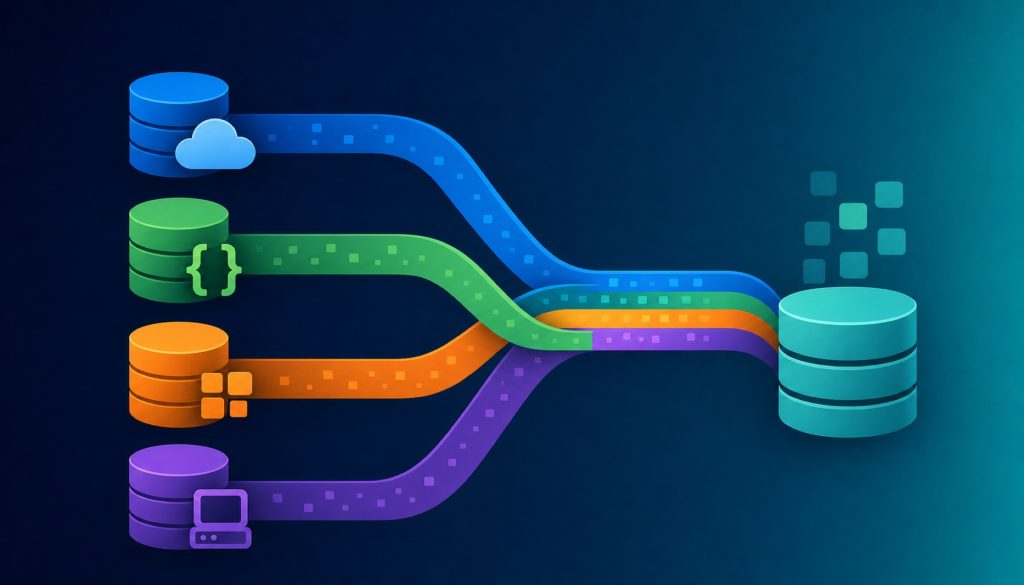
Your sales data lives in Salesforce. Payment records sit in Stripe. User behavior gets tracked through Google Analytics. Your application database runs on PostgreSQL. When your CEO asks for a unified revenue dashboard, you face a problem that has become universal in modern business: getting all this scattered information into one place where you can actually analyze it.
Writing custom ETL scripts seems straightforward until you maintain them for six months. Source APIs change without warning. Data formats evolve. What started as a weekend project turns into a full-time maintenance burden. This reality has created a thriving market for managed data integration platforms that promise to handle the complexity for you.
The market has consolidated around four major players in 2026. Fivetran dominates enterprise contracts with its extensive connector library and white-glove service. Airbyte disrupted the space by open-sourcing its entire platform while offering a commercial cloud tier. Hevo Data carved out the mid-market with transparent event-based pricing. Stitch, now under Talend’s ownership, serves teams already invested in that ecosystem. Each takes a fundamentally different approach to solving the same problem.
Understanding which platform fits your situation requires looking past marketing claims at the actual economics, technical constraints, and hidden costs that only become apparent after deployment.
The Enterprise Choice: When Fivetran Makes Sense
Fivetran built its reputation on reliability and comprehensiveness. The platform offers over 500 pre-built connectors maintained by a dedicated team. When Salesforce updates its API, Fivetran customers don’t scramble to fix broken pipelines. The company’s engineering team handles it, usually before most users even notice the change.
The technical architecture reflects enterprise priorities. Automatic schema drift detection means your warehouse tables stay synchronized with source changes without manual intervention. The platform integrates deeply with dbt, letting transformation logic live in version control while Fivetran handles the extraction and loading. The 99.9% SLA comes with actual financial penalties if they miss it, which matters when your board meeting depends on fresh data.
Pricing follows a Monthly Active Rows model. You pay roughly one dollar per million rows that get touched each month. A row counts as active if it gets inserted, updated, or even just scanned during incremental syncs. This model sounds reasonable until you run real numbers.
Consider a typical growth-stage SaaS company syncing historical Stripe data into Snowflake. Every transaction, every invoice line item, every subscription change becomes a billable row. The first sync moves five years of transaction history. Then incremental syncs check recent transactions but also maintain the active status of historical data that your reports still reference. One company found their first month bill hit eight thousand dollars, far exceeding the budget they allocated based on connector count.
The free tier offers 500 rows monthly, which covers essentially nothing in production use. Even a modest Shopify store generates more order records than that in a day. The pricing structure effectively has no entry point for small companies, which Fivetran accepts as a strategic decision. They target companies with at least ten million in annual revenue where data infrastructure budgets can absorb five-figure monthly costs.
For organizations at that scale, Fivetran delivers clear value. The alternative would be hiring additional data engineers to build and maintain custom connectors. When you calculate loaded engineering costs against Fivetran’s pricing, the platform often wins. But this calculation only works past a certain company size threshold.
The Open Source Disruptor: Airbyte’s Two-Track Approach
Airbyte changed the data integration conversation by making their entire platform open source from day one. You can download the software, deploy it on your infrastructure, and use it indefinitely without paying them anything. This transparency forced competitors to justify their pricing in ways the market hadn’t previously demanded.
The open source version includes 350 connectors and growing rapidly because the community contributes new ones. When someone needs to sync data from a niche marketing tool that larger platforms haven’t prioritized, they can build the connector themselves using Airbyte’s Python or Java SDK. Many of these community contributions get merged into the official connector library, creating a flywheel that accelerates coverage.
Self-hosting Airbyte requires real infrastructure capability. The application expects Kubernetes or at minimum Docker Compose with proper orchestration. You need monitoring for failed syncs, alerting for data quality issues, and a strategy for version upgrades that won’t break existing pipelines. Smaller teams often underestimate this operational burden.
Financial services companies and healthcare organizations frequently choose self-hosted Airbyte because data sovereignty requirements prevent sending customer information to third-party clouds. Regulations like GDPR or HIPAA create scenarios where spending engineering time on infrastructure becomes cheaper than legal risk. A mid-sized fintech company can run Airbyte on AWS infrastructure that costs around seventy dollars monthly for compute, plus the internal time to maintain it.
Teams without compliance constraints or those processing over 100GB monthly often find Airbyte Cloud more practical. The commercial tier charges two dollars and fifty cents per credit, where each credit represents one gigabyte of data moved. This usage-based model makes costs proportional to actual data volume rather than abstract metrics like active rows.
The cloud service offers a 99.5% uptime SLA, slightly below Fivetran’s guarantee but acceptable for most business contexts. The tradeoff buys you transparent pricing and faster connector development. When a new data source launches, Airbyte’s community often ships a connector within weeks while enterprise vendors take months to prioritize it.
The Mid-Market Sweet Spot: Hevo’s Event-Based Model
Hevo Data recognized that companies between 10 and 50 employees face a specific problem. They need enterprise-grade data integration but lack the budget to match enterprise pricing. More importantly, they need predictable costs because sudden budget overruns can derail entire quarters at this scale.
The platform starts at 239 dollars monthly for one million events. The pricing tiers climb clearly: 679 dollars for five million events, with higher tiers for larger volumes. An event means a discrete action like a new sale, a form submission, or a user signup. This metric maps more intuitively to business activity than rows or gigabytes.
Event-based pricing eliminates certain surprises that plague row-based models. When you add historical context to an existing record, that doesn’t create a new event. When you re-sync old data for a backfill, you pay once for the actual new events created, not repeatedly for touching the same rows. Teams can budget based on their product metrics rather than trying to estimate database row counts.
Hevo includes 150 connectors, fewer than market leaders but covering the standard SaaS stack that most mid-market companies actually use. The platform bundles basic transformation capabilities that handle common data cleaning tasks without requiring a separate dbt setup. For teams with one to three data people, this integration simplifies the stack and reduces moving parts.
One e-commerce SaaS company documented their migration from Fivetran to Hevo in a blog post. Their Fivetran bill had climbed to 4,500 dollars monthly as their customer base grew. Switching to Hevo dropped that cost to 679 dollars with minimal functionality loss. They gave up automatic schema change detection, which meant manually monitoring for API changes quarterly instead of relying on automated notifications. For their team size and maturity stage, the tradeoff made clear financial sense.
The 14-day free trial gives enough time to test real production workloads before committing. Unlike free tiers that restrict data sources or row counts to useless levels, Hevo’s trial provides full platform access. You can validate that your specific connectors work reliably with your actual data before the first invoice arrives.
The Ecosystem Play: Stitch Under Talend
Stitch entered the market as an independent player but got acquired by Talend, the enterprise data integration giant. This ownership change shaped the product’s evolution in specific ways. Teams already using Talend’s broader data platform gain tight integration with Stitch for cloud source replication. For everyone else, the platform offers solid fundamentals without pushing the cutting edge.
Pricing starts at 100 dollars monthly for five million rows, scaling to 1,250 dollars for 100 million rows. This row-based model parallels Fivetran but typically costs 30 to 40 percent less at equivalent volumes. The lower price point reflects Stitch’s market positioning: reliable enough for production use but without the premium service tier that Fivetran provides.
The platform supports 130 connectors as of 2026, a number that has held relatively static since the acquisition. In contrast, Airbyte has accelerated to 350 connectors during the same period. Stitch implements the open Singer protocol for connectors, which theoretically allows using community-built taps, but the documentation and tooling for this workflow lags behind Airbyte’s mature SDK.
Stitch makes sense in two scenarios. First, companies already running Talend for on-premise data integration can extend their existing investment rather than introducing another vendor relationship. The unified billing, shared authentication, and integrated monitoring justify choosing Stitch even if a standalone comparison might favor competitors.
Second, budget-constrained teams that need enterprise-grade stability but can’t afford Fivetran find value in Stitch’s discount positioning. If your data sources fall within the available connector set and you don’t need the newest SaaS integrations immediately, Stitch delivers reliable replication at a lower price point than the market leader.
The platform offers a free tier limited to five data sources, which provides enough runway to validate the technical fit before upgrading. This generous free allowance distinguishes Stitch from Fivetran’s effectively unusable free tier while remaining more constrained than Airbyte’s fully open-source option.
Deployment Models and Hidden Costs
The obvious monthly platform fees tell only part of the cost story. Different deployment models carry distinct operational burdens that affect total ownership cost.
Cloud-hosted platforms like Fivetran, Hevo, and Airbyte Cloud minimize operational overhead. You configure connectors through a web interface, set sync schedules, and receive alerts when syncs fail. Your team focuses on using the data rather than maintaining the infrastructure that moves it. This convenience commands a premium but eliminates several engineering roles from your hiring plan.
Self-hosted Airbyte shifts the cost structure entirely. The software itself costs nothing, but you need infrastructure to run it and people to maintain that infrastructure. A typical deployment on AWS might use a t3.large instance at roughly 70 dollars monthly for compute, plus RDS for the metadata database and S3 for temporary storage during syncs. Storage costs scale with data volume but remain modest compared to platform fees.
The real cost comes from engineering time. Version upgrades require testing to verify they won’t break existing pipelines. Monitoring and alerting need configuration to catch failures before they create data gaps. When connectors break due to API changes, someone needs to debug and fix them. Larger organizations can distribute this burden across a platform team. Companies with fewer than 20 employees often find the operational overhead outweighs the licensing savings.
Private deployment of enterprise platforms like Fivetran serves organizations with strict data governance requirements. Healthcare companies bound by HIPAA regulations or financial institutions under SOC 2 Type II audits sometimes cannot send customer data to third-party clouds regardless of contractual protections. Fivetran offers private deployment where their software runs in your VPC, but pricing typically runs three to five times higher than the standard cloud product. One healthcare analytics company reported their private Fivetran deployment cost 23,000 dollars monthly compared to roughly 7,000 dollars for equivalent cloud usage.
Pricing Scenarios With Real Numbers
Abstract pricing models become concrete when you map them to actual company profiles and data volumes.
An early-stage startup with eight employees and 300 customers might sync data from their PostgreSQL application database, Stripe for payments, and Google Analytics. They process roughly 50,000 events monthly. Airbyte self-hosted costs only the infrastructure and their DevOps engineer’s part-time attention. Hevo’s entry tier at 239 dollars provides a managed solution that frees that engineer for product work. Fivetran would cost several thousand dollars monthly and makes no sense at this scale.
A growing SaaS company with 35 employees and 2,000 customers syncs 15 data sources including Salesforce, HubSpot, Zendesk, multiple databases, and various marketing tools. They move about three million events monthly. Hevo’s 679 dollar tier fits comfortably in their budget. Airbyte Cloud would cost roughly 7,500 dollars based on their 75GB monthly data volume. Fivetran might reach 12,000 dollars depending on how many rows different sources generate. The company chooses Hevo and uses the saved budget to hire another data analyst.
An enterprise with 200 employees, complex data needs spanning 40 source systems, and strict SLA requirements processes 50 million rows monthly. Fivetran costs approximately 45,000 dollars but the company’s data infrastructure budget exceeds 100,000 dollars monthly. The automatic schema management, deep dbt integration, and 99.9% uptime guarantee justify the premium. They previously tried Airbyte Cloud but found the 99.5% SLA allowed too many brief outages that disrupted executive reporting.
A financial services firm with 80 employees and extensive compliance requirements cannot use cloud platforms at all. They self-host Airbyte on their own AWS infrastructure at roughly 400 dollars monthly for compute and storage. Their platform team spends approximately 20 hours monthly maintaining the deployment, upgrading versions, and customizing connectors. At their engineering cost structure, this totals around 6,000 dollars of loaded labor cost monthly. Fivetran’s private deployment would cost 35,000 dollars, making self-hosted Airbyte the clear winner despite operational complexity.
Connector Coverage and Data Source Priorities
The marketing claim that a platform has hundreds of connectors matters less than whether they have your specific connectors working reliably.
Fivetran’s 500-plus connectors include virtually every enterprise SaaS application and database. The engineering team prioritizes connectors based on customer demand and market size. When they build a connector, it gets maintained actively with automatic handling of API version changes. If Salesforce deprecates an API endpoint, Fivetran migrates to the new endpoint transparently.
Airbyte’s 350 connectors grow rapidly but vary in maturity. Official connectors maintained by Airbyte’s team receive the same quality attention as Fivetran’s. Community-contributed connectors might work perfectly or might break on edge cases. The platform marks each connector’s reliability status, letting you assess risk before depending on it for production pipelines. The rapid connector growth means Airbyte often supports newer SaaS tools months before enterprise vendors.
Hevo’s 150 connectors cover the standard business stack but gaps appear for specialized tools. If your marketing team uses a niche attribution platform or your ops team relies on a specific workflow tool, Hevo might not support it. The company adds connectors based on customer requests but moves slower than Airbyte’s community-driven model.
Stitch’s 130 connectors have remained stable, focusing on reliability over expansion. The Singer protocol theoretically allows using open-source taps, but documentation and tooling make this path harder than Airbyte’s connector SDK. Most Stitch customers stick with officially supported connectors and work around missing sources.
When evaluating platforms, audit your actual data sources rather than comparing connector counts. One missing critical connector outweighs having 200 others you’ll never use. Most platforms offer free trials or proof-of-concept programs that let you validate your specific sources before committing.
Data Transformation and the dbt Integration Story
Modern data stacks increasingly separate data movement from data transformation. Platforms focus on reliably extracting and loading data while tools like dbt handle transformation logic in SQL. But the integration between these layers affects workflow efficiency.
Fivetran pioneered deep dbt integration. You can define dbt models that reference Fivetran tables, and the platform coordinates scheduling so transformations run after fresh data arrives. Fivetran’s metadata API exposes sync status that dbt can check before running dependent models. This orchestration eliminates manual coordination between teams.
Airbyte supports dbt through normalization that can run post-sync, but the integration feels more manual than Fivetran’s. You can trigger dbt Cloud runs via webhooks when syncs complete, but setting this up requires understanding both platforms’ APIs and writing glue code. For teams already comfortable with orchestration tools like Airflow or Prefect, this flexibility provides more control. For smaller teams wanting simplicity, it adds friction.
Hevo includes basic transformation capabilities directly in the platform. You can apply column mapping, data type conversions, and simple filtering without leaving Hevo’s interface. For teams without dedicated analytics engineers, these built-in transformations handle common needs. More complex transformation logic still requires dbt or similar tools, which Hevo supports through standard post-load patterns but without the tight orchestration that Fivetran provides.
Stitch takes a hands-off approach, loading data into your warehouse and leaving transformation entirely to other tools. This separation keeps Stitch simple but means you need to build your own orchestration if transformation timing matters.
The right approach depends on your team’s composition. If you have analytics engineers who live in dbt, Fivetran’s integration streamlines their workflow. If you have data analysts who write SQL but don’t manage infrastructure, Hevo’s built-in transformations provide helpful guardrails. If you have data engineers comfortable with orchestration frameworks, Airbyte’s flexibility lets you build exactly the workflow you want.
Making the Decision for Your Situation
Generic best practices matter less than your specific constraints, team capabilities, and growth trajectory.
Early-stage companies with technical founders should strongly consider Airbyte self-hosted. The operational burden stays manageable when you have fewer than 10 data sources and someone comfortable with Docker. The zero licensing cost preserves runway while providing production-grade functionality. As you grow, you can migrate to Airbyte Cloud or another platform without rewriting connector configurations.
Companies between 10 and 50 employees with modest technical depth should default to Hevo unless specific requirements pull them elsewhere. The predictable event-based pricing, included transformation capabilities, and managed service model minimize surprises. When your data team consists of one or two analysts who learned SQL to answer business questions rather than formal data engineers, Hevo’s simpler stack reduces cognitive load.
Enterprises with dedicated data platform teams and enterprise SaaS stacks should evaluate Fivetran seriously despite the premium pricing. The automatic schema management alone prevents categories of production incidents that cost more in lost productivity than the platform fees. When your data warehouse feeds executive dashboards that influence million-dollar decisions, the 99.9% SLA and white-glove support justify the cost.
Companies already invested in Talend’s ecosystem should examine Stitch before looking elsewhere. The 30 to 40 percent discount versus Fivetran combined with unified vendor management simplifies procurement. If Stitch’s connector library covers your sources, the integration benefits outweigh broader market comparisons.
Regulated industries with data residency requirements face a simpler decision tree. Can you use cloud platforms at all? If yes, normal selection criteria apply. If no, self-hosted Airbyte becomes the practical choice unless your budget accommodates Fivetran’s private deployment premium.
Looking Past the Initial Decision
The platform you choose today sets expectations but shouldn’t create permanent lock-in. All modern platforms support bulk export of connector configurations and many share enough architectural patterns that migration, while not trivial, remains feasible.
Monitor your actual costs monthly rather than assuming they’ll stay constant. Data volumes grow with your business, and pricing that seemed reasonable at one scale might become problematic at another. One company set a policy that when their data integration bill exceeded two percent of engineering budget, they’d reevaluate platforms.
Track connector reliability for your specific sources. A platform might have 500 connectors total but if the three you depend on break frequently, that breadth provides no value. Most platforms publish status pages, but the relevant metric is your sync success rate, not their aggregate uptime.
Watch for changes in product velocity that signal shifting priorities. When Talend acquired Stitch, the pace of new connector releases slowed noticeably. Companies that chose Stitch expecting continued rapid development found themselves with a stable but slower-evolving platform. These strategic shifts happen across the market as companies get acquired, raise funding, or pivot positioning.
Build internal documentation about why you chose your current platform and what would trigger reconsidering that choice. When the data team turns over, this context prevents replatforming based on whoever’s personal preferences rather than organizational needs.
Conclusion
The data integration market in 2026 offers differentiated choices rather than interchangeable vendors. Fivetran provides enterprise-grade reliability and comprehensiveness at premium pricing. Airbyte combines open-source flexibility with commercial convenience. Hevo optimizes for mid-market predictability. Stitch offers ecosystem integration for Talend customers.
Your correct choice depends on company size, technical capability, regulatory constraints, budget flexibility, and data source requirements. The worst decision is choosing based on incomplete information or letting shiny marketing override practical assessment. The second-worst decision is analysis paralysis that delays building the data infrastructure your business needs.
Pick the platform that fits your current reality, not your aspirational future state. Most companies outgrow their first data integration platform anyway. Starting with something appropriate for today beats spending months evaluating options to find the theoretically perfect choice. The data you’re not collecting while you deliberate costs more than switching platforms later if needed.
Related Reading
- Data Integration Tools for Startups 2026: Fivetran vs Airbyte vs Hevo vs Stitch
- Fivetran vs Airbyte 2026: Cost and Control Analysis for Data Integration
Stay updated with our latest AI insights