Pick the wrong auth provider and you burn two sprint cycles on migration or lose a six-figure deal. Pick the right one and you won’t think about authentication for years. This guide breaks down Okta, Auth0, and Clerk across pricing, enterprise readiness, developer experience, and compliance so you can match the platform to your company’s actual stage and customer profile. No hand-waving, no “it depends without an answer.” Three providers, three distinct sweet spots, one clear decision framework at the end.
Okta: The Enterprise Procurement Checkbox
Okta is the default pick for companies whose buyers have approved vendor lists. Its Workforce Identity Cloud covers SAML, OIDC, SCIM, Active Directory, LDAP, and HR system integrations. If your customer’s security team sends a vendor questionnaire before signing, Okta probably already passed it.
Where it wins: SSO and directory integration depth. Over 7,000 pre-built app integrations (Salesforce, Workday, ServiceNow, legacy internal tools). Full compliance coverage: SOC 2 Type II, ISO 27001, FedRAMP, HIPAA. Complex multi-tenant architectures with granular permission models. When a Fortune 500 procurement team asks “do you support X?”, the answer is almost always yes.
Where it hurts: Developer experience is painful. Documentation reads like a 2015 enterprise software manual. The concept model (Applications, Authorization Servers, Policies, Rules) nests several layers deep. SDK updates lag behind modern frameworks. Integrating with a Next.js app means manually handling sessions, callbacks, and token refresh. Budget several days just to understand the architecture before writing code.
Pricing: Workforce Identity starts at $6/user/month (Starter tier), but the practically usable Essentials tier runs about $17/user/month. A 50-person team costs at least $10,200/year. Minimum annual contract: $1,500. Customer Identity (the Auth0-based product line) charges by MAU with 25,000 free, then usage-based pricing. Enterprise contracts require sales calls, and actual prices typically run 40%+ above listed rates.
Best for: B2B SaaS companies with 50+ employees selling to large enterprises. Your buyer requires SAML SSO, SCIM automated provisioning, and specific compliance certifications before signing.
Auth0: The Middle Path That Scales Both Directions
Auth0 (acquired by Okta but still operating independently) sits between enterprise capability and developer usability. Its documentation is the best of the three. Quick Start guides get you from zero to working auth in about 15 minutes.
Where it wins: Balance. Official SDKs cover 20+ languages and frameworks (React, Next.js, Vue, Python, Go all have first-party support). Auth0 Actions let you inject custom logic at any point in the auth flow: validate email domains, call risk-scoring APIs, push events to Segment, block disposable email providers. Universal Login provides a customizable hosted login page with built-in passwordless, social login, and MFA.
Enterprise-side, it supports SAML and OIDC SSO, though pre-built integrations number around 30 (vs. Okta’s 7,000+). The Organizations feature handles multi-tenancy well, but RBAC granularity falls short of Okta’s depth.
Where it hurts: Pricing complexity. MAU calculation catches teams off guard. Token refresh operations can count toward your monthly active total. A real-time collaboration app expecting 20,000 MAU might see bills for 30,000 to 35,000 MAU because users frequently trigger token refreshes. SSO connection limits also bite: B2B Essentials ($150/month) allows only 3 enterprise SSO connections; B2B Professional ($800/month) gives 5.
Pricing: Free tier covers 25,000 MAU. B2C Essentials starts at $35/month, B2B Essentials at $150/month. B2C Professional runs $240/month, B2B Professional $800/month. Paid plans start at just 500 MAU included. The jump from free to paid is steep, and per-MAU costs accumulate fast once you cross thresholds.
Best for: Growth-stage SaaS teams (10 to 50 people) selling primarily to SMBs with enterprise deals on the 12-month roadmap. You want fast initial setup and the ability to flip on SAML when your first big customer asks for it.
Clerk: The Developer Experience Play
Clerk is the youngest of the three but has become the de facto standard in the Next.js ecosystem. Core philosophy: authentication UI and logic should work like a component library. Drop it in, it works.
Where it wins: Developer experience, no contest. Install @clerk/nextjs, add a few lines of code, and auth is running. Pre-built components like
In 2026, Clerk addressed its biggest gap: enterprise SSO. It now supports SAML and OIDC, connecting to Azure AD, Google Workspace, and Okta as identity providers. Pre-built integration count is still low, but custom IdP configuration is straightforward.
Where it hurts: Enterprise readiness. No SCIM automated user provisioning, which means large customers need manual user management. Audit logging and advanced compliance features remain limited. If your buyer is a Fortune 500 company with a rigorous security review process, Clerk may not pass muster.
Pricing: Free tier covers 10,000 MAU (updated to 50,000 MAU per early 2026 announcement; check clerk.com/pricing for current numbers). Pro plan is $25/month, with $0.02/MAU beyond the free quota. At 100,000 MAU, you’re looking at roughly $1,800 to $2,025/month. Compare that to Auth0 B2B Professional at the same scale: $5,000 to $7,000/month. The cost gap is massive.
Best for: Early-stage SaaS (pre-seed through Series A), indie developers, and any team building on Next.js or React. Your customers are SMBs, individual users, or developers. You need auth live yesterday so you can focus on the core product.
Feature Comparison Table
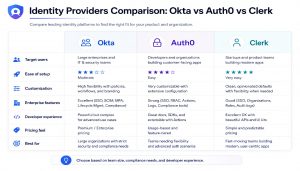
| Dimension | Okta | Auth0 | Clerk |
|---|---|---|---|
| Free Tier | None ($1,500/yr min contract) | 25,000 MAU | 10,000 to 50,000 MAU |
| Paid Pricing | $6 to $17/user/month | $35 to $800/month (by plan) | $25/month + $0.02/MAU overage |
| 100K MAU Cost | $4,000 to $6,000/month (custom) | $3,000 to $5,000/month | ~$1,800 to $2,025/month |
| Developer Experience | Steep learning curve, dated APIs | Strong docs, solid SDKs | Best-in-class Next.js integration |
| SSO Integrations | 7,000+ pre-built | ~30 pre-built | Manual config (SAML/OIDC supported) |
| Multi-tenancy | Requires premium tier | Organizations feature | Built-in Organizations |
| SCIM Provisioning | Full support | Supported | Not available |
| Compliance Certs | SOC 2, ISO 27001, FedRAMP, HIPAA | SOC 2, ISO 27001 | SOC 2 |
| MFA | Full (push, TOTP, WebAuthn) | Full (push, TOTP, WebAuthn) | TOTP, SMS, backup codes |
| Auth Flow Customization | Policies & Rules (complex) | Actions (flexible, code-driven) | Limited hooks |
| Framework Support | Framework-agnostic (mediocre everywhere) | 20+ SDKs, broad coverage | Next.js, React (excellent) |
| AI Agent Auth | Not a focus | Auth0 for AI Agents (2026) | Not a focus |
Pricing Scenarios That Actually Matter
Scenario 1: 50-person team, 5,000 MAU B2B app
- Okta Workforce: ~$10,200/year ($17/user/month x 50)
- Auth0 B2B Essentials: ~$1,800/year ($150/month)
- Clerk Pro: ~$300/year ($25/month, within free MAU quota)
Scenario 2: Consumer app at 100,000 MAU
- Okta Customer Identity: Custom quote (expect $4,000 to $6,000/month)
- Auth0 B2C Professional: ~$3,000 to $5,000/month
- Clerk Pro: ~$1,800 to $2,025/month
Scenario 3: 20,000 MAU B2B app needing 3 enterprise SSO connections
- Okta: Enterprise custom quote
- Auth0 B2B Essentials: $150/month (capped at 3 SSO connections)
- Clerk Enterprise: SSO on custom pricing
The Auth0 billing trap: If your app triggers frequent token refreshes (real-time collaboration, dashboards, chat), your actual MAU count will run 30% to 50% higher than your unique user count. Teams budget for 20K MAU and get billed for 35K. Clerk counts differently, based on distinct active users rather than token events.
What Changed in 2026
Clerk added SAML SSO. This was the single biggest blocker preventing Clerk from serving mid-market companies. Now viable for teams whose customers occasionally need federated identity. SCIM is still missing, though.
Auth0 launched “Auth0 for AI Agents.” Token Vault and Agent identity management target teams building AI-native applications. If you’re shipping autonomous AI agents that need to authenticate against third-party APIs, Auth0 is the only platform with native support for this use case.
Okta’s developer experience stayed flat. Community complaints about slow SDK updates and fragmented documentation haven’t produced meaningful improvements. If you’re hoping Okta becomes developer-friendly soon, don’t hold your breath.
Decision Framework
Answer three questions:
Question 1: Who is your customer?
- Individual users, SMBs, developers: Clerk
- Primarily SMBs with some enterprise prospects: Auth0
- Mostly large enterprises (500+ employees): Okta
Question 2: What’s your stack?
- Next.js App Router: Clerk (integration quality is unmatched)
- Multiple frameworks or non-JS backends: Auth0
- Stack doesn’t matter, enterprise requirements dictate: Okta
Question 3: What’s on your 12-month roadmap?
- Ship MVP, find product-market fit: Clerk
- Expand to mid-market, possibly close first enterprise deal: Auth0
- Win enterprise contracts, pass security audits: Okta
If you answered “Clerk” for questions 1 and 3 but your roadmap includes enterprise deals within 18 months, start with Auth0. Migration cost from Clerk to Auth0 is two weeks of engineering time. Migration cost from Auth0 to Clerk is rarely necessary because Auth0 scales up. The asymmetric risk favors starting slightly above your current needs.
FAQ
Q: Can I start with Clerk and migrate to Auth0 later?
Yes, but budget two full sprint cycles. You’ll need to rebuild login flows, migrate user records (password hashes don’t transfer cleanly between providers), update all session handling, and test every auth-dependent feature. One team reported 80 engineering hours for a 15,000-user migration. If enterprise deals are on your 12-month roadmap, starting with Auth0 saves net engineering time.
Q: Does Auth0’s acquisition by Okta mean they’ll merge eventually?
Unlikely in the near term. Okta positions Auth0 as its “Customer Identity” product while keeping Okta’s core as “Workforce Identity.” They share some backend infrastructure but maintain separate SDKs, documentation, and pricing. Treat them as independent products for planning purposes.
Q: Which provider handles AI agent authentication?
Auth0 is the only one with a dedicated product (Auth0 for AI Agents, launched 2026). It provides Token Vault for storing third-party credentials and identity management for autonomous agents. If your product includes AI agents that call external APIs on behalf of users, Auth0 has native tooling. Okta and Clerk don’t prioritize this use case.
Q: What about self-hosted alternatives like Keycloak or Ory?
Self-hosting saves vendor costs but adds operational burden. Budget 0.5 to 1 FTE for maintenance, security patching, and scaling. For teams under 30 engineers, managed solutions (Clerk or Auth0) almost always deliver better ROI. Self-hosting makes sense when you have strict data residency requirements or run in air-gapped environments.
Q: How do I estimate my true Auth0 MAU cost?
Multiply your expected unique monthly users by 1.3x to 1.5x for apps with frequent token refreshes (real-time features, SPAs that reload often, mobile apps with background refresh). For server-rendered apps with standard session patterns, your unique user count is usually accurate. Run a two-week pilot before committing to an annual contract.
Final Verdict
Clerk if you want auth live this week and your customers don’t require enterprise compliance. The 50,000 free MAU quota carries you to product-market fit without spending a dollar on auth. Post-free-tier at $0.02/MAU, it stays cheap at scale.
Auth0 if you need a platform that grows with you. Start with social login and email verification, flip on SAML SSO when your first enterprise customer asks. Pricing is harder to predict, but flexibility is real.
Okta if your customers specifically require it. Large enterprise procurement processes demand specific certifications, specific integrations, specific vendors. Okta checks every box. The developer experience tax is real, but your customers pay for it through higher contract values.
Choose based on your customer profile, not your technical preference. The right auth platform matches where your company is today and where it’s headed in the next 12 months. Over-engineering wastes sprint cycles. Under-engineering loses deals. Get this right early and you won’t revisit the decision for years.
TITLE: Okta vs Auth0 vs Clerk in 2026: Which SaaS Authentication Provider Actually Fits Your Stage? | SLUG: okta-vs-auth0-vs-clerk-saas-authentication-2026 | SEO_TITLE: Okta vs Auth0 vs Clerk 2026: Pricing, SSO, DX Compared | SEO_DESC: Compare Okta, Auth0, and Clerk for SaaS authentication in 2026. Pricing per MAU, SSO/SAML support, developer experience, and a decision framework for B2B teams. | SEO_KW: Okta vs Auth0 vs Clerk | CATEGORY: comparisons
Related Reading
- Okta vs Auth0 vs Clerk: Choosing SaaS Authentication in 2026
- Okta vs Auth0 vs Clerk: Picking the Right Auth Platform for Your SaaS in 2026
Stay updated with our latest AI insights