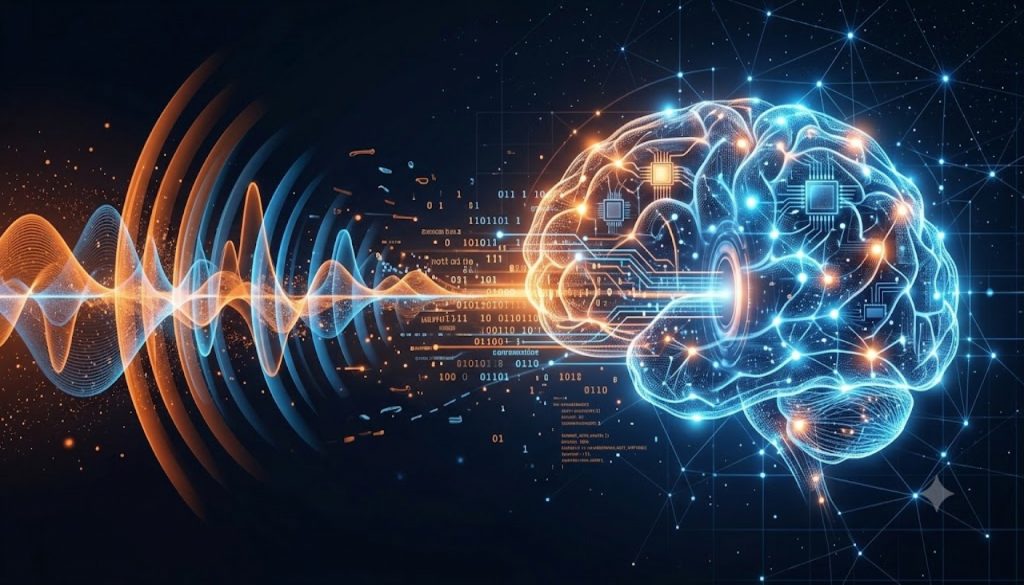
How did humans first pass knowledge to each other?
Not through writing. Not through pictures. Through sound.
Homer sang his epics. Buddhist sutras traveled mouth to ear for generations before anyone wrote them down. The earliest Chinese historical records were called “oral accounts,” not manuscripts. Writing emerged roughly five thousand years ago, but humans have been speaking for at least one hundred thousand years.
Do the math. Ninety-five percent of human communication history happened with voices, not fingers.
Writing came later, and when it arrived, it wasn’t even meant for communication. The first cuneiform tablets were accounting ledgers. How many sheep. How many bags of grain. Writing was storage technology, not expression technology.
Real expression has always belonged to sound.
What Voice Carries, Text Cannot
Say “I’m fine” with three different tones and you get three opposite meanings.
This isn’t a question of rhetoric. It’s information density. Sound carries tone, emotion, rhythm, pauses, breath patterns, pace shifts. Text loses all of that. You can append a “😊” to compensate, but that’s just a low-resolution approximation.
In the 1960s, linguist Albert Mehrabian ran a now-famous experiment. In face-to-face communication, verbal content accounted for only 7% of information transfer. Tone carried 38%. Body language took 55%.
These numbers have been overquoted and criticized as oversimplified. But the direction holds. Pure text is lossy compression.
We’ve grown so used to this compression that we forget it’s a compromise.
Typing Is Humans Adapting to Machines
Step back for a moment and consider how absurd keyboards are.
The most natural human output is speech. An average person speaks 150 words per minute. Typing? Maybe 40 to 80 words per minute. And typing requires translating thoughts into text, then encoding that text one keystroke at a time.
This process isn’t communication. It’s encoding.
Why do we encode? Because machines couldn’t understand human speech.
From typewriters to computer keyboards to smartphone touchscreens, input methods have changed several times. But the essence hasn’t. In every case, humans adapted to machine interfaces. Machines couldn’t process sound, so humans converted sound into text and fed it to machines.
This arrangement lasted about 150 years.
Now, that era is ending.
2025: The Voice AI Threshold
In May 2024, OpenAI released the GPT-4o real-time voice demo. The internet lost its collective mind. In that demo, the AI understood tone. It joked around. It interrupted you mid-sentence. It responded with different emotional registers.
That moment split time. Not because the technology was so advanced, but because it made ordinary people realize something visceral: talking to AI could feel as natural as talking to a person.
Then things accelerated.
In May 2025, Anthropic added voice mode to Claude, rolling it out first on iOS and Android, then expanding to web. That August, OpenAI graduated the Realtime API from beta to production, releasing gpt-realtime, a model trained specifically for voice conversation. They added SIP telephone protocol support, which meant AI could plug directly into corporate phone systems and answer calls like a human customer service rep.
On Google’s side, Gemini Live gained Native Audio capability by late 2025. Users could adjust speech rate, select accents, and experience smoother conversation flow. In March 2026, Google released Gemini 3.1 Flash Live, designed specifically for low-latency real-time voice interaction with audio, video, and tool-calling support.
ElevenLabs launched Eleven v3 in early 2026, leaping from synthetic speech to emotionally weighted conversational voice. Three days ago, ElevenLabs and IBM announced a partnership to integrate voice capabilities into enterprise AI agent platforms.
Anthropic wasn’t idle either. In March 2026, Claude Code began beta testing a voice mode. You could talk to your terminal to write code.
These aren’t scattered product updates. This is an industry-wide convergence. Every major AI company is building voice as a native interaction layer.
The Numbers Tell the Story
The Voice AI market was worth about $3.1 billion in 2024. By 2026, it’s projected to hit $22.5 billion, with a compound annual growth rate of 34.8%.
Forbes reported that in 2025, 60% of smartphone users regularly used voice assistants, jumping from 45% in 2024.
Gartner predicted that by 2026, voice AI would save call centers $80 billion in labor costs.
Behind these numbers sits a simple fact: voice interaction is no longer a future trend. It’s happening right now.
Voice Isn’t Just an Input Method
Many people think of voice AI as “using your mouth instead of a keyboard.”
That understanding is too shallow.
Voice doesn’t change input efficiency. It changes the relationship between humans and AI.
When you type to ChatGPT, your mental model is “I’m using a tool.” When you speak to an AI, your mental model unconsciously shifts to “I’m having a conversation with someone.”
This isn’t an illusion. It’s how human brains are wired. Our social cognition systems are extraordinarily sensitive to sound. When you hear a voice responding to you, your brain automatically activates “social mode,” processing the other party’s emotions, intentions, and attitudes. This system stays dormant during text interaction.
So what voice AI really changes is this: AI transforms from tool to conversation partner.
The impact of this shift runs deeper than most people think. When you treat AI as a tool, you carefully construct prompts, debug them repeatedly, approach it like writing code. When you treat AI as a conversation partner, you talk like you’re chatting with a colleague. You say what comes to mind, think out loud, let the dialogue unfold naturally.
The latter is what humans actually excel at.
Incantations Were Always Meant to Be Spoken
We previously wrote about the connection between ancient incantations and modern prompts, exploring how humans have always done the same thing: used precise language sequences to drive opaque systems, from Daoist talismans to prompt engineering.
One detail from that piece deserves expansion now, because it looks different in hindsight.
Incantations were spoken, not written.
When Daoist priests drew talismans, they recited spells. “Jí jí rú lǜ lìng” was voiced. Egyptian Heka magic centered on “activating power through language,” and that language meant spoken words. Indian mantras required precise pronunciation. One wrong syllable changed the effect. Obviously a sound system, not a text system.
Even the Chinese character for “spell” contains the “mouth” radical.
What does this tell us? In humanity’s earliest practices of driving opaque systems, sound was the native interface. Written versions of spells came later, as documentation of spoken incantations.
When humans first learned to invoke supernatural forces, they used their voices.
Thousands of years later, we’ve completed a long circle. From sound to text to keyboards to touchscreens, and now back to sound.
This isn’t regression. It’s return.
Voice Agents: Beyond Chat
The key development in 2025-2026 isn’t “AI can talk now.” It’s “AI can talk while working.”
OpenAI’s gpt-realtime supports MCP servers, image input, and SIP telephony. This means a voice AI agent can talk to you on the phone while checking your order, viewing screenshots you sent, and operating backend systems.
Google’s Gemini 3.1 Flash Live supports real-time audio, video, and tool calls. You can point your phone camera at something and say “help me figure out how to fix this.” The AI simultaneously sees the image, hears your description, and calls search and knowledge base tools to answer.
This has moved past “voice assistant” territory. This is an agent that can hear, see, and take action. Voice is its primary control interface.
Think about what this resembles.
It resembles directing an intern. You don’t write the intern a detailed prompt document. You just say: “Pull last week’s sales data, make a comparison chart, and send it to the group.”
Voice naturally suits this command-and-execute interaction pattern. Humans have collaborated this way for tens of thousands of years: speak with mouths, work with hands.
What Happens Next
Voice as AI’s native interface will trigger several chain reactions.
First, prompt engineering will bifurcate. Text prompts will become an advanced debugging tool. Daily use will increasingly shift to voice. Most people don’t need to learn command line. The graphical interface suffices.
Second, AI personality will matter more. When interaction happens through voice, the AI’s sound, tone, and speech rhythm directly shape user experience. This is no longer just an engineering problem. It’s a design problem, even an aesthetic problem.
Third, privacy and security challenges will escalate. You can review text prompts carefully before hitting send. Voice happens in real time. Once you’ve spoken, you can’t take it back. And voice data is far more sensitive than text. It contains your voiceprint, emotional state, even health information.
Fourth, and most far-reaching: the boundary between humans and AI will blur. When you spend several hours every day in voice conversation with an AI that understands your tonal habits, emotional patterns, and thought processes, the relationship has moved past “human and tool.”
Is this good or bad? No one knows yet. But it’s happening.
Back to the Beginning
Humans communicated with sound for one hundred thousand years.
Then spent five thousand years inventing writing. Spent one hundred fifty years inventing keyboards. Spent fifty years inventing touchscreens.
Every step was about finding substitutes for sound, because machines couldn’t understand it.
Now machines understand.
So what we’re doing isn’t inventing a new interaction mode. We’re returning to the oldest one.
The only difference is that this time, what’s listening isn’t another human. It’s an intelligent agent whose capability boundaries are still expanding rapidly.
Humanity’s most ancient interface is becoming AI’s most native interface.
That might be the single most important thing to remember about 2026.
Stay updated with our latest AI insights