Why Look for LaunchDarkly Alternatives?
LaunchDarkly dominates the feature flag market, but teams using it often share similar complaints: pricing scales rapidly with MAU and seat counts, easily exceeding $40,000 annually. Feature modules are sold separately, experimentation costs extra, SSO costs extra. Once you’re in, migration becomes difficult, creating classic vendor lock-in.
By 2026, feature flags have become essential infrastructure. Progressive rollouts, gradual releases, A/B testing, kill switches are now standard operating procedures for modern engineering teams. The good news is the market now offers mature alternatives, from open-source self-hosted options to platforms with generous free tiers and specialized experimentation engines.
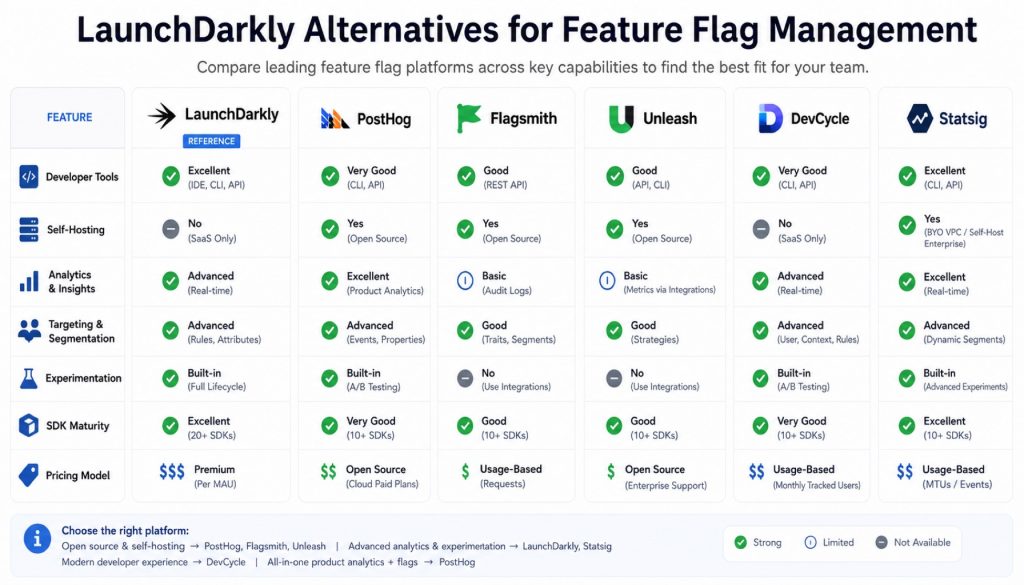
This article examines five compelling LaunchDarkly alternatives: PostHog, Flagsmith, Unleash, DevCycle, and Statsig. We’ll break down pricing, features, deployment options, and ideal use cases to help you find the right fit for your team.
PostHog: All-in-One Analytics and Feature Flags
Core positioning: A “Swiss Army knife” that combines feature flags, product analytics, session replay, and A/B testing in one platform.
PostHog started as an open-source product analytics platform and later integrated feature flags as a core module. The reasoning is straightforward: when you run gradual rollouts, you need to see data. Why not do both in the same place?
Key strengths:
The free tier includes 1M flag requests per month, sufficient for personal projects and small teams. Feature flags integrate natively with product analytics, so you can immediately view conversion funnels and retention curves after enabling a flag. Multivariate testing allows running A/B/C/D comparisons. The platform is open source (MIT license) and can be self-hosted on your infrastructure.
Best for: Teams needing the full stack of feature flags, analytics, and session replay. Particularly valuable for small and mid-sized product teams that prefer not to manage three separate SaaS subscriptions.
Pricing: Free tier includes 1M flag requests/month. Beyond that, usage-based at $0.0001/request. Product analytics, session replay, and other modules are billed separately, so you only pay for what you use. Enterprise starts at $2,000/month (includes SOC 2, HIPAA compliance support).
SDK coverage: JavaScript, React, React Native, Python, Ruby, Go, Node.js, PHP, Java, iOS, Android, Flutter, and 15+ languages/frameworks.
Watch out: PostHog charges based on API requests for flag evaluation. Costs can escalate in high-concurrency scenarios. Local evaluation mode reduces request volume, but each local evaluation counts as 10 requests.
Flagsmith: Open Source, Self-Hosted, Data Stays Home
Core positioning: An open-source platform focused on feature flags and remote config, with zero cost for self-hosting.
Flagsmith follows the “do one thing well” philosophy. Unlike PostHog’s all-in-one approach, Flagsmith focuses squarely on feature flags and remote configuration. Open source, self-hostable, unlimited flags. These three characteristics appeal strongly to teams with strict data privacy requirements.
Key strengths:
Fully open source (BSD 3-Clause). Self-hosted version is free with no feature limitations. All plans support unlimited flags and unlimited environments. Segment-based targeting allows delivering flags based on user attributes. Remote config and feature flags merge into one system, enabling hot configuration updates without redeployment.
Best for: Financial services, healthcare, government teams with high data compliance requirements. Organizations unwilling to store flag data on third-party SaaS platforms. Startups needing legitimate feature flag capabilities on limited budgets.
Pricing:
- Free: 50,000 requests/month, 1 team member, 1 project
- Start-Up: $40/month, 1,000,000 requests/month, 3 team members
- Scale-Up: $50/month+, 5,000,000 requests/month, 5-20 team members
- Enterprise: Custom pricing, includes SAML, on-prem, priority support
- Overage: $7/100k requests
SDK coverage: JavaScript, React, React Native, Python, Ruby, Go, .NET, Java, Node.js, iOS, Android, Flutter, Rust, and 15+ languages.
Watch out: Flagsmith’s A/B testing functionality is relatively basic, lacking a built-in statistical analysis engine. If you need rigorous experiment analysis, you’ll need external tools like Amplitude or Mixpanel.
Unleash: Enterprise-Grade Open Source Feature Toggles
Core positioning: A 10-year-old open-source feature toggle system used by GitLab and NAV (Norwegian Labour and Welfare Administration).
Unleash has been around since 2015, making it the most established open-source solution in this space. With 13,000+ GitHub stars and an active community, it targets enterprise use cases with granular permission management, comprehensive audit logs, and compliance-friendly features.
Key strengths:
The open-source version is feature-complete, self-hosted at zero cost, with no usage limits. Granular permission control (RBAC) plus complete audit logging. Supports gradual rollout (percentage-based releases) and strategy constraints (multi-dimensional condition combinations). Mature kill switch mechanism for one-click rollbacks.
Best for: Mid to large engineering teams, especially those requiring compliance audits (SOC 2, ISO 27001, etc.). Teams that already have analytics tools and just need a clean flag management layer.
Pricing:
- Open Source: $0, self-hosted, feature-complete, unlimited flags
- Pro: $80/month, includes 5 team members, hosted version
- Enterprise: $75/seat/month+ (annual), includes SSO, custom roles, SLA
SDK coverage: JavaScript, React, Node.js, Java, Go, Python, Ruby, .NET, PHP, Swift, Kotlin, Rust, C++, and 15+ languages.
Watch out: Unleash uses a polling architecture, so flag changes propagate with a few seconds of delay (default 15s polling interval), not real-time push. It also lacks built-in experimentation or statistical analysis, focusing purely on flag management. The open-source Edge component will be deprecated in December 2026, so watch for migration requirements.
DevCycle: Developer Experience First, Performance Maxed
Core positioning: The first OpenFeature-native feature flag platform, with edge computing architecture and SDK latency under 1ms.
DevCycle stands out as the most developer-friendly option. It’s the first and currently only OpenFeature-native platform, meaning you use an open standard and avoid vendor lock-in. The architecture leverages edge computing with local bucketing, so flag evaluation happens directly on the client side with minimal latency.
Key strengths:
Native OpenFeature support with all SDKs including built-in OpenFeature providers. Local bucketing architecture means flag evaluation happens SDK-side without round-trips to the server. Real-time flag updates (push-based, not polling). Complete tooling including VS Code plugin, CLI tools, Terraform Provider, and GitHub Actions integration. Built-in stale flag detection automatically reminds you to clean up unused flags.
Best for: Teams prioritizing extreme performance (gaming, real-time communication, high-frequency trading frontends). Heavy CI/CD users. Organizations wanting to avoid vendor lock-in and embrace open standards.
Pricing:
- Free: $0, 1,000 client-side MAU, unlimited flags/seats/environments
- Business: $500/month (annual), 100,000 MAU, 500,000 events/month
- Enterprise: Custom pricing
SDK coverage: JavaScript, React, Next.js, Node.js, Python, Go, Ruby, Java, .NET, iOS, Android, React Native, Flutter, Roku, and 14+ platforms.
Watch out: The free tier’s 1,000 MAU limit is restrictive. If your product has meaningful user traction, you’ll need to upgrade quickly. Also, DevCycle was acquired by Dynatrace in 2025, which may influence long-term product direction.
Statsig: Experimentation-Driven with Built-in Statistics
Core positioning: Born from Facebook’s experimentation platform philosophy, combining feature flags, experiment analysis, and product analytics.
Statsig’s founding team came from Facebook, productizing the big-tech approach of “every feature is an experiment.” Its standout characteristic: flag evaluation is completely free and unlimited. You only pay for analytics events. This means you can create flags freely without worrying about the bill.
Key strengths:
Unlimited free feature flag evaluation (all plans), billing based on analytics events. Built-in statistical analysis engine with CUPED variance reduction, sequential testing, and automatic statistical significance detection. Holdout group support quantifies long-term cumulative impact of your overall experimentation program. Warehouse-native deployment option keeps data in your own Snowflake or BigQuery. Partnership with OpenAI in 2025, team expanded to 170+ people.
Best for: Data-driven product teams running 50+ experiments annually. Teams needing rigorous statistical methods (beyond just p-values). High-traffic applications wanting predictable flag management costs.
Pricing:
- Free: $0/month, unlimited flag checks, limited event quota
- Pro: $150/month, event-based or experiment-based contracts
- Enterprise: Custom pricing, includes warehouse-native, advanced permissions
SDK coverage: JavaScript, React, React Native, Node.js, Python, Go, Ruby, Java/.NET, Swift, Kotlin, C++, Rust, PHP, and 15+ languages.
Watch out: Statsig’s billing is events-based. If your product has dense instrumentation (like e-commerce tracking every click), events can accumulate rapidly. The free tier only retains data for 1 year.
Comparison Table
| Dimension | PostHog | Flagsmith | Unleash | DevCycle | Statsig |
|---|---|---|---|---|---|
| Free Tier | 1M flag requests/month | 50K requests/month | Unlimited (self-hosted) | 1,000 MAU | Unlimited flag checks |
| Paid Starting | Usage-based | $40/month | $80/month | $500/month | $150/month |
| Deployment | Cloud / Self-hosted | Cloud / Self-hosted | Cloud / Self-hosted | Cloud only | Cloud / Warehouse-native |
| SDK Languages | 15+ | 15+ | 15+ | 14+ | 15+ |
| Targeting | ✅ | ✅ | ✅ | ✅ | ✅ |
| A/B Testing | ✅ Built-in stats | ⚠️ Basic | ❌ Needs external | ✅ | ✅ Built-in stats |
| Remote Config | ✅ | ✅ | ✅ | ✅ | ✅ |
| SSO/SAML | Enterprise | Enterprise | Enterprise | Enterprise | Enterprise |
| Audit Logs | ✅ | Scale-Up+ | ✅ | ✅ | ✅ |
| RBAC | ✅ | Scale-Up+ | Pro+ | Business+ | Pro+ |
| OpenFeature | Provider support | Provider support | Provider support | Native | Provider support |
| Open Source | ✅ MIT | ✅ BSD-3 | ✅ Apache-2.0 | SDK open | ❌ |
Which One Fits Your Team?
Tight budget + need analytics → PostHog
1M free flag requests plus built-in product analytics means small teams can run at zero cost. Flags and data in the same interface eliminates integration overhead.
Data compliance first → Flagsmith or Unleash self-hosted
Data stays on your servers, audit logs are comprehensive, suitable for financial, healthcare, and government projects. Flagsmith is simpler to start, Unleash has more complete enterprise features.
Performance critical + embrace open standards → DevCycle
Local bucketing plus edge architecture delivers millisecond-level flag evaluation. Native OpenFeature support means you can switch vendors anytime.
Experimentation culture, data-driven → Statsig
The built-in statistical engine is the killer feature. CUPED, sequential testing, holdout groups are either absent in other platforms or require building yourself. Free flag checks is remarkably generous.
Quick start, no hassle → Flagsmith Cloud
Starts at $40/month, intuitive interface, does two things well: flags and remote config. No complex concepts to learn.
Related Reading
- Best LaunchDarkly Alternatives in 2026: PostHog vs Flagsmith vs Unleash vs DevCycle vs Statsig
- Best LaunchDarkly Alternatives in 2026: PostHog vs Flagsmith vs Unleash vs DevCycle vs Statsig
Stay updated with our latest AI insights