When most people decide to build an AI agent, their first instinct is to grab the most powerful model and a tool that looks agent-y, then get started.
The problem is, when they actually begin building, most people don’t get stuck on the model. They get stuck on something else: how to build the execution layer.
Once you have multiple tools in the mix, this question becomes messy fast. MCP, Zapier, and n8n often show up in the same conversation, but they’re not solving the same problem. If you try to compare a protocol, a connector layer, and a workflow engine side by side, you’ll only get more confused.
This article answers one question: in 2026, if you want to move AI from “can talk” to “can do,” which layer should you build first?
TL;DR
- MCP is not an automation platform. It’s a protocol that standardizes how AI connects to tools and data sources.
- Zapier is closer to a connector layer. Its strength is quickly plugging existing AI into thousands of SaaS apps.
- n8n is closer to a workflow engine. Its strength is orchestrating multi-step logic, state management, branching, and automation end-to-end.
- Want to quickly get Claude or ChatGPT connected to apps and doing real work? Start with Zapier.
- Want to build a scalable agent system for the long term? n8n is more stable.
- Want to understand why the agent ecosystem is about to speed up? You need to learn MCP, but it won’t replace Zapier or n8n directly.
Start by separating the three layers: you think you’re comparing tools, but you’re actually comparing architecture layers
When people discuss AI agent execution layers, they often ask: “Should I use MCP, Zapier, or n8n?”
This question has a built-in problem.
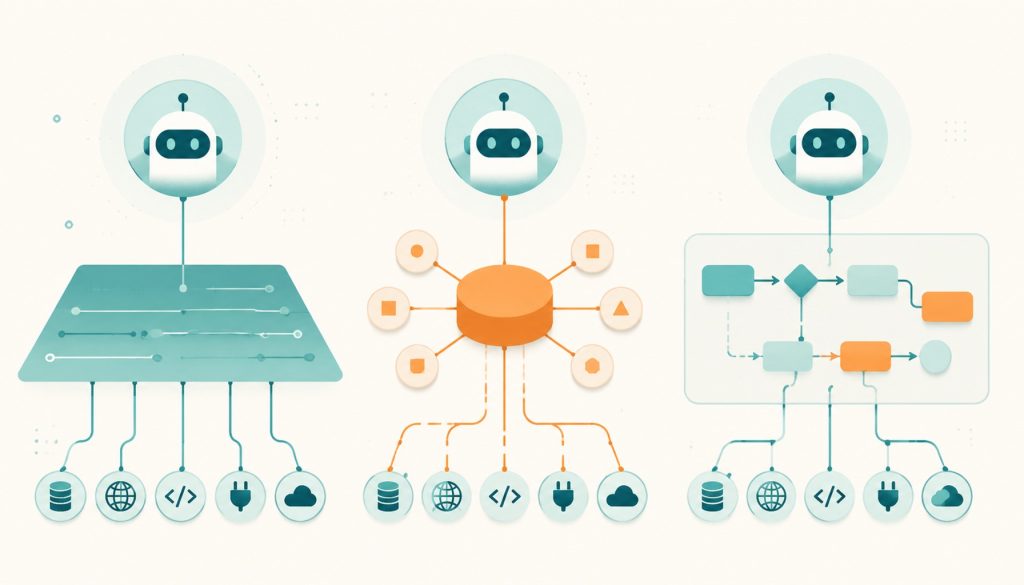
These three tools correspond to three different things:
| Name | What it actually is | What problem it solves | Better analogy |
|---|---|---|---|
| MCP | Protocol / standard | How AI uniformly connects to external tools and data | USB-C for the AI world |
| Zapier | Tool connector layer | How to quickly connect existing AI to SaaS apps | Large-scale integration middleware |
| n8n | Workflow engine | Multi-step flows, logic branches, state control, automation orchestration | Orchestratable automation system |
This is why so many people step on landmines early.
If what you really need is tool connectivity, but you start building an entire workflow system, of course it will feel too heavy.
If what you really need is complex orchestration, but you only build a connector layer, you’ll quickly realize that “AI is connected to tools, but execution still isn’t stable.”
So the first step isn’t picking a product. The first step is asking: which layer are you actually missing?
MCP: it’s making AI tool integration standardized
The reason MCP keeps coming up isn’t because it can directly run your business logic. It’s because it solves a long-standing, annoying foundational problem:
Every model, every agent, every tool requires custom adapter code.
Without a protocol, when AI needs to connect to different systems, you typically need to build a separate integration for each target. When the model changes, the framework changes, or the tool changes, much of the work has to be redone.
MCP’s value is that it provides a more unified interface layer for “AI connecting to tools.” You can think of it this way:
- Tool providers expose MCP servers
- Agents or clients call them through a unified protocol
- Models don’t need to learn a new “proprietary connection method” for every tool
Why MCP matters
Because it will significantly lower the friction of connecting tools in the agent ecosystem.
Before, when people talked about AI tool calling, it often felt like stacking proprietary plugins. Now, MCP is standardizing how “tools expose capabilities to agents.”
This creates two outcomes:
First, more tools will be willing to build standardized integrations.
Second, more agent frameworks will more easily share the same set of tool capabilities.
But MCP is not an automation platform
This point needs to be stressed repeatedly.
Many people hear about MCP and immediately think: does this mean I don’t need Zapier or n8n anymore?
No.
MCP solves “how to connect,” not “how to orchestrate.”
It won’t automatically decide for you:
- Which step to query first
- What to do when an exception occurs
- Which step needs human confirmation
- How to handle retries, timeouts, approvals, or branches
- How to turn a single action into a stable workflow
So no matter how important MCP is, it’s more like a low-level connectivity standard, not a complete execution system.
Zapier: if what you want most is “get AI connected to apps and doing work right now”
Zapier’s value has actually become clearer in the AI era.
Because many users don’t want to study agent architecture. What they want is:
Can Claude connect to Gmail? Can ChatGPT write calendar events? Can AI query a CRM, push to Slack, or write to a spreadsheet? Can I get a demo running tonight?
For this use case, Zapier is strong. It’s essentially a mature app connector layer. In the past, it mainly served traditional automation. Now it’s extending toward AI tool use, catching a new wave of demand at the right time.
Zapier’s strongest point: speed
If your goal is quick validation, such as AI helping you organize customer information then sending emails, AI creating tasks based on messages, AI querying multiple SaaS data sources then generating drafts, or AI triggering real tool actions during a conversation, then Zapier is often the shortest path.
You don’t need to figure out what the entire agent operating system looks like first. You connect real tools first, and business value starts appearing.
Zapier’s trade-offs
But its limitations are also clear.
If what you want to do later includes very complex multi-step logic, more granular error handling, stronger state control, or deeper custom node integration with internal systems, you’ll gradually realize that connecting apps and orchestrating systems are not the same thing.
Zapier is great for getting AI into the real world, but it may not be ideal for orchestrating the real world into a long-term stable execution engine.
So it’s more like getting your agent on the road, not necessarily the best chassis for the long haul.
n8n: if you want to build a system, not a one-off demo
n8n sits in a different position.
It doesn’t start by solving “how many apps can AI connect to.” It starts by solving this: how does a real task chain get organized, judged, routed, logged, validated, and executed through to completion?
This makes it look heavier, but also more like long-term infrastructure.
What scenarios fit n8n better
You don’t just want AI to call one tool. You want to string together multi-step flows.
You need webhooks, databases, queues, approvals, human confirmation, and conditional branches.
You want to settle things into reusable templates that can later be reused by your team or clients.
You want to control costs, or even consider self-hosting.
Once these needs appear, n8n’s advantages become clearer and clearer.
Because it’s inherently a workflow engine, not just a tool marketplace entry point.
The real barrier to n8n
Many people think the barrier to n8n is “can you drag nodes around?”
Actually, no. The real barrier is: do you have a workflow mindset?
In other words, can you think clearly about which step should be decided by the model, which step is better with plain logic, when you must add human confirmation, how to roll back from exceptions, and how to prevent the agent from running wild?
n8n’s strongest point isn’t “being like an agent.” It’s “being able to put an agent inside a controllable system.” For things that need to go live, this matters more than a one-off demo.
Which layer should you build first? It depends on which stage you’re stuck at
Stage one: you’re still validating whether “AI connected to tools” has value
Start with a connector layer like Zapier.
Because what matters most at this stage isn’t system elegance. It’s seeing as quickly as possible whether AI can actually operate business tools, whether users will pay for it, and which types of tasks are most suitable for agents to take over.
The lighter, the better at this step.
Stage two: you’ve discovered value, but processes are getting complex
Start building in a workflow engine like n8n.
Because what you’ll encounter next won’t be “can I connect?” but rather: how do I execute stably, how do I control branches and exceptions, how do I settle experience into reusable flows, and how do I make the entire system not rely on someone’s memory?
At this step, workflow design capability becomes more important than “connecting a few more apps.”
Stage three: you’re starting to care about portability and ecosystem standards
You must learn MCP.
Because as more and more tools in the agent ecosystem expose capabilities through standardization, whoever understands the protocol layer earlier will more easily write less repetitive adapter code, connect to more tools faster, and avoid being locked into one proprietary platform.
But again, MCP is foundational understanding you need to build up, not something you should use tonight to replace all orchestration tools.
A more practical combined answer: often it’s not pick one of three, but layer them together
A solid agent execution stack often doesn’t mean betting on one name. It means layering them:
MCP handles making tool capability exposure more standard. Zapier handles quickly connecting to a large number of existing SaaS apps. n8n handles orchestrating complex flows and state.
This sounds like “want everything,” but it’s not saying you should deploy all of them on day one. It’s reminding you that the execution layer isn’t a single-tool problem. It’s an architectural division-of-labor problem.
If you’re just validating today, don’t build the system too heavy from the start. If you’re ready to go live and settle things down, don’t mistake the connector layer for the final chassis. If you want to build long-term agent capability, don’t ignore the reuse value that protocol standards bring.
Conclusion: stop comparing protocol, connector layer, and workflow engine side by side
MCP, Zapier, and n8n appear in the same conversation because they’re all answering “how does AI do things.”
But they’re answering different layers of that question.
MCP answers “how to connect uniformly.” Zapier answers “how to quickly plug into the app world.” n8n answers “how to orchestrate things stably through to completion.”
So the most solid answer to this question often isn’t which one wins. It’s which one is closest to your current real bottleneck.
If you pick the right layer, building the execution layer gets smoother and smoother. If you pick the wrong layer from the start, it only gets messier and messier.
Moving AI agents from talk to action has never been about finding a smarter model. It’s about separating the execution layers clearly, connecting them stably, and orchestrating them smoothly.
FAQ
1. Are MCP, Zapier, and n8n the same type of product?
No. MCP is a protocol, Zapier is closer to a tool connector layer, and n8n is closer to a workflow engine. The three are not in the same layer.
2. If I want Claude or ChatGPT quickly connected to business tools, which should I look at first?
Prioritize a connector layer like Zapier, because it’s best suited for quickly plugging existing AI into a large number of SaaS applications.
3. If I want to build more complex, reusable AI agent workflows, which is more suitable?
n8n is more suitable, because it excels at multi-step flows, logic branching, state control, and scalable automation orchestration.
4. Why is MCP worth learning?
Because it standardizes AI tool calling. Understanding MCP helps reduce repetitive adapter work and makes it less likely you’ll get locked into one proprietary platform.
Related reading
- Free AI Agent Tools in 2026: n8n vs Zapier MCP vs Lindy
- AI Workflow Automation Tools Compared: Gumloop vs Zapier AI vs n8n AI vs Make AI in 2026
- The Execution Layer Is the Next Competitive Divide in Software
- AI Agents Are Replacing Apps: From Chatbots to Autonomous Execution in 2026
- The People Who Know How to Build Agent Workflows Are Becoming the Most Valuable Employees in Their Companies
Stay updated with our latest AI insights