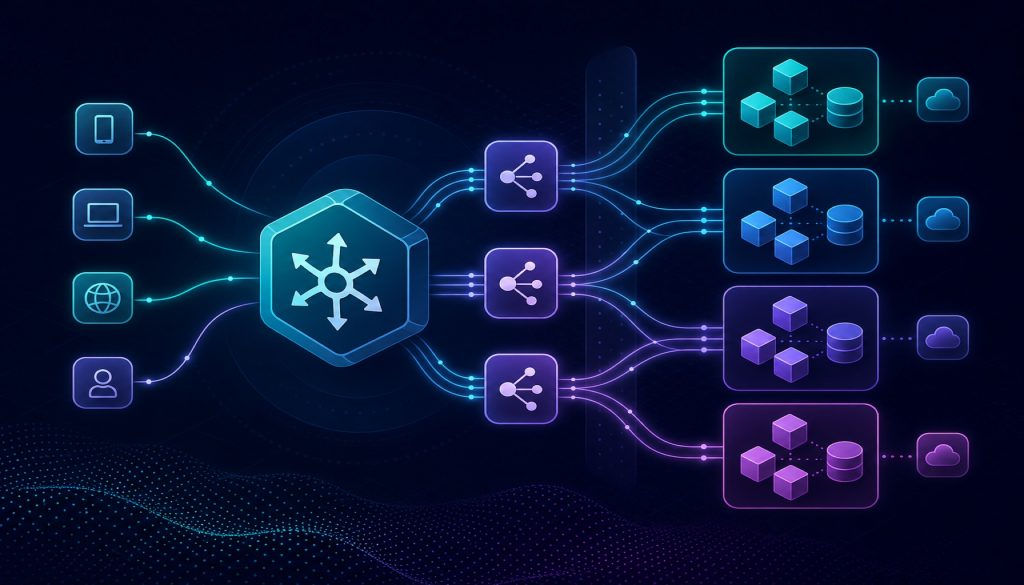
Once you split a monolith into 20+ services, the first pain point hits fast: unified routing, auth, rate limiting, and observability at the edge. Writing that logic into every service is a maintenance nightmare. An API gateway centralizes these cross-cutting concerns at the ingress layer so your backend teams can ship features instead of reimplementing JWT validation for the fifteenth time.
In 2026, three self-hosted gateways dominate the conversation for platform teams running Kubernetes or hybrid infrastructure: Kong, Tyk, and Traefik. Each takes a different architectural approach, optimizes for a different workflow, and prices its enterprise tier differently. This article breaks down real-world performance numbers, plugin ecosystems, operational trade-offs, and a decision framework so you can pick the right tool without a three-month proof of concept.
Kong: The Plugin Powerhouse
Kong is built on Nginx and OpenResty (LuaJIT). It shipped as open source in 2015 and has accumulated the largest plugin ecosystem in the API gateway space: over 300 plugins covering authentication (OAuth2, JWT, LDAP, mTLS), traffic control (sliding window rate limiting with Redis cluster backing), observability (Prometheus, Datadog, Splunk, OpenTelemetry), and request/response transformation.
Where Kong Wins
The plugin library is Kong’s moat. Need Prometheus metrics? Enable the prometheus plugin and get per-route latency histograms, status code counters, and upstream health stats with zero custom code. Need canary releases? The canary plugin splits traffic by weight percentage. Need request body transformation before it hits your upstream? request-transformer handles field renaming, header injection, and query parameter manipulation declaratively.
Community support is strong. GitHub issues get responses within 24 hours for most questions, and Kong’s documentation covers edge cases that smaller projects skip entirely.
Performance Profile
On an 8 vCPU / 16GB RAM instance (AWS c5.2xlarge), Kong handles approximately 9,000 requests per second with a p50 latency of 5.2ms. Memory consumption sits around 500MB with 100 configured routes. The Nginx foundation gives it solid connection handling under sustained load, but the Lua plugin execution layer adds overhead compared to pure Go implementations.
Pricing
- Open source (Kong Gateway OSS): Free, Apache 2.0 license
- Kong Enterprise: Starting at $3,000/month, includes RBAC, developer portal, advanced analytics, audit logging, and multi-tenant workspace isolation
Operational Considerations
Kong stores configuration in PostgreSQL or Cassandra by default. If your database goes down, your gateway stops accepting config changes (existing routes continue working from cache). High availability requires database replication and failover automation.
DB-less mode (declarative YAML config) eliminates the database dependency but sacrifices dynamic configuration. Every change requires a service reload. For teams running GitOps pipelines, this trade-off is acceptable. For teams that need real-time route manipulation via Admin API, it is not.
Memory usage is the other consideration. At 500MB per instance for 100 routes, Kong is the heaviest option in this comparison. Budget accordingly for your node sizing.
Best Fit
Organizations with dedicated platform engineering teams (5+ engineers), diverse API requirements across many services, and existing PostgreSQL infrastructure. If your team has three people total, Kong’s operational overhead will consume most of your engineering bandwidth.
Tyk: Performance Meets Developer Experience
Tyk is written in Go, which gives it a single-binary deployment model and better per-core throughput than Kong’s Lua/Nginx stack. Official benchmarks show 12,000 requests per second on the same 8 vCPU test environment where Kong hits 9,000. Memory footprint is 300MB for 100 routes.
Where Tyk Wins
The built-in developer portal is Tyk’s differentiator for B2B SaaS companies. It generates API documentation from your OpenAPI specs, handles API key provisioning with self-service signup, and tracks usage per consumer. If you sell an API product or expose partner integrations, Tyk saves you from building a custom management portal.
The Dashboard UI covers API creation, version management, analytics dashboards, and policy configuration in a single interface. Rate limiting supports Redis Sentinel and Redis Cluster backends for high-availability counting at scale.
Tyk also ships native GraphQL federation support and WebSocket proxying, which positions it well for modern API architectures beyond REST.
Pricing
- Open source (Tyk Gateway): Free, MPL 2.0 license
- Tyk Cloud: Starting at $250/month (fully managed, includes dashboard and portal)
- Tyk Enterprise (self-managed): Starting at $1,500/month (multi-datacenter, RBAC, custom plugins)
At roughly half the cost of Kong Enterprise for comparable features, Tyk offers strong value for mid-market SaaS companies.
Operational Considerations
The plugin ecosystem is smaller than Kong’s. Custom plugins require Go code or the gRPC plugin protocol (supporting Python and Node.js runtimes). Debugging gRPC-based plugins adds complexity compared to Kong’s Lua plugins, which run in-process.
GraphQL federation works for straightforward schemas but lacks the query optimization maturity of dedicated solutions like Apollo Router for complex nested queries with high cardinality.
Best Fit
Teams with Go expertise building B2B SaaS products that need developer-facing API portals. Mid-to-high concurrency workloads (10K+ RPS) where Kong’s memory overhead is unacceptable. Companies that want a single tool covering gateway + portal + analytics without stitching together three separate projects.
Traefik: Cloud-Native Automation
Traefik was built for the container era. It integrates directly with Kubernetes, Docker Swarm, Consul, and other service registries through providers. Add an annotation or IngressRoute CRD to your Kubernetes Service, and Traefik picks it up automatically. No manual route configuration. No Admin API calls. Service goes down, route gets removed. Service scales up, new endpoints join the load balancer pool.
Where Traefik Wins
Automatic service discovery is the killer feature. In a Kubernetes cluster where teams deploy 10 new services per week, Traefik eliminates the gateway configuration bottleneck entirely. Platform teams define middleware chains (auth, rate limiting, headers) once, and application teams reference them in their annotations.
Let’s Encrypt integration handles TLS certificate provisioning and renewal automatically. For organizations managing hundreds of domains or subdomains, this removes an entire operational workflow.
Multi-protocol support (HTTP, TCP, UDP, gRPC) with native HTTP/2 and WebSocket handling covers modern service communication patterns out of the box. The real-time dashboard displays the full routing topology, making debugging straightforward during incidents.
Performance Profile
Traefik achieves approximately 11,000 requests per second on the standard 8 vCPU benchmark with a p50 latency of 4.1ms. Memory consumption is 150MB for 100 routes, making it the second lightest option after KrakenD.
Pricing
- Open source (Traefik Proxy): Free, MIT license
- Traefik Enterprise: Starting at $3,000/month (distributed rate limiting, API management, advanced monitoring, RBAC)
The open source version is production-ready for most Kubernetes deployments. Enterprise pricing targets large organizations needing cross-cluster coordination and compliance features.
Operational Considerations
Enterprise-grade features are thin in the open-source edition. Fine-grained RBAC, audit logging, and advanced rate limiting all require the paid tier. Middleware-based rate limiting configuration is more verbose than Kong’s single-plugin approach.
If you run services on virtual machines without container orchestration, Traefik’s core value proposition (automatic discovery) does not apply. In that scenario, Kong or Tyk will serve you better.
Best Fit
Kubernetes-native organizations with frequent service deployments and lean platform teams (2-4 engineers). Environments where reducing manual configuration is worth more than maximum plugin flexibility.
Comparison Table
| Dimension | Kong | Tyk | Traefik |
|---|---|---|---|
| Language | Lua/C (Nginx + OpenResty) | Go | Go |
| Open-source license | Apache 2.0 | MPL 2.0 | MIT |
| Throughput (8 vCPU) | ~9,000 RPS | ~12,000 RPS | ~11,000 RPS |
| P50 latency | 5.2ms | 3.8ms | 4.1ms |
| Memory (100 routes) | 500MB | 300MB | 150MB |
| Plugin count | 300+ | ~80 | ~30 middleware |
| Custom plugin language | Lua, Go, Python, JS | Go, gRPC (Python/Node) | Go (compiled middleware) |
| Developer portal | Enterprise only | Built-in (OSS dashboard, full portal in Cloud/Enterprise) | No |
| Service discovery | Manual / DNS | Manual / DNS | Native K8s, Docker, Consul |
| Auto TLS (Let’s Encrypt) | Plugin | Manual/external | Built-in |
| GraphQL support | Plugin (basic) | Native federation | No |
| Config storage | PostgreSQL/Cassandra or declarative YAML | Redis + MongoDB (or file) | Kubernetes CRDs / file |
| Enterprise starting price | $3,000/month | $1,500/month | $3,000/month |
| Best for | Complex plugin requirements | B2B API products, mid-market SaaS | Kubernetes-native, high deployment velocity |
Decision Framework
Choose Kong when:
- You need 10+ different plugin capabilities across your API surface
- Your organization already operates PostgreSQL clusters
- Custom Lua scripting for edge logic is a requirement
- You need the largest community and most Stack Overflow answers
Choose Tyk when:
- You sell or expose APIs to external developers/partners
- Your team writes Go and wants to extend the gateway natively
- Budget matters (enterprise tier is half the cost of Kong/Traefik)
- You need GraphQL federation at the gateway layer
Choose Traefik when:
- You run Kubernetes and want zero-touch route management
- Your team is small and cannot maintain a separate config database
- Services deploy and scale multiple times per day
- You need the lowest memory footprint per gateway instance
Skip self-hosted gateways entirely when:
- Your entire backend runs on AWS Lambda/ECS with no multi-cloud plans
- Your team has zero infrastructure experience
- Monthly request volume stays below 10 million (AWS API Gateway at $1/million requests costs less than operating any self-hosted solution)
FAQ
Q: Can I run Kong in DB-less mode to avoid the PostgreSQL dependency?
Yes. Kong’s declarative configuration mode reads a YAML file at startup and operates without a database. The trade-off: you lose the Admin API for dynamic changes. Every configuration update requires regenerating the YAML and reloading the service. Teams using GitOps (ArgoCD, Flux) find this acceptable because config changes already go through pull requests. Teams that need instant route manipulation via API should keep the database.
Q: How does Tyk handle rate limiting at scale across multiple gateway instances?
Tyk uses Redis as a distributed counter store. It supports both Redis Sentinel (for automatic failover) and Redis Cluster (for horizontal scaling). Rate limit counters are shared across all gateway instances in real time. At 50K+ RPS, the Redis round-trip adds 1-2ms to request latency. For extreme throughput requirements, Tyk offers a local rate limiter that trades accuracy for speed by syncing counts asynchronously.
Q: Is Traefik production-ready without the Enterprise license?
For most Kubernetes deployments, yes. The open-source version handles routing, load balancing, TLS termination, circuit breakers, retries, and basic middleware chains. You hit the enterprise paywall when you need distributed rate limiting across multiple clusters, advanced RBAC for multi-team gateway access, or SLA-backed support. Organizations running a single cluster with fewer than 200 services rarely need the paid tier.
Q: What about KrakenD for pure performance requirements?
KrakenD deserves mention for latency-critical workloads. It achieves 50,000 RPS with 1.2ms p50 latency on the same benchmark hardware, using only 100MB of memory. The catch: all configuration is static JSON (changes require restart), there is no management UI, and custom plugins require recompiling the binary. KrakenD fits when your routes are stable and throughput is the primary constraint (gaming backends, IoT ingestion, financial data feeds).
Q: How do migration costs compare if I pick wrong?
Gateway migration is expensive regardless of direction. Plan for 2-4 weeks of engineering time to rewrite plugin logic, update CI/CD pipelines, migrate rate limiting state, and validate routing rules. The highest migration cost comes from Kong to anything else due to Lua plugin rewrites. Tyk-to-Traefik migrations are lighter because both use Go and declarative config. Invest one week in a proof of concept with your actual traffic patterns before committing.
Conclusion
Kong owns the plugin ecosystem but charges you in memory and operational complexity. Tyk delivers the best balance of performance, developer experience, and price for B2B SaaS teams that expose APIs externally. Traefik eliminates configuration toil in Kubernetes environments where services deploy and scale continuously.
Run the open-source version of your top candidate against production-like traffic for two weeks before signing an enterprise contract. API gateways sit in the critical path of every request. The switching cost after six months of accumulated configuration is high enough that an extra week of evaluation pays for itself many times over.
Pick based on your team’s operational capacity, not the feature comparison table. A gateway your team can operate confidently at 3 AM during an incident is worth more than one with 200 extra plugins nobody configured.
TITLE: Best API Gateway for Microservices in 2026: Kong vs Tyk vs Traefik | SLUG: best-api-gateway-microservices-kong-tyk-traefik-2026 | SEO_TITLE: Best API Gateway 2026: Kong vs Tyk vs Traefik Compared | SEO_DESC: Compare Kong, Tyk, and Traefik API gateways for microservices. Performance benchmarks, pricing, plugin ecosystems, and a decision framework for platform engineers. | SEO_KW: best API gateway for microservices | CATEGORY: comparisons
Related Reading
- API Gateways for Microservices in 2026: Kong, Tyk, KrakenD, Traefik, and AWS Compared
- Best API Gateway for Microservices: Kong vs Tyk vs Traefik in 2026
Stay updated with our latest AI insights