Spacelift is an Infrastructure as Code orchestration platform supporting Terraform, OpenTofu, Pulumi, and other tools. It provides policy-as-code, drift detection, and workflow automation. However, its pricing model charges based on concurrent workers, starting at $250 per month for Starter Plus. Governance features like SSO and audit logs remain locked in Enterprise tiers, pushing many teams to explore alternatives.
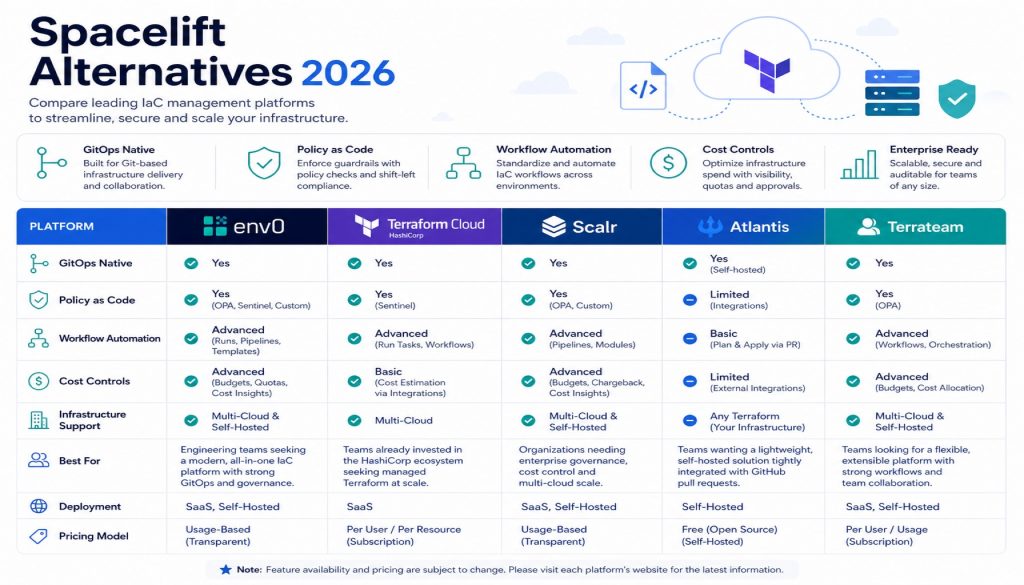
This guide compares five Spacelift alternatives: env0, Terraform Cloud (HCP Terraform), Scalr, Atlantis, and Terrateam. We’ll examine pricing models, core features, and use cases to help you find the right fit for your team size and budget.
Quick comparison overview
| Tool | Pricing model | Starting price | Core differentiator | Best for | Open source |
|---|---|---|---|---|---|
| env0 | Per Apply/environment | ~$1,500/month (100 envs) | Cost management + FinOps integration | Mid-to-large teams focused on cloud cost control | No |
| Terraform Cloud | Per managed resource | $0.10/resource/month (Essentials) | Native HashiCorp ecosystem | Pure Terraform teams | No |
| Scalr | Per Run | Free 50 runs/month, $0.99/run after | Enterprise governance + TFC replacement | Mid-sized teams migrating from TFC | No |
| Atlantis | Free self-hosted | $0 (requires operations) | PR-driven, highly flexible | Small teams with operations capacity | Yes (Apache 2.0) |
| Terrateam | Free community + paid | $0+, Enterprise $1,087.50/month | GitOps native, zero configuration | Small to mid-sized, GitHub power users | Yes (MPL-2.0) |
Detailed evaluation
1. env0: Cost management leader for IaC platforms
env0 (now branded as env zero) is Spacelift’s most direct competitor with similar feature coverage, but it goes further on cloud cost management.
Core features:
Built-in FinOps tools automatically track cost changes for each deployment and integrate with third-party cost platforms like CloudHealth and Cloudability. Drift management includes a complete cycle: detection, root cause analysis, and automatic remediation (updating cloud or updating code), not just alerts. A self-service portal lets non-engineers initiate deployments through templates while the platform handles approval and policy checks. Supports Terraform, OpenTofu, Pulumi, Terragrunt, CloudFormation, and Kubernetes.
Who should use it: Mid-to-large teams managing 50+ environments, especially organizations needing to report IaC costs to leadership. If your pain point is “can’t articulate how much infrastructure costs increased,” env0 is the most targeted solution.
Pricing: Charges based on successful Applies or active environments. Cloud Navigator starts around $1,500 per month for 100 active environments with unlimited users and concurrent runs. Cloud Voyager (premium) requires contacting sales and adds AI analysis and advanced drift remediation.
Pros: Cost visualization is genuine differentiation; not charging per resource makes large-scale deployment costs predictable.
Cons: Entry price is steep; teams under 10 people can’t justify it; UI learning curve is slightly steeper than Spacelift.
2. Terraform Cloud (HCP Terraform): Official product with ecosystem lock-in
After IBM acquired HashiCorp in 2026, Terraform Cloud was renamed HCP Terraform. The pricing model shifted from per-workspace to per-managed-resource. The free tier was drastically reduced on March 31, 2026, keeping only a 500-resource ceiling.
Core features:
Native Terraform integration provides seamless access to Registry, Provider, and Module ecosystems. Sentinel and OPA policy engines offer built-in compliance checks starting at the Standard tier. Remote state management uses the official backend with best-in-class stability and compatibility. Run Tasks embed third-party checks (security scanning, cost estimation) into workflows.
Who should use it: Pure Terraform stack teams with resource counts under 2,000. Beyond that scale, bills grow quickly.
Pricing: Charges based on peak managed resources: Essentials $0.10 per resource per month, Standard $0.47, Premium $0.99. A team managing 5,000 resources pays approximately $2,350 monthly at the Standard tier.
Pros: Tightest coupling with Terraform ecosystem; rich documentation and community resources; zero-configuration state management.
Cons: Per-resource billing means “more resources equals higher cost” even if resources haven’t changed in months; shrunken free tier forces small teams to pay; doesn’t support Pulumi, CloudFormation, or other non-HCL tools.
3. Scalr: Enterprise governance and TFC replacement
Scalr positions itself as a “Terraform Cloud replacement,” supporting direct import of TFC workspaces and state files with minimal migration cost. It charges per Run, so more resources don’t increase costs.
Core features:
Hierarchical governance model uses three-level permission inheritance: Account → Environment → Workspace, suitable for multi-team organizations. TFC-compatible API means nearly all TFC CLI and API calls can point to Scalr without code changes. OPA policy engine is built-in and available at all tiers, unlike TFC which locks it behind premium plans. SAML and SSO come free, avoiding “SSO tax.”
Who should use it: Mid-sized teams (20-100 person engineering organizations) currently using Terraform Cloud but unhappy with billing or feature locks. Smoothest migration path.
Pricing: Free for 50 runs per month; $0.99 per run after that, with volume discounts. Users, workspaces, managed resources, and Private Agents all free. A team running 200 applies monthly pays approximately $150 per month.
Pros: Transparent pricing with predictable bills; nearly zero friction migrating from TFC; governance features not tier-locked.
Cons: Only supports Terraform and OpenTofu, not Pulumi or Kubernetes; smaller community than Spacelift; drift detection capabilities are relatively basic.
4. Atlantis: Open-source self-hosted, PR-driven
Atlantis is a CNCF Sandbox project, fully open source and self-hosted. It does one thing well: listens to GitHub/GitLab/Bitbucket PR webhooks, automatically runs terraform plan, posts results in PR comments, and executes deployment when receiving an atlantis apply command.
Core features:
Completely free under Apache 2.0 license with no paid tiers. PR comment-driven workflow using atlantis plan and atlantis apply keeps developers in their Git workflow. Highly customizable through atlantis.yaml and custom workflows that can embed arbitrary scripts. Supports GitHub, GitLab, Bitbucket, and Azure DevOps.
Who should use it: Engineering teams of 5 to 15 people with Kubernetes or VM operations capacity, limited budget but automation requirements.
Pricing: $0. Your cost is operations overhead: servers, TLS certificates, webhook security configuration, and version upgrades all require self-management.
Pros: Zero licensing fees; complete code control enables custom auditing and compliance; active community with many plugins.
Cons: No UI console; all management through configuration files and command line; no built-in drift detection, cost estimation, or policy engine; primitive permission management in multi-team scenarios; operations burden scales linearly with growth.
5. Terrateam: GitOps-native newcomer
Founded in 2023, Terrateam takes a GitOps-native approach with all configuration in the repository’s .terrateam.yml. It offers both open-source self-hosted (MPL-2.0) and managed cloud service with fully transparent pricing.
Core features:
Zero external UI dependency with all operations in GitHub PRs: plan output, cost estimates, approval flows, and apply all happen in comments. Multi-IaC support unifies workflows for Terraform, OpenTofu, CDKTF, Pulumi, and Terragrunt. Built-in cost estimation (OpenInfraQuote) displays monthly cost changes directly in PRs. Drift detection, access control, and policy enforcement all configured in YAML.
Who should use it: GitHub power users, teams of 3 to 30 people who don’t want to maintain separate platform UIs and embrace “code is everything” GitOps philosophy.
Pricing: Community edition free self-hosted; managed cloud service has Free tier; Team and Enterprise are clearly priced, with Enterprise at $1,087.50 per month without needing to contact sales.
Pros: Public pricing without “contact sales” games; complete open-source features; configuration as code with version traceability.
Cons: Currently only supports GitHub (not GitLab or Bitbucket); relatively new product with less mature community and documentation than Atlantis; fewer large-scale enterprise validation cases.
Decision guide
Don’t obsess over “which is best.” The choice depends on your specific constraints:
- Extremely limited budget with operations capability → Atlantis. Zero fees, but you handle operations yourself.
- GitHub team wanting modern GitOps experience → Terrateam. Lightweight, transparent, open-source fallback.
- Currently using TFC, frustrated with bills → Scalr. Smoothest migration, more rational per-Run billing.
- Need cost control capabilities → env0. FinOps integration is genuine differentiation.
- Pure Terraform needing stable remote backend only → HCP Terraform Essentials. Don’t overthink it; the official option works.
One universal recommendation: calculate how many resources you manage and how many applies you run monthly, then plug into each pricing model. For the same team size, different billing models can produce annual cost differences of 3 to 5x.
FAQ
What’s the core difference between Spacelift and env0?
Pricing model and cost management capabilities. Spacelift charges per concurrent worker with features unlocked by tier. env0 charges per Apply or environment with FinOps capabilities (cost tracking, budget alerts, third-party integrations) built into the platform. If your team has explicit reporting requirements for “how much did each deployment cost,” env0 is more aligned.
How do I choose between self-hosted (Atlantis/Terrateam) and cloud service?
It depends on your team’s operations bandwidth. Self-hosting saves money but consumes people: webhook security, high availability, version upgrades, and state backups all require self-management. For teams under 10 people without dedicated platform engineers, cloud services (env0/Scalr/Spacelift) actually have lower operational costs. Organizations over 50 people with platform teams can customize self-hosted solutions to internal compliance requirements.
Is migrating from Terraform Cloud to other platforms costly?
Depends which platform you choose. Scalr provides TFC-compatible API, so workspaces and state files import directly. CLI configuration just needs a URL change, making it the lowest-cost migration. env0 and Spacelift both have migration wizards but require reconfiguring workflows and variables. Atlantis and Terrateam require manual state backend migration. The core cost isn’t technical migration but rebuilding policies and workflows.
Which platform has the best OpenTofu support?
Spacelift, env0, Scalr, and Terrateam all claim OpenTofu support. In practice, Scalr and Terrateam have the most native OpenTofu integration, treating Terraform and OpenTofu identically with unified workflows. HCP Terraform doesn’t support OpenTofu due to HashiCorp’s commercial interest conflicts.
What are the IaC platform trends in 2026?
Two directions: billing models shifting from “resource count” to “usage” (Run/Apply) because per-resource billing punishes “managing more” rather than “using more.” FinOps and drift remediation moving from “nice-to-have” to “standard,” with env0 and Terrateam embedding cost estimates into PR workflows. Focus on these when choosing platforms to avoid forced migration in a year.
Related Reading
- 5 Spacelift Alternatives Worth Comparing in 2026
- 5 Best Spacelift Alternatives for IaC Management in 2026
Stay updated with our latest AI insights