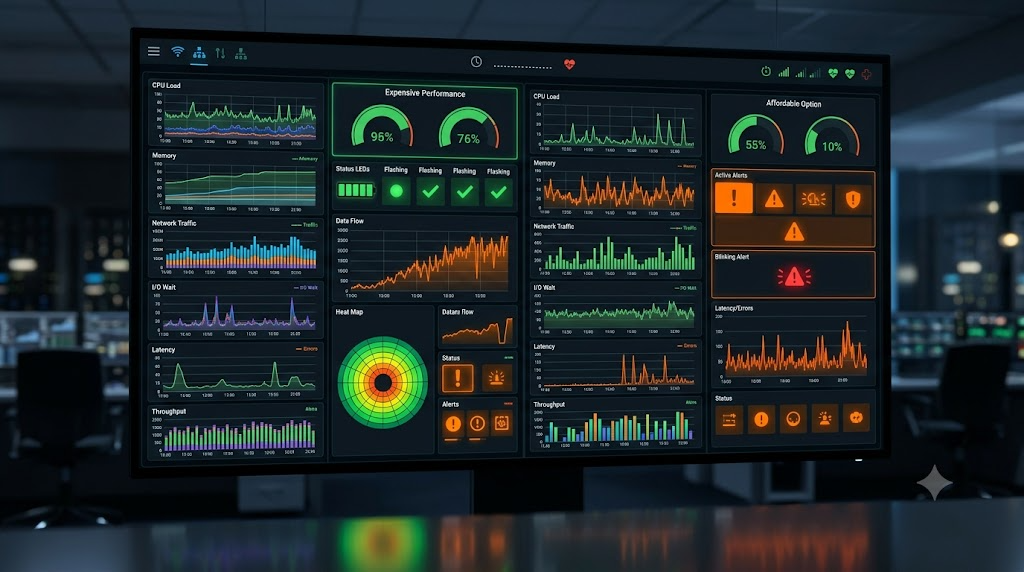
Your Datadog bill just hit $15,000 this month. Last month it was $18,000. Next month? Who knows.
You’re not alone. Datadog charges per host, per container, per custom metric. A mid-size microservices setup easily runs $5,000+ monthly. We tracked one team running 16 microservices—their daily Datadog cost averaged $174. That’s $63,510 per year.
Here’s the thing: most teams use maybe 20% of Datadog’s features but pay for 100%. You need logs, metrics, and traces. You don’t need 47 integrations you’ll never touch.
We tested five Datadog alternatives that deliver real observability without the price tag. Some cut costs by 70%. Others by 98%. All of them work.
Why Datadog Gets So Expensive
Datadog’s pricing model stacks charges like LEGO blocks:
- $15 per host per month (Infrastructure monitoring)
- $31 per host per month (APM)
- $0.10 per 100 custom metrics
- $1.70 per million log events
- $1.27 per million analyzed spans
Scale to 50 hosts with moderate APM usage and custom metrics? You’re looking at $2,300 base + variable costs that climb fast. Add container monitoring, synthetic tests, or security features—costs balloon to $8,000-$30,000+ monthly.
The real killer: you can’t predict next month’s bill. Traffic spike? Bill spike. New microservice? Bill spike. Someone fat-fingered a log level to DEBUG in production? You just paid for 10x more log ingestion.
1. SigNoz: The OpenTelemetry Native Choice
# went all-in on OpenTelemetry from day one. If you’re already using OTel (or planning to), this matters.
What You Get
SigNoz covers the observability trifecta: traces, metrics, logs. The UI feels familiar if you’ve used Datadog—intentionally so. Dashboard builder, query builder, alerts. Nothing groundbreaking, but nothing missing either.
Key difference: pricing by data volume, not host count. Your cloud version starts at $199/month with generous data allowances. Self-host for free if you have the infrastructure chops.
Real Cost Comparison
Take that 16-microservice setup costing $174/day on Datadog ($5,220/month). On SigNoz Cloud with similar data volumes: roughly $800-1,200/month. That’s 77% savings.
Best For
- Teams already using OpenTelemetry
- Engineering teams comfortable with self-hosting
- Anyone who wants Datadog features without Datadog pricing
Watch Out
Smaller integration ecosystem than Datadog. Self-hosted version requires Kubernetes knowledge. Cloud version is newer, so enterprise support isn’t as mature.
2. Grafana Cloud: Ride the Open Source Wave
# bundles Loki (logs), Tempo (traces), and Mimir (metrics) into one platform. If you’re already running Prometheus and Grafana on-prem, this is your easiest migration path.
What You Get
The free tier is genuinely useful: 10,000 metrics series, 50GB logs, 50GB traces monthly. Most small teams never leave free tier.
Pro tier starts at $29/month. That gets you 240,000 active metrics series, 200GB logs, and 200GB traces. Compare to Datadog’s entry point around $500+.
Real Cost Comparison
A team with 30 hosts, moderate APM, and 500GB monthly log volume:
- Datadog: $4,000-6,000/month
- Grafana Cloud: $800-1,500/month
Savings: 70-75%.
Best For
- Teams already using Prometheus/Grafana
- Engineers who value flexibility over hand-holding
- Organizations wanting vendor-neutral observability
Watch Out
Steeper learning curve than Datadog. You’ll configure more, click through wizards less. Dashboard setup takes longer. Support response times lag behind Datadog’s premium tiers.
3. New Relic: The Enterprise Alternative
# rebuilt pricing in 2020. Now you pay per user plus data ingestion. No more host-based surprise bills.
What You Get
Full APM suite that’s been battle-tested since 2008. Distributed tracing, error tracking, infrastructure monitoring, log management. The platform feels mature because it is.
Free tier includes 100GB data ingestion monthly plus one full-platform user. Actual cost example: 10 users + 500GB monthly data = $1,110.
Real Cost Comparison
Medium-sized SaaS company (40 hosts, 800GB logs monthly, 15 engineer users):
- Datadog: $7,000-9,000/month
- New Relic: $2,400-3,200/month
Savings: 60-65%.
Best For
- Teams migrating from legacy APM tools
- Organizations needing proven enterprise support
- Companies with compliance requirements (SOC 2, HIPAA, etc.)
Watch Out
User-based pricing bites you if your whole engineering team needs access. Data ingestion costs climb fast past free tier. Query language (NRQL) has a learning curve.
4. Better Stack: Simplicity Wins
# doesn’t try to do everything. It does uptime monitoring, incident management, and log management really well.
What You Get
Free tier: 10 monitor checks, 1GB logs monthly, 3 on-call responders. Paid plans start at $18 per responder monthly.
The interface is clean. Really clean. You’ll set up your first monitor in 60 seconds. Log search is fast. Incident timeline view actually makes sense during 3am outages.
Real Cost Comparison
Small SaaS startup (5 engineers, 15 services monitored, 50GB logs monthly):
- Datadog: $1,800-2,400/month
- Better Stack: $150-250/month
Better Stack claims they’re 30x cheaper than Datadog. For small teams, that math checks out.
Best For
- Small teams (under 20 engineers)
- Startups watching every dollar
- Teams that want monitoring without a PhD
Watch Out
No APM. No distributed tracing. If you need deep application performance insights, look elsewhere. This is monitoring and logging, not full observability.
5. OpenObserve: The Storage Cost Killer
# attacks the problem differently: radical storage efficiency. They use columnar storage instead of Elasticsearch, cutting storage costs by 140x.
What You Get
Pricing: $0.30-0.50 per GB ingested. That’s it. No per-host fees, no per-user fees, no surprise charges.
1TB monthly ingestion:
- Datadog: $6,000-8,000
- OpenObserve: $300-500
That 16-microservice example spending $174/day on Datadog? On OpenObserve: $3/day. That’s 98% savings.
What You Get
Full-text log search, metrics, traces. Built-in dashboards. SQL-based querying. Stores data 10x longer than Elasticsearch for the same cost.
Self-host option available. Cloud version handles scaling automatically.
Best For
- High log volume teams (500GB+ monthly)
- Organizations needing long retention (90+ days)
- Anyone where storage costs dominate monitoring bills
Watch Out
Younger product (launched 2023). Smaller community. Integration ecosystem still growing. APM features aren’t as polished as Datadog or New Relic.
How to Choose Your Datadog Replacement
Don’t overthink this. Match your actual needs:
You’re using OpenTelemetry or plan to: Go with #. Native OTel support means less friction, cleaner data.
You already run Prometheus and Grafana: # is your path of least resistance. You know the tools, just let them host it.
You need enterprise-grade APM: # has the maturity and support. It’s not the cheapest, but it’s 60% cheaper than Datadog with better predictability.
You’re a small team (under 20 people): # gives you what you need without the complexity tax. Your engineers will thank you.
Your log volume is eating your budget: # turns storage costs into a rounding error. If you’re ingesting 500GB+ monthly, this is your answer.
The Bottom Line on Cheaper Datadog Alternatives
Datadog isn’t bad. It’s just expensive. Really expensive. You’re paying for enterprise features, integrations, and scale you probably don’t need.
Most teams need three things: logs they can search, metrics they can graph, and traces they can follow. These five alternatives deliver that for 30-98% less money.
We’ve watched teams cut monthly monitoring costs from $8,000 to $1,200 by switching to SigNoz. Others dropped from $5,000 to $300 with OpenObserve. The tools work. The savings are real.
Your next Datadog bill arrives in 3 weeks. What’s it going to say?
Try a Better Alternative Today
Pick one tool from this list. Sign up for the free tier. Spend 2 hours migrating one service. Check the results.
If it works for one service, it’ll work for all of them. Most teams complete migration in 2-3 weeks. The first month’s savings pays for the migration time.
Start with # if you’re using OpenTelemetry. Try # if you’re already in the Grafana ecosystem. Test # if log storage is killing you.
Your CFO will ask why you didn’t do this sooner.
Related Reading
- Best Datadog Alternatives in 2026: SigNoz vs Grafana Cloud vs New Relic vs Better Stack
- 5 Best Datadog Alternatives for Observability in 2026
Stay updated with our latest AI insights