TL;DR
mParticle is the enterprise choice if you’re a marketing team managing omnichannel campaigns with a big budget. RudderStack wins if you have data engineers on staff, already use a modern data warehouse, and want to avoid vendor lock-in. For most startups and mid-sized companies building on Snowflake or BigQuery, RudderStack makes more sense. For large retail brands running complex attribution across 10+ channels, mParticle justifies its cost.
What These Platforms Actually Do
Both mParticle and RudderStack are Customer Data Platforms (CDPs). They collect user behavior from your websites, apps, and servers, then route that data to marketing tools, analytics platforms, and data warehouses.
The core promise is simple: instrument your tracking once, then flip switches to send data wherever you need it. No more maintaining 15 different SDK integrations or dealing with inconsistent data formats across tools.
mParticle launched in 2013 as a mobile-first platform. They’ve evolved into a full enterprise CDP focused on marketing use cases. Think of them as the “enterprise sales” CDP—white-glove onboarding, account managers, and pricing that reflects that service level.
RudderStack showed up in 2019 with a different philosophy. They’re open-source, warehouse-native, and built for engineering teams who want full control over their data stack. Their pricing model is transparent and usage-based, which is rare in this space.
The Fundamental Difference
Here’s what really separates these two platforms:
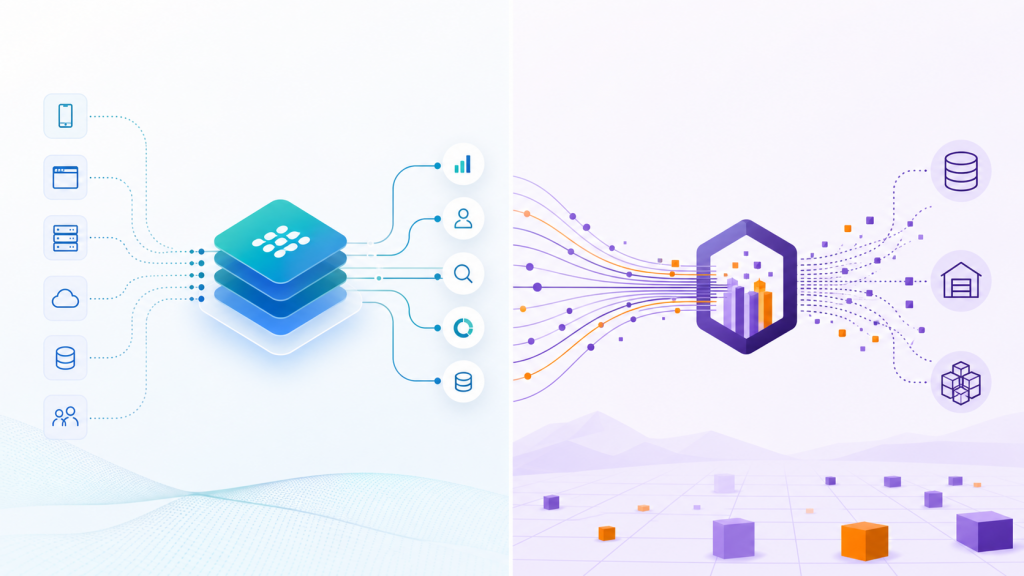
mParticle processes and stores your data in their cloud. Your event stream flows through their infrastructure before landing in your destinations. This gives them tight control over data quality, real-time processing, and audience building—but it also means your data sits in their systems.
RudderStack takes a warehouse-first approach. Events flow through their ingestion layer but your single source of truth lives in your data warehouse (Snowflake, BigQuery, Redshift, etc.). RudderStack reads from that warehouse to build audiences and sync data to tools. You own the infrastructure and the data never leaves your control.
This architectural choice cascades into everything else: pricing, flexibility, vendor lock-in risk, and who on your team will actually use the platform.
Feature Breakdown
Data Collection & SDKs
Both platforms offer client-side SDKs (JavaScript, iOS, Android), server-side libraries (Node, Python, Go, etc.), and cloud-mode integrations for tools that support server-to-server delivery.
mParticle’s SDKs are mature and battle-tested. They handle offline queuing, automatic retry logic, and consent management out of the box. The mobile SDKs include built-in session tracking and lifecycle events. I’ve seen these SDKs handle millions of events per day without breaking a sweat.
RudderStack’s SDKs are solid but leaner. They prioritize simplicity and low overhead. The open-source nature means you can read the source code and fork it if needed. For web tracking, RudderStack supports device-mode vs. cloud-mode for each destination, giving you fine-grained control over where processing happens.
Winner: Tie, but for different reasons. mParticle if you want everything handled for you. RudderStack if you value transparency and customization.
Integrations & Destinations
mParticle supports 300+ integrations covering marketing automation, analytics, advertising, CRM, and data warehouses. Their catalog skews heavily toward marketing tools—you’ll find every obscure email platform and mobile attribution tool.
RudderStack supports 200+ destinations with a focus on developer tools and data infrastructure. Their warehouse integrations are first-class citizens, not afterthoughts. They also support reverse ETL, letting you sync warehouse data back to operational tools.
Both platforms let you build custom destinations, but RudderStack makes it easier. Their Transformation API lets you write JavaScript to manipulate events before they hit destinations. mParticle offers similar functionality but it’s buried in their enterprise tier.
Winner: mParticle for breadth of marketing integrations. RudderStack for data infrastructure and developer flexibility.
Real-Time Capabilities
mParticle processes events in real-time and can trigger immediate actions based on user behavior. Their Audience Builder lets you create segments that update in real-time, then sync those audiences to ad platforms within minutes.
RudderStack handles real-time event streaming but their Profiles feature (audience building) requires periodic warehouse queries. This introduces latency—usually 5-15 minutes depending on your warehouse’s query performance. For many use cases, this delay doesn’t matter. For real-time personalization or fraud detection, it’s a dealbreaker.
Winner: mParticle if you need sub-minute latency for audience activation. RudderStack if your use cases can tolerate a few minutes of delay.
Data Governance & Privacy
mParticle offers comprehensive data governance features: data master planning, schema enforcement, data quality monitoring, and privacy controls. Their Rules feature lets you filter, transform, or block data based on conditions. They’re SOC 2 Type II certified and support major privacy frameworks (GDPR, CCPA, etc.).
RudderStack also handles consent management and privacy compliance. Their warehouse-native approach means you control retention policies, access controls, and data deletion in your own infrastructure. For companies with strict data residency requirements, this is a huge advantage.
Winner: mParticle for out-of-the-box governance tooling. RudderStack if you need absolute control over data residency and access.
Identity Resolution
mParticle’s identity resolution merges user profiles across devices and channels. They maintain a unified customer profile that persists in their cloud. This profile includes computed attributes, audience memberships, and historical behavior.
RudderStack’s identity graph also stitches together anonymous and known users, but the unified profile lives in your warehouse as tables you can query directly. Their Identity Resolution API is open-source, so you can audit exactly how profile merging works.
Both platforms handle the basics well. The difference is whether you want mParticle managing those profiles or you want them in your warehouse where your data team can access them.
Winner: Depends on your team. Marketing teams prefer mParticle’s managed profiles. Data teams prefer RudderStack’s warehouse-native approach.
Feature Comparison Table
| Feature | mParticle | RudderStack |
|---|---|---|
| Data Collection | Client & server SDKs, mobile-optimized | Client & server SDKs, warehouse-native |
| Integrations | 300+ (marketing-heavy) | 200+ (data infrastructure focus) |
| Real-Time Processing | Sub-minute latency | 5-15 minute latency for audiences |
| Identity Resolution | Managed unified profiles | Warehouse-native identity graph |
| Data Governance | Built-in rules, schema enforcement | Warehouse-level controls |
| Audience Builder | Real-time segments | Warehouse-based segments |
| Privacy Compliance | GDPR, CCPA, consent management | GDPR, CCPA, self-hosted option |
| Transformations | Visual + code-based (enterprise tier) | JavaScript transformations (all tiers) |
| Open Source | No | Yes (core engine) |
| Deployment Options | Cloud only | Cloud or self-hosted |
| Data Ownership | Data flows through mParticle cloud | Data stays in your warehouse |
Pricing Reality
mParticle doesn’t publish pricing. Expect to pay $100k-$500k+ annually for enterprise contracts. Their pricing is based on Monthly Tracked Users (MTUs) and the features you enable. Small companies might start around $50k/year, but most deals I’ve seen are six figures.
You’ll also pay for professional services during onboarding. Budget another $25k-$50k for implementation if your data model is complex.
RudderStack publishes transparent pricing. Their Free tier supports 500k events/month. Paid plans start at $750/month for 5 million events, scaling up based on volume. Their Growth plan includes all core features; the Enterprise tier adds SSO, SLAs, and dedicated support.
For 50 million events per month, expect to pay around $2,500/month for RudderStack vs. potentially $200k+/year for mParticle.
The catch with RudderStack: you need to pay for warehouse compute and storage separately. If you’re running complex queries for audience building, your Snowflake bill will increase. Factor in $500-$2k/month for warehouse costs depending on your volume.
Bottom line: RudderStack costs 5-10x less than mParticle for most workloads, but you need to account for warehouse costs.
When to Choose mParticle
You’re a large retail or e-commerce brand with a complex omnichannel strategy. You need real-time audience activation across email, push notifications, SMS, paid ads, and in-store experiences. Your marketing team is 20+ people and they need a UI they can use without involving engineers for every change.
You value support and hand-holding. mParticle’s customer success team will help you design your data architecture, troubleshoot issues, and optimize your setup. If you’re paying for that level of service anyway, the higher price makes sense.
Your data team is already overworked. You don’t have bandwidth to manage warehouse infrastructure, build custom pipelines, or debug data quality issues. You need a vendor who takes responsibility for the entire data flow.
Real-time matters for your business. You’re running dynamic pricing, fraud detection, or personalization that requires sub-minute latency. mParticle’s managed infrastructure can deliver that consistency.
Compliance is mission-critical. You’re in a regulated industry (healthcare, finance) and you need a vendor with proven compliance frameworks and certifications.
When to Choose RudderStack
You already use a modern data warehouse. If you’re on Snowflake, BigQuery, or Redshift and your data team is competent, RudderStack plugs right into your existing stack. You avoid duplicating data across systems.
You want to avoid vendor lock-in. RudderStack’s open-source core means you could self-host or switch to a different tool without losing your entire data infrastructure. Your warehouse is the source of truth, not a vendor’s cloud.
Your team includes data engineers. Someone on staff can write SQL, manage warehouse permissions, and build data models. RudderStack gives these folks full control rather than abstracting everything behind a UI.
You’re cost-conscious. Startups and mid-sized companies benefit from RudderStack’s transparent, usage-based pricing. You can start small and scale up without renegotiating enterprise contracts.
You need custom transformations. RudderStack’s Transformation API is available on all paid plans. You can manipulate events, enrich data, or filter noise without paying for an enterprise tier.
You value transparency. The open-source codebase means you can audit how data flows, debug issues, and contribute improvements back to the community.
The Verdict
For most teams reading this in 2026, RudderStack is the better choice. The warehouse-native architecture aligns with where the industry is moving. Data teams want their customer data in the same place as their product analytics, financial data, and everything else. Keeping a separate customer profile database in a vendor’s cloud feels increasingly outdated.
mParticle still wins for large enterprises with marketing-led organizations and complex real-time needs. If you’re a Fortune 500 retail brand managing hundreds of campaigns across dozens of channels, mParticle’s managed service and real-time capabilities justify the cost.
But if you’re a B2B SaaS company, a modern e-commerce brand, or any organization that’s invested in a data warehouse as your foundation, RudderStack gives you more flexibility at a fraction of the cost.
Here’s my decision framework:
Choose mParticle if:
- Your annual revenue is $100M+
- Your marketing team is 20+ people
- You need sub-minute latency for audience activation
- You’d rather pay for support than build in-house expertise
- Your data team is small or overwhelmed
Choose RudderStack if:
- You have data engineers on staff
- You already use Snowflake, BigQuery, or Redshift
- You want to control costs and scale gradually
- You value data ownership and avoiding vendor lock-in
- Your use cases can tolerate 5-15 minutes of latency
The customer data platform landscape is maturing. The “collect everything and store it in our cloud” approach that mParticle pioneered made sense 10 years ago. Today, with mature data warehouses and reverse ETL tools, the warehouse-native architecture that RudderStack champions is the better long-term bet for most companies.
That said, both platforms do what they promise. The question is which philosophy fits your organization’s culture, budget, and technical capabilities. Choose based on who will actually use the platform and what your data architecture looks like three years from now.
Related Reading
- Segment vs RudderStack: Which CDP Actually Fits Your Stack in 2026?
- Segment vs RudderStack: Which CDP Should You Choose in 2026?
Stay updated with our latest AI insights