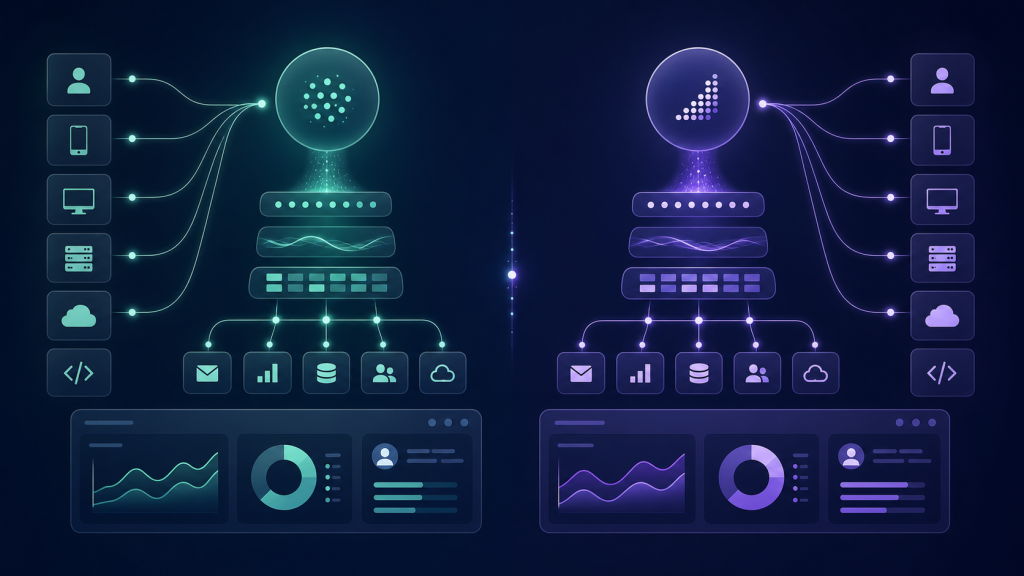
Customer data is messy. You have events coming from your website, mobile app, backend servers, and a dozen SaaS tools. They all use different formats, different identifiers, and different schemas. Your marketing team wants to send data to Facebook Ads. Your product team needs it in Amplitude. Your data team wants everything in Snowflake.
This is exactly the problem Customer Data Platforms (CDPs) solve. They collect data from everywhere, normalize it, and route it to anywhere. Two names dominate the space: Segment and RudderStack. Segment is the established player — bought by Twilio in 2020 for $3.2 billion. RudderStack is the open-source challenger that promises the same functionality at a fraction of the cost.
The core question: do you pay for Segment’s polish and plug-and-play simplicity, or do you roll up your sleeves with RudderStack to save money and keep control of your data? This guide will help you decide based on your data volume, budget, and engineering resources.
Quick Comparison
| Dimension | Segment | RudderStack |
|---|---|---|
| Pricing Model | $120/month for 10k MTUs, scales up fast | Free (open source) or $750/month for 5M events |
| Integrations | 400+ destinations | 200+ destinations |
| Data Sovereignty | Cloud-only, data passes through Segment | Self-hosted or cloud-hosted (you own the infrastructure) |
| Technical Complexity | Low — no-code setup, plug and play | Medium-High — requires Docker/Kubernetes for self-hosting |
| Best For | Small teams with budget, need speed | High-volume users, teams with data engineers |
| Real-time Performance | Good for tools, slower for warehouses (1-4h delay) | Excellent — warehouse-native, real-time in minutes |
Pricing: Where the Real Difference Lies
This is where the fight gets interesting.
Segment charges by Monthly Tracked Users (MTUs). An MTU is any unique visitor or identified user in a month. Start at $120/month for 10,000 MTUs on the Team plan. Sounds reasonable, right? But here’s the catch: once you cross 50k MTUs, prices jump significantly. Companies report paying $2,000-$5,000/month at moderate scale, and $25,000+/month when you hit enterprise volumes.
The MTU model punishes growth. Every new user costs you more. If you’re building a consumer app or a high-traffic website, costs can spiral fast. One SaaS founder on Reddit mentioned their Segment bill hit $8,000/month when they crossed 100k active users — more than their AWS bill.
RudderStack takes a different approach. The open-source version is completely free. Deploy it yourself on AWS, GCP, or your own servers. You pay for infrastructure (typically $200-$500/month depending on scale), but there’s no per-user or per-event vendor fee.
If you prefer not to manage infrastructure, RudderStack offers a cloud-hosted plan starting at $750/month for 5 million events. No MTU nonsense — just straight event volume pricing. For comparison, 5 million events might represent 50k-100k active users depending on how aggressively you track. That’s already cheaper than Segment at similar scale.
Real-world example: A B2B SaaS company with 200k monthly visitors and 50k identified users would pay roughly $3,000-$5,000/month on Segment. On RudderStack Cloud (assuming 10-15M events/month), they’d pay around $1,500-$2,000/month. Self-hosting brings that down to $500-$800/month in infrastructure costs.
Companies like Kajabi reported saving six figures annually after migrating from Segment to self-hosted RudderStack. Aircall cut costs by 35% switching to RudderStack Cloud.
The break-even point? If you’re tracking more than 20k MTUs and have any engineering capacity, RudderStack starts looking very attractive.
Integration Ecosystem: Breadth vs Depth
Segment wins on pure numbers: 400+ integrations covering everything from niche marketing tools to enterprise data warehouses. They’ve been around since 2011, so they’ve had time to build out support for obscure platforms your marketing team might randomly request.
Segment’s integrations are also extremely well-documented. Each one has guides, troubleshooting docs, and community discussions. When something breaks (and it will), you’ll find answers.
RudderStack offers 200+ integrations, which sounds like less but covers 90% of what most teams actually use: Google Analytics, Facebook Ads, Amplitude, Mixpanel, Salesforce, HubSpot, and all major data warehouses (Snowflake, BigQuery, Redshift, Databricks).
Where RudderStack shines is in the quality of warehouse integrations. They’re warehouse-native by design — meaning they optimize for getting data into your warehouse fast and in a clean schema. Segment treats warehouses as “just another destination.” RudderStack treats them as the primary destination.
RudderStack also has an active open-source community contributing connectors. Need a custom integration? You can build it yourself or hire their team to build it. With Segment, you’re stuck waiting for them to prioritize it (or paying enterprise fees for custom development).
Verdict: If you need a long-tail integration for some obscure ad network, Segment probably has it. If your priority is getting clean data into your warehouse, RudderStack is often better.
Data Sovereignty and Compliance
This is a big one, especially for companies in regulated industries.
Segment is cloud-only. Every event you send flows through Segment’s servers before reaching destinations. They cache it, process it, and then forward it. For most companies, this is fine. But if you’re in healthcare (HIPAA), finance (SOX, PCI), or dealing with European customers (GDPR), you might have a problem.
Even with Segment’s Business plan and BAA (Business Associate Agreement), your data still touches their infrastructure. Some compliance officers aren’t comfortable with that. Some data protection laws require you to know exactly where data flows and for how long it’s retained.
RudderStack offers self-hosting. Data flows from your sources through infrastructure you control directly to destinations. It never touches RudderStack’s servers. For companies with strict data residency requirements (e.g., “all data must stay in EU”), this is the only viable option.
RudderStack Cloud (the managed version) also processes data, but they offer more granular controls: choose your region, configure retention policies, and get detailed audit logs. They’re also built by data engineers who understand compliance — their docs actually explain how to handle PII masking, consent management, and user deletion requests.
Real-world impact: A European fintech startup chose RudderStack specifically because their legal team wouldn’t sign off on Segment. They needed to prove data never left their AWS Frankfurt region. With RudderStack self-hosted, they could.
Technical Complexity: Plug-and-Play vs DIY
Segment is incredibly easy to set up. Create an account, drop a JavaScript snippet on your site, and start sending data. Want to add a new destination? Click a button, enter API keys, done. No infrastructure to manage, no servers to provision, no Docker to learn.
This is Segment’s biggest strength. You can have data flowing from your website to Google Analytics, Facebook, and your data warehouse in under an hour. For small teams without dedicated data engineers, this is huge.
RudderStack self-hosted requires actual engineering. You need to:
- Deploy RudderStack server (Docker or Kubernetes)
- Set up a PostgreSQL database (for RudderStack’s metadata)
- Configure object storage (S3 or GCS for event buffering)
- Set up monitoring and alerting
- Handle updates and scaling
If your team already runs containerized workloads and has DevOps chops, this isn’t a big deal. But if you’re a 5-person startup where everyone wears multiple hats, this overhead can be painful.
RudderStack Cloud (their managed offering) solves this problem. It’s as easy to set up as Segment — create account, install SDK, configure destinations. You lose some control compared to self-hosting, but you keep the cost benefits and data flexibility.
Who can handle self-hosting? If you have at least one person who’s comfortable with Docker, Terraform, and AWS, you’re fine. If the idea of setting up a Kubernetes cluster makes you nervous, stick with Segment or RudderStack Cloud.
Real-time Performance and Data Quality
Both platforms handle real-time data streaming, but there are differences in how they prioritize it.
Segment has historically been better at real-time event forwarding to destinations like Facebook Ads, Google Analytics, and Amplitude. They built their architecture around low-latency routing. Events typically reach downstream tools in seconds.
But Segment’s warehouse syncs are slower. Depending on your plan, data lands in your warehouse every 1-4 hours. For teams building real-time dashboards or operational analytics, this lag is a problem.
RudderStack is warehouse-first. They optimize for getting data into your warehouse as fast as possible — often within minutes. This is perfect if your data team lives in SQL and wants to build analytics on fresh data.
RudderStack also offers real-time event streaming to other destinations, with performance comparable to Segment. The difference is usually seconds, not minutes.
Transformations: Both platforms let you transform data in-flight (e.g., clean up event names, enrich with additional properties, filter out PII). Segment’s transformations run in their cloud. RudderStack lets you run transformations in JavaScript or Python, and you can test them locally before deploying — offering more flexibility for custom business logic.
When to Choose Segment
Pick Segment if:
- You’re a small team (< 10 people) with no data engineer. You need something that works out of the box. Your time is more valuable than the $200-500/month you’d save with RudderStack.
- You’re pre-product-market-fit and moving fast. When you’re iterating weekly and testing new tools constantly, Segment’s 400+ integrations and plug-and-play setup save time.
- Your data volume is low (< 10k MTUs). At this scale, Segment costs $120/month. RudderStack might not be worth the setup overhead.
- You need a specific niche integration that only Segment supports. Check both catalogs first, but if you’re locked into some obscure tool, Segment might be your only option.
- Your team has zero interest in managing infrastructure. Not everyone wants to be a DevOps shop. If you’d rather pay for convenience, that’s a legitimate choice.
When to Choose RudderStack
Pick RudderStack if:
- You have high data volumes (> 50k MTUs or > 5M events/month). This is where RudderStack’s pricing advantage becomes massive. You could save $2,000-10,000/month compared to Segment.
- You have at least one data engineer or DevOps person. Someone who can set up the infrastructure (self-hosted) or configure the cloud version thoughtfully.
- Data sovereignty is a requirement. Regulated industries, European companies with GDPR concerns, or anyone who needs to prove data never leaves their infrastructure.
- You’re building on your data warehouse (Snowflake, BigQuery, Redshift). RudderStack’s warehouse-native approach means cleaner schemas, faster sync times, and better support for tools like dbt.
- You want customization and control. Need custom transformations? Want to modify how a destination connector works? RudderStack’s open-source model lets you fork and customize.
- You’re cost-sensitive and growing fast. Startups with aggressive growth targets often hit a wall with Segment pricing. RudderStack scales more predictably.
Migration: Switching from Segment to RudderStack
The most common migration path is Segment → RudderStack, driven by cost concerns.
Why people migrate: A typical story: “We started on Segment at $120/month. Two years later, we’re paying $6,000/month and it’s now our third-largest cloud bill after AWS and Snowflake. We migrated to RudderStack self-hosted and now pay $600/month in infrastructure costs.”
Migration effort: RudderStack is deliberately Segment-compatible. They support similar SDK methods and event schemas. For basic setups, migration can take 1-2 weeks:
- Deploy RudderStack infrastructure
- Swap out the Segment SDK for RudderStack SDK (often a one-line code change)
- Reconfigure destinations in RudderStack’s UI
- Run both in parallel for a week to validate data
- Cut over and shut down Segment
What gets tricky: If you’re using Segment Personas (their identity resolution product) or Protocols (data quality features), migration is harder. RudderStack has equivalents, but they’re not drop-in replacements. Budget extra time for testing.
RudderStack offers migration guides and, on Enterprise plans, migration support from their team.
The Bottom Line
There’s no universal “best” choice. It depends on your stage, your budget, and your team’s capabilities.
Early-stage startups should probably start with Segment. Get to market fast, validate your product, don’t overthink infrastructure. When your Segment bill hits $1,000-2,000/month and you have a data person on the team, reassess.
Growth-stage companies (Series A/B, 50+ employees, dedicated data team) should seriously evaluate RudderStack. The cost savings compound quickly, and you’re at the stage where data quality and warehouse integration matter more than adding random marketing tools.
Enterprises can go either way. Segment offers premium support and proven reliability at scale. RudderStack offers cost control and data sovereignty. If you’re in a regulated industry or processing millions of events daily, RudderStack’s economics often win.
The smart play? Try both. RudderStack has a free tier (10k events/month on Cloud, unlimited on self-hosted). Segment has a free tier (1k MTUs/month). Set up parallel tracking for a week, compare the experience, and decide based on real data instead of marketing claims.
Your CDP will be a core piece of infrastructure for years. Choose based on where you’ll be in 2-3 years, not where you are today. If you’re betting on growth, bet on a pricing model that scales with you instead of against you.
Related Reading
- Segment vs RudderStack: Which CDP Actually Fits Your Stack in 2026?
- mParticle vs RudderStack: Which CDP Is Right for Your Team in 2026?
Stay updated with our latest AI insights