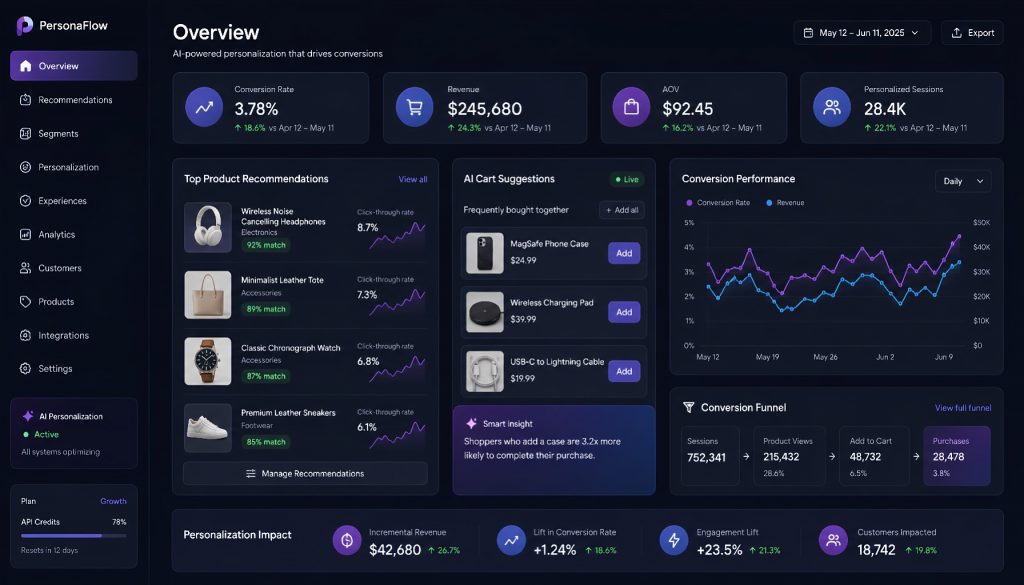
A DTC pet food brand hit a wall. Their repurchase rate flatlined at 22% for three straight quarters. Email flows were optimized. Loyalty program was live. Nothing moved the needle.
They plugged in Rebuy’s Smart Cart. First month: AOV jumped 14%. The fix wasn’t more marketing. It was showing the right product at the right moment inside the cart drawer.
That’s the pitch for ecommerce personalization. But which platform actually fits your stack, your budget, and your team’s capacity? Five tools dominate this space right now. They look similar on feature lists. They are wildly different in practice.
Here’s what each one actually does, what it costs, and who should buy it.
The Quick Comparison
| Platform | Best For | Pricing | Platform Support | Setup Complexity |
|---|---|---|---|---|
| Rebuy | Cart conversion on Shopify | $99–$499/mo (by order volume) | Shopify only | Low (days) |
| Nosto | Full-site personalization | Revenue share 2.5–4% | Shopify Plus, Magento, BigCommerce | Medium (1–2 weeks) |
| Klevu (Athos Commerce) | AI search + merchandising for large catalogs | $449–$849/mo | Platform-agnostic | Medium (1–2 weeks) |
| Dynamic Yield (Mastercard) | Enterprise multi-channel personalization | $35K+/year | Platform-agnostic | High (6–12 weeks) |
| Bloomreach | Full-stack commerce experience | $35K–$400K/year | Platform-agnostic | Very High (3–6 months) |
Now let’s break each one down.
Nosto: Full-Site Personalization With Revenue Sharing
Nosto takes a different approach. Instead of focusing on one part of the funnel, it personalizes the entire site experience. Homepage banners, product recommendations, category page sorting, pop-ups, email content. Everything adapts per visitor.
The Shopify Plus connection matters. Nosto is an official Shopify Plus Technology Partner. That means deeper API access, priority support, and integration stability that third-party apps can’t match. If you’re already on Shopify Plus, this partnership removes a lot of integration risk.
How the revenue share works: Instead of flat monthly fees, Nosto charges 2.5–4% of the revenue it attributes to its personalization. The percentage depends on your total GMV and contract terms. For a store doing $5M/year where Nosto claims credit for $500K of that, you’re paying $12,500–$20,000 annually.
This model aligns incentives. Nosto only makes money when you make money. But it also means your costs scale with success. A really effective implementation gets expensive fast.
What it actually personalizes:
- Homepage hero banners and content blocks
- Product recommendations across PDP, cart, and post-purchase
- Category page merchandise sorting per visitor
- Email and SMS content blocks
- Pop-ups and on-site messaging
- Search results personalization
The catch: Revenue share pricing makes ROI calculations circular. Is that sale “attributed” to Nosto’s recommendation, or would the customer have bought anyway? Every revenue-share tool faces this question. Nosto’s attribution window is generous to Nosto.
Who should pick Nosto: Shopify Plus brands doing $3M–$50M that want site-wide personalization without building a data science team. You need enough traffic (50K+ monthly sessions) for the AI to learn meaningful patterns. Below that threshold, rule-based personalization works just as well.
—
Klevu / Athos Commerce: AI Search and Merchandising for Big Catalogs
Klevu rebranded as Athos Commerce in late 2025, though most people still call it Klevu. The core product is AI-powered site search and product discovery. If you have 5,000+ SKUs and your default search returns garbage results, Klevu fixes that.
The search problem is bigger than most brands realize. Site search users convert 4–6x higher than browsers. But default platform search (especially Shopify’s) is basic keyword matching. It doesn’t understand synonyms, typos, or buying intent. Klevu’s NLP engine handles all of that.
Beyond search, it’s a merchandising platform. Category pages get AI-sorted based on conversion probability per visitor. You can set business rules on top (boost new arrivals, bury low-margin items) without overriding the AI completely.
Pricing: $449/mo for the search product alone. $849/mo for search plus merchandising plus recommendations. Enterprise pricing for custom implementations. No revenue share.
What it does well:
- Natural language search (understands “red dress for summer wedding under $200”)
- Automatic synonym detection and typo tolerance
- Visual merchandising controls with drag-and-drop
- Faceted filtering that adapts to search context
- Analytics on search behavior and zero-result queries
The catch: Klevu is a discovery layer. It doesn’t do cart personalization, email content, or on-site messaging. You’ll still need Rebuy or Nosto (or something else) for those functions. It’s a specialist tool, not a platform play.
Who should pick Klevu: Brands with 5,000+ SKUs where product discovery is the bottleneck. Fashion, home goods, industrial supply, marketplaces. If customers can’t find what they want, nothing downstream matters. Fix search first, then worry about cart upsells.
—
Dynamic Yield (Mastercard): Enterprise Personalization, Enterprise Budget
Dynamic Yield earned Gartner’s “Leader” designation in their personalization Magic Quadrant eight consecutive times. Mastercard acquired them in 2022. This is the enterprise option. The pricing reflects it.
Starting at $35K per year, Dynamic Yield serves brands like McDonald’s, IKEA, and Sephora. If you’re a $5M DTC brand, this is not for you. If you’re doing $100M+ across multiple channels and geographies, now we’re talking.
What enterprise-grade means in practice:
- Server-side personalization (no client-side flicker)
- Multi-channel orchestration (web, app, email, in-store kiosks, call centers)
- Advanced audience segmentation with predictive scoring
- A/B and multivariate testing built into the personalization layer
- AdaptML, their machine learning engine for automatic optimization
- Full API-first architecture for headless implementations
The testing capability is the sleeper feature. Most personalization tools let you A/B test. Dynamic Yield lets you run personalization experiments at scale, automatically allocating traffic to winning variations and measuring incremental lift over control groups. This is how you prove personalization ROI to a CFO.
The catch: Implementation takes 6–12 weeks minimum with a dedicated solutions team. You need internal resources (at least one full-time personalization manager) to operate it. The tool is powerful but complex. Without proper staffing, you’ll use 20% of its capabilities and pay 100% of the price.
Who should pick Dynamic Yield: Multi-channel retailers doing $100M+ in revenue with dedicated ecommerce teams of 5+ people. You need the budget, the traffic volume (millions of monthly sessions), and the organizational maturity to run a personalization program, not just install a tool.
—
Bloomreach: The Full-Stack Commerce Experience Platform
Bloomreach is the most ambitious platform on this list. It’s not just personalization. It combines product search, a customer data platform (CDP), marketing automation, and a headless CMS into one system.
The product suite:
- Discovery: AI search and merchandising (competes with Klevu)
- Engagement: CDP plus marketing automation (competes with Klaviyo + Segment)
- Content: Headless CMS for commerce content (competes with Contentful)
You can buy modules individually or go full-stack. Most customers start with Discovery and add modules over time.
Pricing is the widest range on this list. $35K/year for a single module at mid-market scale. $400K+/year for full-stack enterprise implementations. The average mid-market deal is around $80K–$120K annually.
What makes Bloomreach different: The CDP is the connecting layer. Every customer interaction, whether it’s a search query, email click, page view, or purchase, feeds into a unified profile. Personalization decisions across all channels pull from that same profile. No data silos between your search tool, your email platform, and your on-site experience.
The Loomi AI engine powers recommendations, predictive analytics, and content generation across the platform. It optimizes send times for email, predicts churn probability, and auto-generates product descriptions. This is where the “AI everywhere” trend in martech actually produces compound returns, because the same model sees all customer touchpoints.
The catch: Bloomreach is a multi-year commitment. Implementation takes 3–6 months for the full stack. You’re likely replacing 3–5 existing tools (search provider, CDP, email platform, CMS). That means migration risk, team retraining, and a long time-to-value.
Total cost of ownership goes beyond the license. Budget for implementation services ($50K–$150K), ongoing platform management (1–2 FTEs), and the productivity dip during migration.
Who should pick Bloomreach: Mid-market to enterprise brands ($50M–$1B+ revenue) that are frustrated with a fragmented martech stack and have the organizational willpower to consolidate. You need executive sponsorship, a dedicated project team, and patience. The payoff is real, but it takes 6–12 months to materialize.
—
How to Choose: A Decision Framework
Skip the feature matrices. Ask these five questions:
1. What platform are you on?
Shopify-only? Your choices are Rebuy and Nosto (and Klevu for search). Custom or headless? Dynamic Yield and Bloomreach are built for that.
2. What’s your annual personalization budget?
- Under $10K: Rebuy
- $10K–$50K: Nosto or Klevu
- $50K–$150K: Dynamic Yield or Bloomreach (single module)
- $150K+: Bloomreach full-stack or Dynamic Yield enterprise
3. Where’s the biggest gap in your funnel?
- Cart abandonment / AOV: Rebuy
- Site-wide conversion: Nosto
- Product discovery / search: Klevu
- Multi-channel orchestration: Dynamic Yield
- Stack fragmentation: Bloomreach
4. How many people will manage this tool?
- Zero dedicated headcount: Rebuy (self-serve)
- Part-time ecommerce manager: Nosto or Klevu
- 1–2 dedicated personalization people: Dynamic Yield
- Full platform team (3–5 people): Bloomreach
5. How fast do you need results?
- This week: Rebuy
- This month: Nosto or Klevu
- This quarter: Dynamic Yield
- Next year: Bloomreach full-stack
—
The Bottom Line
There is no “best” ecommerce personalization tool. There is only the right fit for your current stage, budget, and team.
If you’re a Shopify brand under $20M wanting quick wins, start with Rebuy. The Smart Cart pays for itself in weeks.
If you’ve outgrown point solutions and want full-site personalization without enterprise pricing, Nosto is the move for Shopify Plus stores. Klevu is the move if product discovery is your specific problem.
If you’re doing $100M+ and need multi-channel personalization with rigorous testing, Dynamic Yield has earned its Gartner pedigree.
If you’re ready to consolidate your entire commerce experience stack into one platform and have the budget and patience for it, Bloomreach is the most complete option on the market.
Start where the pain is sharpest. Measure incrementally. Upgrade when you’ve outgrown the current tool. That’s how you build a personalization program that compounds over time instead of becoming another underused SaaS subscription.
Related Reading
- Nosto vs Rebuy vs Bloomreach vs Klevu: Which Ecommerce Personalization Tool Fits Your DTC Brand in 2026?
- Nosto vs Rebuy vs Bloomreach: E-commerce Personalization for DTC Brands in 2026
Stay updated with our latest AI insights