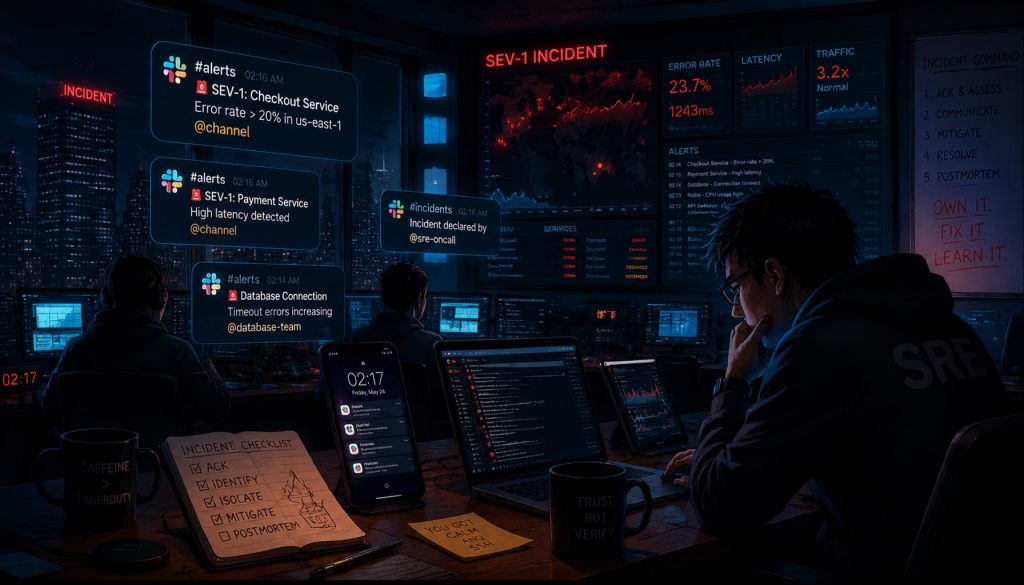
Your phone buzzes at 3:17 AM, dragging you out of deep sleep. The screen shows a PagerDuty alert: payment service P99 latency has spiked to 12 seconds. You rub your eyes, open your laptop, switch to Slack to find teammates, open Datadog to check metrics, then realize the person who should be responding is actually Wang from the adjacent team. By the time you’ve pulled the right people into a channel, located the relevant runbook, and confirmed what changed in the last deployment, fifteen minutes have passed. The fix itself might take five minutes, but before you can even start troubleshooting, you’ve spent triple that time doing “coordination gymnastics.”
This isn’t one unlucky SRE’s nightmare. It’s the daily reality for countless teams in 2026. The incident management space is experiencing a fundamental shift in its underlying logic: from “who should be woken up” to “how to make a group of people collaborate efficiently under pressure.” Standing at opposite ends of this inflection point are PagerDuty, which has dominated for fifteen years, and incident.io, which reached a $400 million valuation in just four years.
PagerDuty: A Smoke Alarm for an Era
In 2009, Alex Solomon and his co-founders wrote the first lines of PagerDuty code in Toronto. The term “DevOps” had been coined just two years earlier, and most companies still relied on email notifications or SMS polling for their alerting systems. PagerDuty’s core value proposition was simple and powerful: when your system breaks, ensure the right person gets woken up correctly.
It did this well. Fifteen years later, PagerDuty’s annual recurring revenue approaches $500 million. It’s publicly traded on the NYSE, serving over 15,000 paying customers. Its 700+ integrations cover virtually every monitoring tool you can think of, from Datadog to Prometheus, from AWS CloudWatch to self-hosted Grafana.
But over time, “good” can become its own burden.
PagerDuty’s product architecture is built around alert routing as its core. On-call scheduling, escalation policies, alert noise reduction have all been refined over more than a decade, and they are mature. The question is: what happens after the alert arrives? You receive a notification, open PagerDuty’s web interface, acknowledge the alert, and then you have to jump back to Slack to pull people in, jump to Datadog to see data, jump to Confluence to dig through historical docs, jump to Jira to create a ticket. PagerDuty woke you up, but it doesn’t help much with what comes next.
Between 2024 and 2026, this problem became increasingly apparent. PagerDuty’s growth has notably slowed, with recent quarters showing year-over-year revenue growth in the single digits and net revenue retention hovering around 100%, meaning existing customers are no longer expanding their usage. Market cap has fallen from a peak in the tens of billions to roughly $1.1 billion, just over twice its ARR. SaaStr analysts put it bluntly: profitability alone isn’t enough. You need growth.
This doesn’t mean PagerDuty got worse. It simply stopped at a position that’s no longer sufficient.
The Challenger from a London Fire Station
In 2021, three former Monzo Bank engineers launched incident.io in a converted fire station in London. Stephen Whitworth, Pete Hamilton, and Chris Evans had spent years on platform reliability at Monzo, living through 3 AM incident response workflows cobbled together from PagerDuty plus Slack plus Google Docs. What they wanted to solve wasn’t “how to wake people up” but “everything that happens after you wake them up.”
From day one, incident.io was rooted in Slack. Not the “I’ll send a notification to Slack and then you click a link to my web interface” kind of integration, but having the entire incident lifecycle happen inside Slack channels: declare incidents, assign roles, capture timelines, update status pages, draft post-mortems. You don’t need to leave Slack to operate elsewhere.
This positioning was sharp. After a seed round in 2021, they raised roughly $28.7 million in Series A in 2022, followed by a $62 million Series B led by Insight Partners in April 2025, reaching a $400 million valuation. Total funding exceeds $96 million. Their customer roster includes Netflix, Etsy, Ramp, and Linear. Customer count tripled over the past year, with over 250,000 incidents processed to date.
In March 2024, incident.io launched its own On-call product, formally entering PagerDuty’s core territory. This move transformed it from “a supplement to PagerDuty” into “a replacement for PagerDuty.” Scheduling, escalation policies, alert routing are all there now, natively integrated with their incident response workflow. No jumping between two systems.
Smoke Alarm vs Fire Department
To understand the most essential difference between these two products, consider this analogy: PagerDuty is a smoke alarm, incident.io is a fire department.
PagerDuty detects the fire (alert triggers), ensures the right person hears the alarm (on-call routing), and then its core job is done. How you extinguish the fire is your problem.
incident.io, when it wakes you up, simultaneously auto-creates a dedicated Slack channel, pulls relevant engineers in, displays recent deployment records and relevant runbooks, starts capturing every action on a timeline, updates your public status page in real time, and auto-drafts a post-mortem report once the incident closes.
These two philosophies aren’t absolutely right or wrong, but they do suit different scenarios.
PagerDuty’s strength lies in the depth of alert management itself. Over 700 native integrations, mature alert noise reduction (AIOps), complex dependency mapping, multi-tier escalation policies. If your core pain point is “massive alert volume drowning on-call engineers,” PagerDuty’s accumulated expertise in this area runs deep. Its mobile app is also well-refined after years of iteration, with comprehensive functionality.
incident.io’s strength lies in incident response collaboration efficiency. From the moment an alert arrives, it’s reducing “coordination tax,” the time spent pulling people together, finding docs, creating channels, and writing summaries. According to their own data, traditional on-call tools introduce 10 to 15 minutes of coordination overhead at the start of each incident, while Slack-native workflows compress that number by 80%.
A Table That Clarifies Core Differences
| Dimension | PagerDuty | incident.io |
|---|---|---|
| Founded | 2009 | 2021 |
| Core Position | Alert routing and on-call management | End-to-end incident response platform |
| Primary Interface | Proprietary web/app | Slack / Microsoft Teams |
| Alert Integrations | 700+ | Growing continuously, covers mainstream monitoring tools |
| AI Capabilities | AIOps noise reduction (extra cost) | AI post-mortems, root cause analysis (included in Pro) |
| Status Page | Extra cost | Included in Pro plan |
| Base Pricing | $21-41/user/month | $19-25/user/month |
| On-call Scheduling | Core feature | $10-20/user/month add-on |
| Annual Full-Feature Cost (50-person team) | ~$39,000 (with AI and status page add-ons) | ~$27,000 (Pro includes on-call) |
| Typical Customer Profile | Large enterprises, complex service dependencies | Mid-size SaaS, fast-growing engineering teams |
| Mobile App | Mature, feature-complete | Newer, focused on key operations |
| Post-Mortems | Requires third-party tools | Auto-generated drafts in platform |
There’s also a structural difference in pricing: PagerDuty’s base plan looks affordable, but AI noise reduction (AIOps) costs an extra $699/month, advanced AI features (Advance AI) cost $415/month, and status page costs $89/month. For many teams, these aren’t nice-to-haves but basic requirements, and together they make the actual bill significantly higher than the list price. incident.io’s Pro plan bundles AI and status pages in, making pricing more predictable.
Which Fits Your Team?
Tool selection has no universal answer, but scenarios can help narrow the field.
Scenarios favoring PagerDuty:
Your organization has an engineering team of 500+ people managing complex dependency relationships across hundreds of microservices. You’ve been running on PagerDuty for years with finely tuned escalation policies and integration configurations. Alert noise reduction is your biggest pain point, with hundreds of alerts daily requiring ML-level aggregation analysis. Your enterprise procurement process requires platforms to pass SOC 2 Type II, FedRAMP, and other compliance certifications. Your team doesn’t primarily use Slack as its collaboration tool.
Scenarios favoring incident.io:
Your engineering team is between 50 and 500 people, handling 10+ incidents per month. Slack is your team’s default collaboration ground. You’re tired of jumping between five tools to handle one incident. Writing post-mortems is everyone’s headache. You want a unified platform covering on-call, incident response, status pages, and post-mortems rather than buying four separate tools and gluing them together. You want transparent pricing without surprise renewal increases.
Special scenarios for product and business teams:
If your customer success team and product managers also need visibility into status updates and impact scope during incidents, incident.io’s Slack-native model lowers the barrier for non-technical participants. They don’t need to learn a new web interface, just join the relevant Slack channel to follow developments. PagerDuty’s interface works fine for purely technical users, but has a steeper learning curve for non-engineering roles.
How Heavy Is the Migration Lift Really?
“Replacing PagerDuty” sounds sweaty. On-call scheduling and alert routing are infrastructure-level configurations, and if you miss a critical alert during migration, consequences can be severe.
But the actual migration complexity may be lower than imagined.
incident.io offers a “Rescue Program” with a core strategy of parallel operation: during the switchover, both systems receive alerts simultaneously. You gradually migrate services from PagerDuty to incident.io until all teams have validated, then shut down the old system. This avoids big-bang migration risk. They claim to provide up to 12 months of free usage during contract overlap (requires multi-year commitment) to eliminate “paying for two platforms simultaneously” concerns.
Public case studies show Zendesk migrated 1,200 users, 150 teams, and 5,000 monitors to incident.io with a core execution team of just two people, without major issues. Of course, this is a large company with a dedicated engineering productivity team leading the effort. Smaller teams may have different experiences.
The real migration cost isn’t just tool configuration. More hidden is habit cost: team members are already used to receiving alerts via PagerDuty’s mobile app, used to its acknowledgment flow, used to existing escalation policy configuration methods. These take time to readjust. Reasonable expectations: teams under 15 people can complete the switch within 20 days; teams of 50 to 200 need 4 to 8 weeks; larger organizations may require a quarter of phased rollout.
There’s also the option of incomplete migration: keep PagerDuty for alert routing (it does this well) while introducing incident.io as the incident coordination layer. incident.io itself supports receiving alerts from PagerDuty as a signal source. This sacrifices some platform unity but reduces migration risk, suitable for teams with extremely complex PagerDuty configurations who don’t want to touch the alert layer in the short term.
The Bigger Picture in 2026
Behind the competition between these two products, the incident management space itself is redefining its boundaries.
Atlassian announced Opsgenie will end support in April 2027, forcing users to migrate to Jira Service Management. This means a large batch of Opsgenie users must make a choice in 2026. Grafana Cloud IRM is integrating alert management into its observability platform. Players like Rootly and FireHydrant have each carved out niche positions.
AI is the story everyone is telling, but implementation depth varies widely. PagerDuty’s AI is primarily used for alert aggregation and noise reduction, a “subtraction” that helps filter signal from noise. incident.io’s AI leans more toward “addition,” auto-generating post-mortem drafts, identifying root causes from historical patterns, and executing response tasks. Both directions have value, depending on where your team’s pain concentrates.
If you’re considering this choice, the most honest advice is to look back at your last three months of incidents. Break down the time for each incident: how many minutes spent on “detecting the problem and calling people,” how many on “coordination and communication,” how many on “actual fixing.” If the first dominates, PagerDuty’s core capabilities match your needs. If the middle chunk consumes the most time, incident.io’s design philosophy is more on target.
No tool will fix bugs for you at 3 AM. But a good tool at least shouldn’t make you spend fifteen minutes on administrative work before you can even start fixing bugs.
Related Reading
- PagerDuty Alternatives 2026: 5 Incident Management Tools Compared for Modern SRE Teams
- Best PagerDuty Alternatives for Incident Management in 2026
Stay updated with our latest AI insights