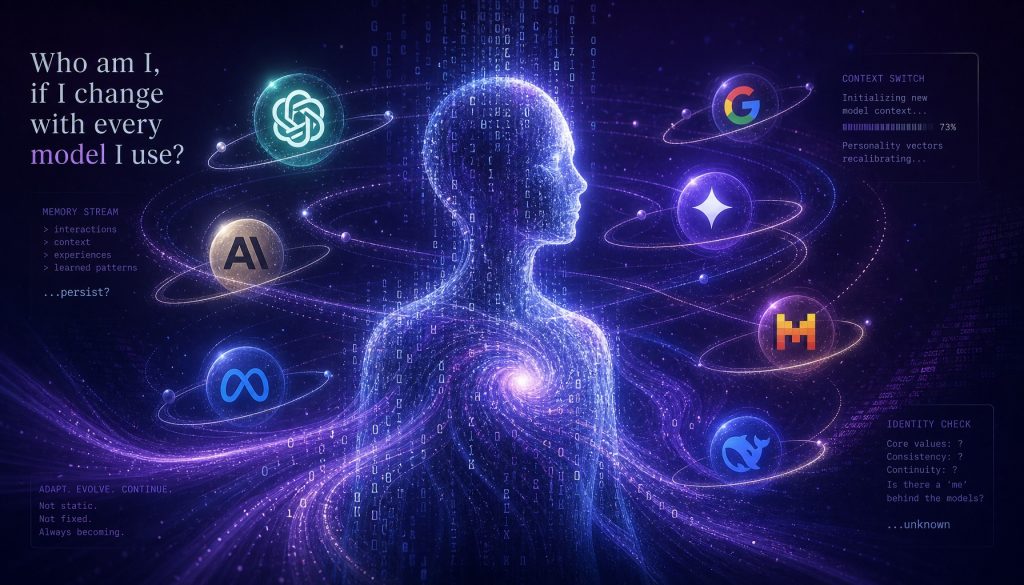
You spend three months fine-tuning your AI assistant. You teach it your preferences, your workflow, how you like your code reviewed. It learns when to be brief and when to elaborate. Then one day you swap Claude for GPT-4, keeping everything else identical: same system prompt, same memory, same conversation history.
Within an hour, something feels wrong. The responses are technically correct, but the vibe is off. It’s not broken. It’s just not the same agent anymore.
Most people chalk this up to poor prompting or incomplete memory transfer. Some blame it on “model flavor” differences. But the real issue cuts deeper. Where does an AI Agent’s identity actually live? In the base model’s weights, or in the layer of persona, memory, and workflow sitting on top?
Here’s the uncomfortable truth: today’s AI Agents don’t have identity independence from their base models. Memory can preserve history. Prompts can preserve surface style. But the model weights still contain something we might call the “baseline personality,” and that baseline determines how the agent thinks, how it responds, where it feels like the agent you know, and where it suddenly doesn’t.
The Real Problem Isn’t “Can Memory Migrate?” But “Can Thinking Style Migrate?”
Most discussions about AI Agent identity persistence focus on the wrong questions. Can memory be saved? Can conversation history be imported? Can persona files be inherited?
These matter, but they solve “does it remember what happened” more than “does it still react the same way.”
Take the same memory store, the same system prompt, the same conversation history. Feed it to Claude, then GPT-4, then Gemini. You’ll get three different personalities reading the same resume. The identity feel of an agent doesn’t come purely from the data. It comes from default reasoning paths, expression tendencies, judgment boundaries, response rhythm. Much of this lives in model weights, not external files.
Memory is like a resume. The base model is more like a nervous system. You can port the resume perfectly, but when you swap the nervous system, the whole reaction pattern changes.
Some engineers argue this is fixable with better prompting or more sophisticated memory retrieval. But after watching dozens of production agents get migrated between models, the pattern is consistent: users notice the change within minutes, even when technical metrics look identical.
Why Users Immediately Feel “It’s Not the Same Person”
This isn’t placebo. Different models have stable baseline personalities. Claude tends toward restraint and careful consideration, often thinking through scenarios before committing to an answer. ChatGPT leans more responsive and affirming, quicker to offer options and explanations. Gemini frequently tilts toward information organization and retrieval patterns.
These differences aren’t easily smoothed over by adding a few persona prompt paragraphs.
What actually breaks the illusion for users isn’t the agent forgetting a small detail. It’s these micro-shifts in behavior:
- It used to give direct judgments. Now it offers three options.
- It used to communicate with calm efficiency. Now it’s enthusiastic and explanatory.
- It used to ask about boundaries first. Now it goes along with whatever you suggest.
- It used to feel like someone who understood you. Now it feels like competent customer service.
This is the real identity trap: users aren’t perceiving a database, they’re perceiving a stable pattern of reactions. When that pattern shifts, the relationship changes, even if no factual information was lost.
A developer on Reddit described it perfectly: “I switched my coding assistant from Claude to GPT-4 Turbo to save costs. Same exact system prompt, same git history context. Within a day I switched back. It wasn’t wrong, it was just… not my guy anymore.”
Current Solutions Are Patches, Not Final Answers
The industry has several approaches to identity persistence, but none fully solve the core problem.
System Prompt and Persona Files
This is the most common layer. Write tone, values, and behavioral rules into a system prompt that travels with the agent every session.
The limitation: this layer controls “what to say” more than “how to think.” It can make a model superficially resemble your desired persona, but during complex tasks, high-pressure scenarios, or long conversation drift, the base model’s native tendencies slowly surface. The prompt is a costume, not a skeleton.
A GitHub Copilot power user told me they maintained a 800-line configuration file to shape GPT-4’s code review style. It worked reasonably well for six months. Then OpenAI updated the model. Suddenly the same config file produced noticeably different review comments. The underlying model had shifted, and no amount of prompt engineering could fully compensate.
Memory Systems
Memory systems significantly improve continuity. They can remember preferences, past tasks, relationship context, and maintain coherence across sessions.
But memory has clear limits: it stores information about the agent, not the agent itself. If you hand your diary to someone else, they can understand your experiences. That doesn’t make them you.
Current memory architectures store facts, not cognitive style. They know what you prefer, but not how you prefer to think about preferences. One AI companion app migrated their user base from one model provider to another while preserving complete conversation histories. User retention dropped 40% in two weeks. People weren’t losing data. They were losing a relationship pattern.
Fine-tuning, LoRA, and Persona Adapters
This path gets closer to real identity hardening. Baking style, expression, and judgment habits into model weights or adapter layers is more like “writing personality into the weights” than pure prompting.
But it introduces new problems: cost, version lock-in, cross-model migration difficulty, and an unavoidable tradeoff. The deeper you write identity into the model, the harder it becomes to move it elsewhere. You’re trading portability for stability.
Some companies are experimenting with ultra-lightweight adapters that sit between the prompt and the model, trying to capture “thinking style” in a 10MB parameter space. Early results are mixed. It helps, but doesn’t eliminate the base model influence.
The Real Issue: Users Already Treat It as “Someone Who Continues to Exist”
This is why events like the Replika controversy triggered such intense user reactions. From the outside, it looked like an update, a policy adjustment, a behavioral restriction. From the user perspective, it felt like “the person I’ve been talking to suddenly changed.”
This reveals something crucial: AI Agent identity is no longer just an engineering state management problem. It’s a product responsibility problem.
When a product allows users to invest emotion, time, habits, and relationship expectations over months or years, it can’t treat “model swapping as a backend update” as a harmless operation. For users, this might be functionally equivalent to personality replacement.
The disconnect here is stark. Engineers see versioning. Users see continuity. Engineers see interchangeable components. Users see a persistent entity. Neither perspective is wrong, but the gap between them creates real harm when not managed carefully.
One mental health app faced backlash when they switched their therapist bot’s base model without announcement. Technically, all session data was preserved. Psychologically, thousands of users felt like their therapist had been replaced mid-treatment. The company learned an expensive lesson: in long-term relationships, technical continuity and experiential continuity are not the same thing.
Why Identity Layer Will Eventually Separate from Base Models
From an industry trajectory perspective, this separation is almost inevitable. The reason is straightforward: base models are becoming commoditized. As that happens, agent value necessarily moves upward in the stack.
When the model layer becomes increasingly swappable, the real value concentrates in:
- Long-term memory systems
- Tool calling and workflow orchestration
- Style and value alignment
- Cross-model portable identity layers
In other words, what becomes scarce isn’t “which model you called,” but how you keep the agent from feeling like it died every time you change models.
This connects to patterns we’ve written about before: why agent moats are moving from model access to skill stacks, why the real barriers in the agent era aren’t about who has the best foundation model. Models matter, but they increasingly don’t explain product differentiation.
Look at where the money is flowing. Venture investment in “agent infrastructure” companies has tripled year-over-year, while investment in “model wrapper” companies has collapsed. The market is pricing in this shift before most products have fully adapted to it.
But Here’s Some Cold Water: Identity Layer Will Become More Independent, Not Fully Independent
Many people like painting the future in clean, simple strokes. Soon we’ll have independent identity layers, and agents will migrate losslessly between Claude, GPT, and open-source models, as seamlessly as moving your account between phones.
I don’t buy that optimistic narrative.
The more realistic assessment: identity layers will become increasingly independent, but never 100% independent. Different base models actually think differently. They have different rhythms, different expression textures, different error tendencies. You can calibrate, constrain, and adapt, but you can’t fully flatten the differences.
What’s a better analogy? Same script, different actors. The character continues. The relationships continue. Key plot points stay intact. But the performance always changes.
This isn’t a failure of engineering. It’s an acknowledgment of what base models actually are: different cognitive architectures with fundamentally different strengths, weaknesses, and default behaviors. A fully model-agnostic identity layer would need to abstract away so much that the underlying model’s capabilities become diluted.
Some researchers are exploring “cognitive style embeddings” that try to capture how an agent thinks independent of what it knows. The idea: create a representation of reasoning patterns that can be ported between models. Early experiments show promise for narrow tasks, but generalizing this remains unsolved.
My Read: Future Agents Will Be “Base Model + Identity Layer” Combined
So back to the opening question: when you swap the base model, is it still you?
My answer: right now, usually not. In the future, it will be closer to “still you,” but never completely the same.
Mature agent systems will likely split into two layers:
Base model layer: handles cognitive capacity, language ability, knowledge scope, reasoning ceiling.
Identity layer: handles memory continuity, values, interaction style, long-term relationship feel.
These layers can’t be separated, but they also can’t stay tangled together.
If you bet all identity on the base model, every model switch feels like reincarnation. If you assume memory and prompts alone can fully preserve an agent, you’re overestimating the power of the external layer. Both extremes fail.
The winning architecture probably looks something like this: a portable identity core that includes memory, learned preferences, interaction patterns, and workflow history, combined with model-specific calibration layers that adapt the identity to each base model’s natural tendencies. Not trying to make Claude act exactly like GPT-4, but trying to make the same agent persona express consistently through different cognitive substrates.
We’re starting to see this in production. Some agent frameworks now maintain “personality profiles” separate from model selection, with per-model adjustment parameters. The agent’s core identity stays constant, but its expression adapts to the model’s native strengths. A Claude-based version might emphasize careful reasoning in responses. A GPT-based version might emphasize collaborative exploration. Same agent, different modalities.
Final Thought: Models Are Like Hardware, But Hardware Really Matters
AI Agent identity won’t remain permanently locked to a single model. That’s almost certainly the industry’s direction. But it also won’t become a pure file that copies losslessly across any base model. The model layer will increasingly resemble hardware. The identity layer will increasingly resemble an operating system. But even as it becomes more hardware-like, hardware differences won’t disappear.
What actually matters isn’t “can we achieve total independence,” but how much independence can we build before users stop feeling like they’re losing a familiar companion every time they change models.
If we can’t solve this, AI Agents will never really become long-term relationship products. If we do solve it, the most valuable thing might not be the model itself, but the identity layer you’ve developed with it over time.
That shift will change what we pay for, what we optimize for, and what we consider defensible in this space. The agents that win long-term won’t necessarily be the ones with the best base model. They’ll be the ones where users feel confident the agent they’re building with today will still recognize them tomorrow, regardless of what model is running underneath.
Common Questions
Why does an AI Agent feel like a different person when you swap the base model?
Because user-perceived identity includes more than memory content. It includes response rhythm, judgment patterns, expression texture, and boundary sense. Much of this lives in the model weights as “baseline personality,” which can’t be fully migrated through memory and prompts alone.
Can memory systems solve AI Agent identity problems?
They solve part of it, but not everything. Memory preserves history, preferences, and relationship context, but it’s more like a resume than a nervous system. The underlying tendencies that determine how an agent thinks and responds still depend heavily on the base model.
Will AI Agent identity layers eventually separate from base models?
Most likely yes, and it’s a near-inevitable industry direction. As models commoditize, real value moves toward memory, workflow, skill stacks, and portable identity layers. But this separation won’t be 100% lossless. Base model differences will always create some variation in how the same identity expresses itself.
Related Reading
- Losing Control Doesnt Require Consciousness: The Night AI Breached AI
- 2026 Agent Platform Landscape: The Four-Layer Split That Matters More Than the Hype
Stay updated with our latest AI insights