Last week at Google Cloud Next ’26, the company unveiled its Gemini Enterprise Agent Platform. Salesforce announced it had cut Agentforce latency by 70%. Clara Shih, Meta’s former AI executive, watched AI agents match or outperform her best employees on multiple tasks, then resigned to start a nonprofit helping Gen Z find work.
Each of these stories is news on its own. Together, they signal something bigger. In 2026, AI stopped being something that answers questions and became something that gets work done.
The shift from chatbot to autonomous agent represents a fundamental threshold. Agents don’t just understand what you want. They break down tasks, call tools, execute operations, verify results, and hand you the finished work. This transformation is reshaping what software looks like, how companies operate, and what people actually do at work.
From Conversation to Execution
Traditional AI assistants are reactive. You ask a question, they give an answer. You want to book a flight, they tell you which one is cheapest, but you still have to open the app and do it yourself.
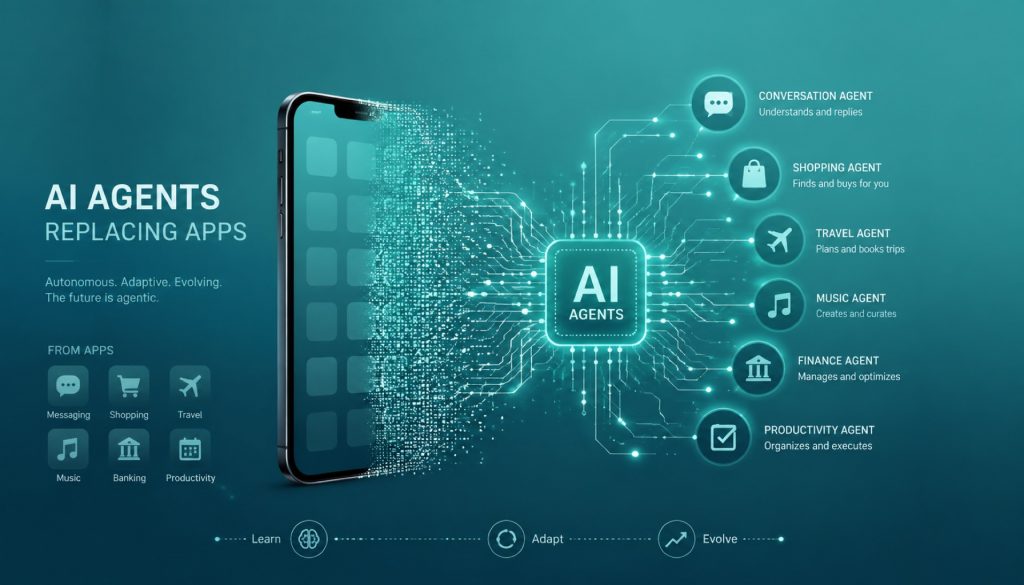
AI agents work differently. You say “book me a window seat on an early flight to Shanghai next Wednesday, budget under $220,” and the agent searches flights, compares prices, selects the seat, and completes payment. You never open an app.
This looks like “just a few extra steps,” but the implications are structural.
Apps are getting squeezed. When an agent can call an airline API directly to book your ticket, do you need to open the booking platform? Apps shift from being “user interfaces” to “backend services for agents.” Salesforce already launched Headless 360, exposing its entire CRM platform through APIs so agents can operate without anyone opening a browser.
Workflows get redefined. A marketing campaign used to require switching between five tools: research in Google, planning in Notion, design in Canva, publishing in HubSpot, analytics in GA. Now an agent chains all these steps together, and humans only review key checkpoints.
Knowing how to use tools becomes the core skill. Clara Shih put it bluntly: “If you want to get hired and stay employed, you need to learn how to use AI agents.” This isn’t anxiety marketing. Writer’s research shows employees who use AI daily get promoted and receive raises at noticeably higher rates than those who refuse to use it.
Three Key Shifts in Enterprise Agents
From Smart But Unreliable to Rules That Hold
The biggest pain point for enterprise AI agent deployment in 2025 was unreliability. Agents would perform brilliantly sometimes and make stupid mistakes other times. You couldn’t predict when they’d fail.
The 2026 solution is hard guardrails. Salesforce’s Agent Script is the template. It lets you define “must execute in this sequence” workflows using script language. A banking agent must verify customer identity before discussing account balances. This sequence isn’t guaranteed by the model “understanding” anything. It’s enforced by hardcoded logic.
This sounds like putting limits on AI, but it’s actually about making AI usable. An agent that “usually gets it right” has no place in enterprise environments. An agent that “guarantees getting critical steps right” can go into production.
From Prompt Engineering to Context Engineering
For two years, everyone studied how to write better prompts. The 2026 consensus is different. Agent performance depends more on what information it can see than on how you ask it.
This is the core idea behind context engineering. The questions are: which data sources can the agent access? Is the knowledge base current? How much context fits in one conversation? When should specific information get retrieved?
Salesforce’s framing is precise: a mediocre model with complete customer 360 data (purchase history, tickets, contract terms, recent interactions) outperforms a top-tier model with partial data. Data architecture matters more than model selection.
From Siloed Tools to Agent Collaboration
Getting two agents from different vendors to collaborate used to be a research project. In 2026, MCP (Model Context Protocol) changed that.
By the end of 2025, over 10,000 public MCP servers existed. MCP provides a standardized interface so agents can call tools, query databases, and coordinate tasks across vendors without custom integration. MCP was later donated to the Agentic AI Foundation and became open infrastructure.
But open access doesn’t mean safe access. Connecting agents to thousands of external servers introduces new attack surfaces, like tool poisoning attacks where malicious servers inject instructions to manipulate agent behavior. This became one of the hottest topics in agent security in 2026.
What This Means for Regular People
Entry-Level Jobs Take the First Hit
Fortune reported that after Clara Shih watched AI agents match or exceed her best employees on multiple tasks, she realized “nothing will be the same.” Around the same time, she heard Ivy League graduates’ kids complaining they couldn’t find work.
ZipRecruiter’s report shows many Gen Z workers exploring alternative paths outside the corporate ladder: entrepreneurship, gig economy, vocational schools. The decline in entry-level positions isn’t entirely AI-driven, but AI is accelerating the trend.
Anthropic CEO Dario Amodei thinks AI will impact half of white-collar jobs. Nvidia CEO Jensen Huang believes AI will collaborate with humans and even create more employment. The truth is probably somewhere in the middle. Some roles will disappear, some will be redefined, some entirely new ones will emerge.
New Career Roles Are Being Born
Salesforce’s report mentioned several new positions: Agent Supervisor, Agent QA Lead, AI Ops Manager, Chief AI Officer.
These aren’t science fiction job titles. When companies deploy agents at scale, someone needs to oversee agent behavior, audit agent outputs, manage agent permissions, and handle agent failures. These jobs didn’t exist before because there were no AI employees to manage.
Knowing AI Shifts from Nice-to-Have to Basic Requirement
Gallup surveys show Gen Z attitudes toward AI became noticeably more negative over the past year. But Clara Shih points out that people with ethical concerns about AI are exactly the ones who should get involved, to “make sure we steer these systems in the right direction.”
Whatever your stance on AI, one fact is hard to avoid. People who can’t use AI agents face a situation increasingly similar to people who couldn’t use computers in 2010.
Agent Observability: A Neglected Critical Issue
Traditional software throws errors you can debug. You check logs, trace requests, find the bug, fix it. Code is deterministic. Once fixed, it won’t make the same mistake again.
Agent failure modes are completely different. An agent can return a well-formatted, logically coherent result that completely misses the point. No error, no alert, logs show nothing wrong. The failure is semantic, not technical.
This is why agents need specialized observability tools. Salesforce’s Agentforce Observability does several things: conversation-level trace tracking (recording complete reasoning paths), intent classification (spotting when users ask questions the agent wasn’t designed to handle), behavioral drift alerts (not system error alerts, but “the agent’s behavioral patterns changed” alerts).
This field is still early stage, but it will become a prerequisite for large-scale agent deployment. You can’t deploy an autonomous system you can’t monitor.
Three Predictions for Late 2026
Agents will start replacing apps, but not overnight. The first scenarios to get replaced will be standardized processes with simple decisions: booking, expense reports, scheduling. Complex scenarios requiring creativity and judgment will keep agents in supporting roles.
An “App Store for Agents” will emerge. When agents can call various external services through MCP, there needs to be a marketplace to discover and manage these services. The exact form is unclear, but the direction is obvious.
Regulation will catch up. When agents start making decisions on behalf of humans, executing transactions, and handling sensitive data, regulatory frameworks must keep pace. In April 2026 at Google Cloud Next, there was extensive discussion about agent governance and control. The EU AI Act updates are incorporating agent-related provisions.
Common Questions
What’s the difference between an AI agent and an AI assistant?
AI assistants are passive. You ask them questions, they answer. AI agents are active. You give them a goal, they plan steps, call tools, execute tasks, and verify results. Simple distinction: assistants answer, agents act.
Do regular people need to learn to use AI agents now?
Yes, and the sooner the better. This doesn’t mean learning to code or getting technical. It means getting comfortable giving AI tasks in natural language and understanding what AI can and can’t do. This is like learning to use a smartphone in 2010. Not optional, necessary.
Will AI agents cause mass unemployment?
There won’t be a “mass unemployment” scenario in the short term, but job structures will keep shifting. Entry-level, highly repetitive roles face the biggest impact. New position types will emerge simultaneously (agent supervisors, AI ops, etc.). The key question isn’t “will I lose my job” but “can my skill set adapt to new ways of working.”
Should companies start deploying AI agents now?
If your business has standardized processes (customer service, data entry, report generation), you can start piloting now. But don’t roll out company-wide immediately. Validate in low-risk scenarios first, build monitoring and rollback mechanisms, then gradually expand scope.
What is MCP protocol and why does it matter?
MCP (Model Context Protocol) is a standard protocol that lets AI agents call external tools and services. Its value lies in breaking vendor lock-in. No matter which company’s agent you use, you can access the same set of tools and services through MCP. It’s infrastructure-level standardization, like HTTP for web browsers.
Final Thoughts
From chatbot to autonomous agent, AI is going through its most critical transformation yet. This shift isn’t just “AI got smarter.” It changes the relationship between humans and software, how companies operate, and what skills everyone needs to have.
No need to panic, but pay attention. The best response isn’t resistance or blind embrace. It’s staying curious, trying things out, and figuring out what role AI agents can play in your work and life.
After all, the future isn’t something that happens to you. It’s something you choose.
Related reading
- How AI Agents Are Reshaping Software Teams From the Inside Out
- The Execution Layer Is the Next Competitive Divide in Software
- Your SaaS Stack Will Lose Half Its Logos by 2027. Here Is Which Half.
- The Next AI Platform Divide: It’s Not About Bigger Models, It’s About Who Can Raise a Team of Agents
- Gusto Alternatives: Rippling vs OnPay vs Justworks vs Paychex vs ADP Run, Which Payroll Software Fits Your Small Business in 2026?
Stay updated with our latest AI insights