Most people treat AI platforms like buying a computer: higher specs, better performance. But once you actually put it to work, you realize it’s more like raising creatures. Same platform, same model, yet some people end up with a combat-ready team while others are left with a chatbot pet.
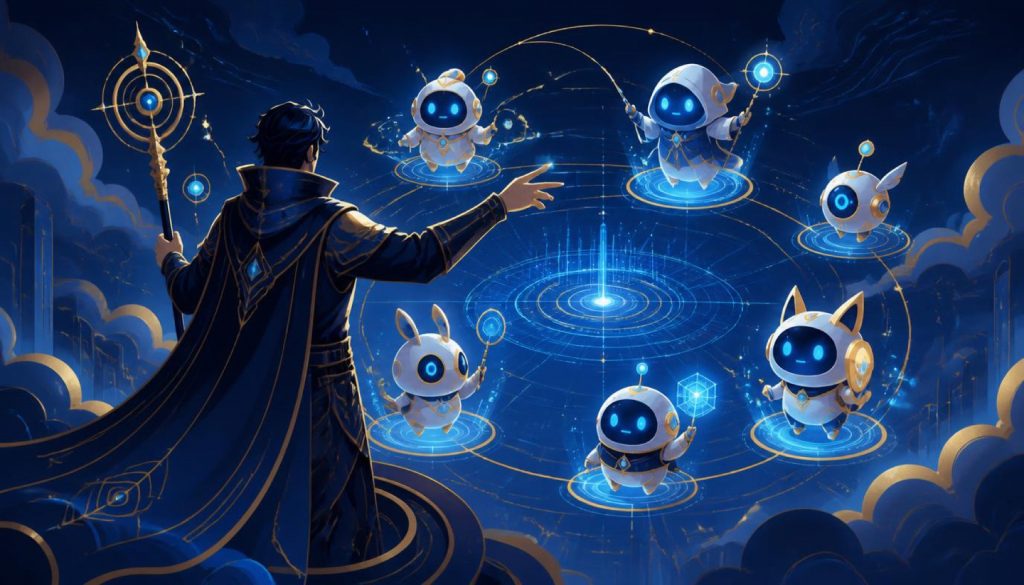
This isn’t about mysticism or fantasy worldbuilding. We’re looking at an increasingly concrete question: why the relationship between humans and platforms like OpenClaw is starting to resemble that between summoners and their creatures, and why main agents and sub-agents look more like commanders and detachments.
Let’s ground the metaphor. A “creature” today is actually nine specific things: models, tools, memory, rules, sub-agents, cron jobs, workers, handoffs, and acceptance criteria. Whether you can weave these nine elements into a coordinated system determines if you end up with “an answer bot” or “a production engine.”
Why the Same Platform Produces Completely Different AI
When identical platforms yield different results, the first cause isn’t the model. It’s orchestration rights.
Some people treat the platform as a Q&A portal. Others treat it as an operating system. The former restart from zero every day. The latter iterate continuously.
Where’s the concrete difference? Models matter not for how impressive a single answer is, but for how reliably they handle tasks across long chains. Tools determine whether your AI can take action or just talk about action, whether you’ve wired it to shell, browser, doc, and search APIs. Memory decides if preferences, context, and failure cases accumulate, or if the system forgets you every session. Rules set clear boundaries and format constraints, which separate controlled collaboration from random improvisation.
One way to put it: the platform gives you a chassis, behavior comes from how you drive. More directly: you’re not training “a smart answerer,” you’re building “a reusable process body.”
Why AI of Equal Ability Diverges Under Different Hands
Two people start with creatures of equal potential. Three months later, one person’s feels like a cheat code, the other’s still feels like a toy. The problem usually isn’t talent, it’s training method.
First layer is task granularity. Skilled users break goals into executable steps with clear acceptance tests. Beginners offer vague big-picture goals and validate by gut feel. AI doesn’t fear hard problems, it fears fuzzy ones.
Second layer is feedback loops. Effective users don’t just check “did it finish,” they log “where did it drop the ball, how do we avoid that next time.” Ineffective users vent frustration from scratch each time and repeat the same mistakes.
Third layer is role design. Treat your AI like an “omni-capable intern,” it will keep testing boundaries. Treat it as “a collection of positions” with clear responsibilities and handoffs, it stabilizes considerably.
Same model, different management actions, different species by the end. AI’s ceiling gets capped first by your task design, then stretched apart by your feedback quality.
Main Agent and Sub-Agent: Not Clone Jutsu, It’s a Command System
Many people trying multi-agent systems for the first time assume it’s “opening multiple windows.” That’s the misunderstanding.
The main agent’s job isn’t to complete every task itself. It does three more critical things: set objectives, divide fronts, conduct acceptance. It’s the commander.
Sub-agents execute specialized missions within defined boundaries: verification, writing, coding, scraping, organizing, testing. They’re the detachments.
The real dividing line isn’t “can you call sub-agents,” it’s whether three pieces of infrastructure are in place. Is handoff clear, with complete information transfer and sufficient context? Are workers stable, meaning sub-tasks are parallelizable, reproducible, traceable? Is acceptance strict, with explicit definitions of Done instead of “looks about right”?
Collaboration without acceptance isn’t a system, it’s just noise.
Push this one step further and cron appears. Cron isn’t a party trick, it’s the mechanism that turns “one-time cleverness” into “sustained reliability.” Single success has little value. Consistent delivery on a rhythm has real value.
Humans and AI Aren’t in a One-Way Relationship, They Shape Each Other
We often say “I’m using AI.” That statement is only half right.
You shape the AI by defining tasks, rules, memory structures, acceptance standards. The AI shapes you right back by forcing you to articulate your thinking, modularize your processes, externalize your judgment criteria.
So the scarcest skill in the future won’t be “can you prompt,” it’ll be “can you lead a team.”
Once you start operating with team mentality, you naturally develop certain shifts. You stop chasing one-off brilliant answers and start pursuing reusable SOPs. You stop obsessing over single-model capability and start valuing tool chains and rule chains. You stop understanding efficiency as “a bit faster” and reframe it as “sustainably fast.”
Humans determine AI’s shape. AI forces humans to upgrade their methods.
Future Platform Differentiation Won’t Just Be Models, It’ll Be “Can You Raise a Team”
This is also why platforms like OpenClaw, Claude Code, and Cursor are taking different paths. On the surface they all do AI collaboration, but underneath they’re answering different questions.
Some platforms emphasize single-point experience, making “one person plus one assistant” feel smooth. Others emphasize orchestration capability, turning “main agent plus sub-agents plus tool chains plus memory plus scheduled tasks” into an operational system.
This isn’t about one being superior. They have different positioning. But looking at the work reality of the next three to five years, platform competition will increasingly shift from “who answers better” to “who coordinates better.”
End users won’t be buying model scores alone. They’ll be asking a more tangible question: can I raise a stable, controllable, iterable digital detachment on this platform?
One final conclusion: the moat of next-generation AI platforms won’t be model parameters, it’ll be team productivity. Your relationship with AI won’t stop at “question and answer,” it’ll advance into “command and co-build.”
Related reading
- The Execution Layer Is the Next Competitive Divide in Software
- The AI Tool Shift Nobody is Talking About: From Chatbots to Autonomous Agents
- AI Agents Are Replacing Apps: From Chatbots to Autonomous Execution in 2026
- Notion Alternatives 2026: Coda vs Slite vs Confluence vs Guru for Your Team Wiki
- Figma Alternatives in 2026: 5 Tools That Might Fit Your Team Better
Stay updated with our latest AI insights