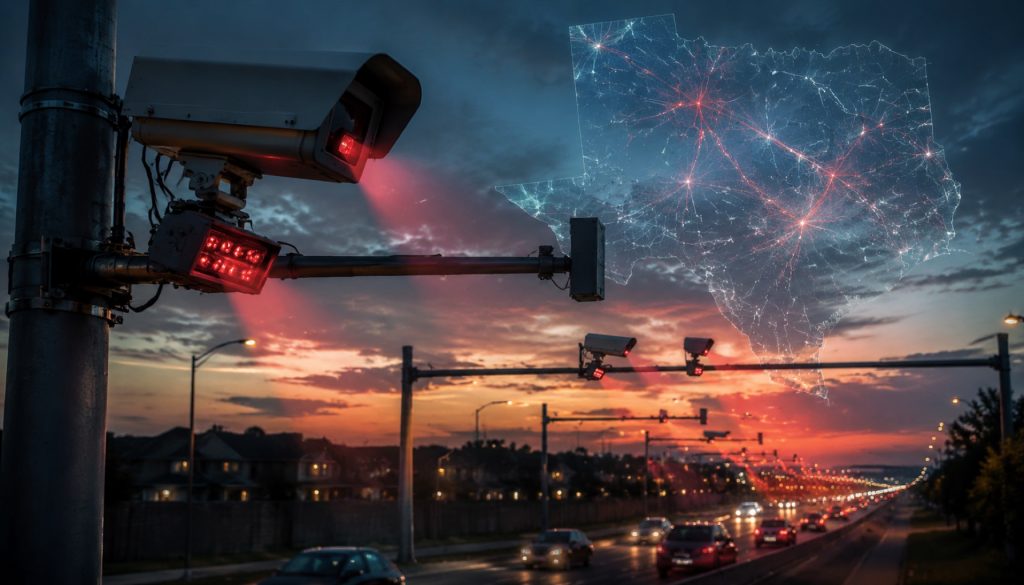
On a Thursday night this summer, Texas Governor Greg Abbott signed an order. The instruction was simple: every state agency was to immediately stop sending money to a company called Flock Safety to buy its AI surveillance cameras.
There was no press conference, no advance notice. The timing said a lot. The order landed just as the Texas Tribune was about to publish an investigation into an uncomfortable fact for taxpayers. Through grants handed down to local agencies, Texas had spent at least $30 million on Flock’s AI cameras. What made the money trail worse was where it came from. The funds traced back to a higher fee that Texas lawmakers had piled onto residents’ car insurance policies.
Put plainly, Texans paid extra on their insurance so the state could buy cameras to watch them.
A few years ago this might have been a local story that rippled for a day and faded. In 2026 it became something else. The fight over Flock, and over large-scale AI monitoring in general, has turned into a rare battle that crosses party lines, playing out in state after state at the same time.
A hundred thousand cameras, watching
To understand the storm, you have to understand what Flock Safety actually does.
The technology itself is not complicated. The company installs cameras along roadsides that automatically read the license plates of passing vehicles and upload the data to a cloud database. Law enforcement can then search that database for the movements of a specific plate: when a car appeared at a given intersection, which neighborhoods it passed through, how long it lingered.
It sounds like a useful public safety tool, and police do like it. A car gets stolen, you punch in the plate and find where it last surfaced. A suspect’s vehicle passed near a crime scene during a certain window, and one query tells you so. For small-town departments running short on officers, a Flock camera is close to a gift from the sky. No extra staffing, no stakeouts, one device watching around the clock.
The problem is scale.
More than 120,000 Flock cameras are now deployed across 49 states. That means the moment you drive onto a public road, your plate and your travel patterns are quietly recorded and stored in a database you cannot see or touch. And in most cases, none of it requires a warrant.
No warrant needed. Those three words sit at the center of the whole dispute, and they are what finally set public sentiment alight. In the American legal system, before police can search your house or scroll through your phone, they usually need a warrant signed by a judge, backed by reasonable suspicion. That is the Fourth Amendment’s baseline protection of privacy. But a plate reader capturing your movements on a public road? That falls into a slippery gray zone. Your plate is already public, and your route down a public street hardly counts as private space. So a large number of agencies acquire and use Flock cameras while sidestepping the warrant entirely.
You might think: I have done nothing wrong, so what if I get photographed?
It is a common reaction, and a natural one. But what happened next has pushed more and more Americans to reconsider the whole “nothing to hide” logic.
When a tool becomes a weapon
The Washington Post has reported cases of law enforcement officers using their access to Flock data to track and harass former partners.
This is not a movie plot or a theoretical risk. It has already happened. Someone with access to the system can easily pull up where a person’s car shows up every day, what time it passes which road, how long it sat at a certain address. For anyone with the intent to stalk, that is a weapon placed directly in their hands.
And these are only the cases that came to light. When 120,000 cameras collect an ocean of movement data every day, and access to that data lacks strict auditing and oversight, it becomes hard to believe abuse is a rare exception. Picture a bored officer on shift who wants to check where an ex-girlfriend has been lately. Is there anything in the system to stop him? In most jurisdictions that have deployed Flock, the answer is close to nothing.
That worry quickly produced a telling phenomenon. Websites like “Have I Been Flocked?” sprang up to let ordinary people check whether their plate has landed in Flock’s database. The name obviously echoes the well-known security site “Have I Been Pwned?”
A public safety tool built for police, reaching the point where citizens feel they need a dedicated website to see whether it has “captured” them, is darkly funny on its own. It says that in many Americans’ minds, Flock is no longer the good thing that helps catch criminals. It has become something to guard against, filed alongside data breaches and hacking as the same class of threat. The collapse of trust often hides in exactly that kind of subtle shift.
Ten thousand cameras in a campaign ad
Back to Texas.
Abbott did not rush to sign that late-night order solely because of the $30 million grant scandal about to surface. Days earlier, his Democratic challenger Gina Hinojosa had released a campaign ad with a line that cut especially deep. Texas, it said, has 10,000 Flock cameras reading your plate, logging where you sleep and pray, and all of it with no warrant needed.
Logging where you sleep and pray. That phrasing hits two of the most sensitive nerves in American society at once: personal privacy and religious freedom. Especially in a place like Texas, where conservatives hold the majority and instinctively distrust government power, the story of “the government used the extra fees you paid to buy cameras that track which church you attend” is devastating.
For a Republican governor, being tagged as soft on mass surveillance is fatal. Republican voters believe in small government down to the bone, the less it governs the better, individual liberty sacred and untouchable. A Republican governor spending $30 million on AI monitoring is a narrative that, once it sets, is nearly impossible to reverse in an election.
So Abbott’s reaction was almost a reflex.
The interesting part is that this anti-surveillance wave is not confined to Texas, and not confined to Republicans.
A rare consensus across the aisle
In today’s American politics, Democrats and Republicans oppose each other on nearly every issue. Immigration, abortion, guns, healthcare, climate. You say east, I say west, until it becomes a reflex.
On the question of large-scale AI surveillance, though, the two parties have fallen into a strange resonance.
In Michigan, Democratic Senate candidate Abdul El-Sayed gave his Republican opponent Mike Rogers a nickname, “Mass Surveillance Mike.” His strategy was to cast his rival as someone who backs blanket AI camera monitoring of voters. In Pennsylvania, candidates on both sides are running on anti-surveillance platforms. And in Missouri, Republican Senator Josh Hawley announced an investigation into Flock Safety to figure out exactly how the company handles the vast trove of vehicle movement data it collects.
You rarely see a scene like this in American politics, close to a spectacle. A candidate on the left and a senator on the right, with different motives and different language, pushing in the same direction. The left worries about civil liberties and the disproportionate surveillance of minorities. The right worries about swelling government power and the erosion of individual privacy. Different starting points, the same landing spot. This stuff is spreading too fast, governed too loosely, and ordinary people are left in the dark.
That kind of consensus across ideological lines is unusual and worth watching. It hints that large-scale AI surveillance has touched something deeper than partisan disagreement, a bedrock anxiety about where the limits of government power should sit. The left phrases it as civil liberties, the right phrases it as small government, but the anxiety underneath is the same.
The technology is innocent, the deployment is not
Cool-headed analysis says Flock’s plate-reading technology is not some evil invention. Automatically reading license plates is something toll booths and parking garages around the world do every day. The camera at the entrance to your own apartment complex may well do something similar.
What set off this crisis is not the technology. It is the way the technology was deployed at scale.
The first issue is scale itself. 120,000 cameras across 49 states is no longer the level of “a few cameras on a high-crime stretch of road.” It is a nationwide tracking network. When one camera catches your plate, you are a single record on a single photo. But when the data from 120,000 cameras pours into the same cloud database, it can assemble a complete picture of you. What time you leave every morning, which road you take to work, where you grabbed lunch, which church you visited on the weekend, whose house you stayed at overnight. Any single item is public information. Stitched together, it is a precise map of a life.
The second issue is consent. The vast majority of Americans recorded by Flock cameras have no idea they have been recorded. The cameras usually sit in unremarkable spots, with no prominent sign telling you a plate reader is ahead. When your plate data is collected, how long it is kept, who is allowed to pull it, whether those queries are audited, the average person knows none of it.
The third issue is a legal framework badly out of date. The Fourth Amendment was written in 1791. The lawmakers of that era could never have imagined a scenario where, without sending anyone to tail you, without entering your home, without searching any of your belongings, the state could reconstruct all your movements simply by photographing your plate on public roads. Existing law has almost no clear rules for this kind of large-scale data collection in public space, which is why agencies can use the data at scale without any judicial authorization.
The fourth issue is commercial incentive. Flock is a private company, and its business model is selling cameras to as many agencies as possible and collecting subscription fees. The bigger the footprint, the higher the revenue. That gives the company a natural drive to push for ever-larger deployment, and its sales pitch leans on figures like improved clearance rates and faster response times, not on “our data could be misused to stalk an ex.”
When a technology’s deployment races far ahead of the law and regulation meant to govern it, when the power to use it carries no matching check, when the citizens it affects neither know nor consent, a crisis of trust is not a possibility. It is a certainty.
A warning shot for AI everywhere
What happened in Texas matters far beyond one governor blocking one round of funding.
Over the past few years AI has seeped into every corner of society at a dizzying pace. Generative AI writes your copy and draws your images, recommendation algorithms pick your videos and your products, facial recognition waves you through the turnstile. Most of the time, people’s attitude toward these applications is that they are handy, with the occasional gripe about a bad recommendation or an image with six fingers.
Flock tears open a deeper question. When AI stops “doing things for you” and starts “watching what you do,” public tolerance drops sharply.
The line looks subtle but is actually clear. AI translates an article for me, and I am the active user. I know what is happening and I can stop it anytime. AI automatically reads my plate, records my movements, and stores the data in a database I do not know about, and I am the passive subject of collection. I did not know, I did not agree, and I cannot opt out. The first is a tool. The second is control. People are generous with the former and instinctively wary of the latter.
That wariness knows no borders. The logic that drove a bipartisan backlash against Flock is universal. The technology itself is not the problem. The problem is who uses it, how, to what end, and whether the people affected have any right to know or to say no.
For every company and government pushing large-scale AI deployment, this is a clear warning shot. Speed does not equal legitimacy. Coverage does not equal justification. Technical capability does not equal a license to deploy. When the public feels completely transparent to a technology while knowing nothing about it, the backlash arrives faster and harder than you expect, and, as Flock is now learning, it can come from every direction on the political spectrum.
What comes next
The governor blocked the funding, but the Flock cameras already installed across Texas will not vanish overnight. Missouri’s investigation is ongoing. Legislative debates over plate-reader data are only beginning in various states.
It is safe to predict that the legislative fight over AI surveillance will be a slow-burning issue in American politics for years. Just as the internet era produced data privacy laws like Europe’s GDPR and California’s CCPA, the age of AI surveillance will eventually produce dedicated rules for automated data collection. The trouble is that law always trails technology, and in the gap sits the exposed privacy of countless ordinary people.
The deeper lesson reaches well past one American state. Any deployment of technology must eventually answer a plain question. How do you plan to earn the trust of the people it affects?
Whatever road you drive down, the cameras are there. The only real questions are who is watching, where the data goes afterward, and whether you know about it and have the right to say no.
That is what this storm is really asking.
Related reading
- Losing Control Doesnt Require Consciousness: The Night AI Breached AI
- Myths Were Never Myths: What AI Personality Reveals About Creation
Stay updated with our latest AI insights