There’s a particular kind of pain that doesn’t get talked about enough in engineering. Not a production outage, not data loss. Just the moment you’ve spent a full week debugging why your Airflow scheduler isn’t firing when it should, and the answer turns out to be a Python dependency version conflict in the environment.
That’s not an edge case. For teams building task scheduling or workflow orchestration systems, it’s routine. Airflow is the dominant tool in this space, but its learning curve and operational overhead have pushed a lot of teams to quietly search for “Airflow alternatives” after a few months of running it.
Kestra is one of the tools that comes up in those searches. It has 28387 stars on GitHub, describes itself as an “event-driven orchestration and scheduling platform for mission-critical workflows,” and defines workflows in YAML. The problem it’s solving sounds similar to Airflow’s, but the approach is completely different.
This article isn’t trying to tell you which tool has the most features. It’s trying to help you see the actual tradeoffs when you match each tool against a specific team scenario.
Why Workflow Orchestration Is Harder Than It Sounds
Step back for a moment. “Workflow orchestration” covers a lot of ground, and different teams mean different things by it.
For data engineers, it usually means scheduled ETL runs, managing table dependencies, and handling retries on failure. For backend teams, it might be a series of async tasks that fire after a user signs up: send an email, update the cache, notify downstream services. For DevOps, it’s the gray area beyond CI/CD: periodic log cleanup, certificate rotation, scheduled backups.
Airflow was built inside Airbnb primarily for data pipeline work, so its entire conceptual model (DAGs, Operators, Scheduler) is oriented toward batch data flows. That works well until your requirements drift away from that path, at which point the friction starts.
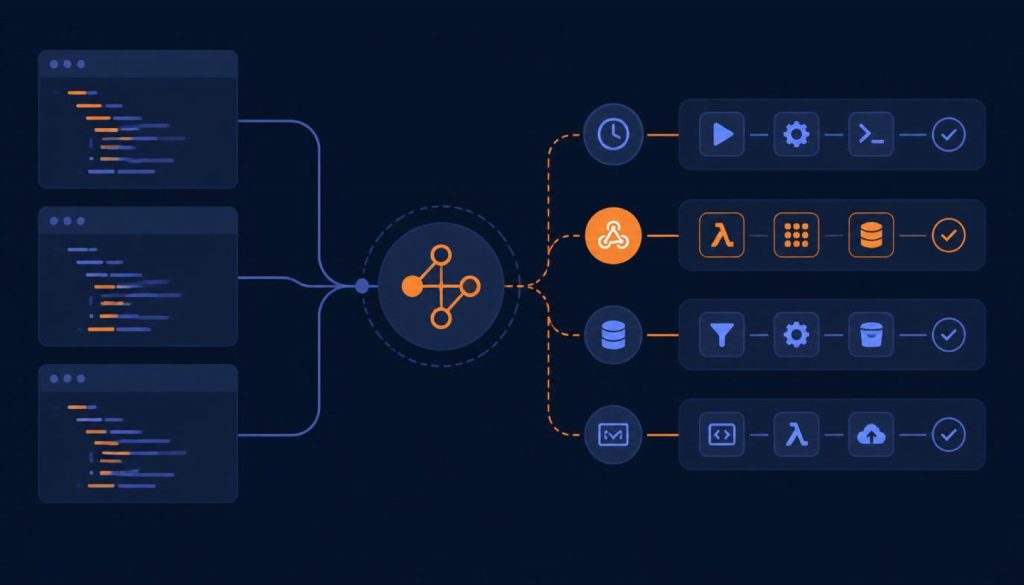
Kestra approaches the problem differently. It separates workflow definition from code and puts it in YAML. It also supports more than just cron-based triggers: an incoming HTTP request, a new message in a queue, a file appearing at an S3 path. Any of those can kick off a workflow. That makes Kestra viable beyond data pipelines, covering general business process automation as well.
n8n sits in a different category. It’s a visual platform aimed at connecting services through drag-and-drop, more suited to people who don’t write code than to engineering teams building production systems.
Prefect sits somewhere between Airflow and Kestra. It keeps a Python-first development experience but modernizes the architecture by separating the control plane from the execution layer.
Four tools, four different audiences. Here’s a closer look at each.
Apache Airflow: Biggest Community, Heaviest Operations
Say you’re a data engineer at a mid-size internet company. You picked Airflow in 2019, you’ve been running it for five years, you have hundreds of DAGs, an internal monitoring setup, and institutional knowledge of the operational quirks. Airflow is a reasonable choice for you. The community is the most mature of any tool in this space, most problems already have Stack Overflow answers, and the Provider ecosystem covers nearly everything.
But if you’re evaluating workflow tools today, the cost of Airflow needs serious consideration.
Airflow workflows are Python code. That means workflow logic and execution environment are tightly coupled. A DAG file can end up mixing scheduling logic, business logic, and configuration parameters. Keeping them cleanly separated requires real engineering discipline. The Scheduler periodically parses all DAG files and executes them, so a syntax error or a failed import in one file can affect scheduler stability across the board.
On the deployment side, a full Airflow installation requires a Webserver, Scheduler, Workers (if you’re using Celery or Kubernetes Executor), and a database (PostgreSQL or MySQL). Without Docker Compose or a Helm chart, standing it up from scratch takes meaningful time. Managed options exist (MWAA on AWS, Cloud Composer on GCP, Astronomer), but the pricing is hard to justify for smaller teams.
For triggering, Airflow’s core mechanism is cron-based scheduling. External triggers go through the REST API or Sensors. Sensors that watch for external events run as polling loops, occupying worker slots the whole time. At scale, a lot of Sensors burning resources continuously adds up.
The license is Apache 2.0, fully open source. That part’s clean.
Prefect: A Reasonable Exit Ramp for Python Teams Leaving Airflow
Different scenario. You’re an MLOps engineer at an AI company. Your team is all Python: model training, data processing, evaluation, deployment. Everything lives in one Python codebase. You need to orchestrate those steps, handle dynamic parameters, branch on conditions, and track the state of every run.
Prefect fits that scenario well. The core model is simple: decorate a Python function with @flow or @task and it becomes an orchestratable workflow unit. No new DSL to learn, no structural changes to your code, low migration cost for existing Python projects.
Prefect’s architecture splits the control plane (Prefect Cloud handles scheduling, UI, and state tracking) from the execution layer (Work Pool workers running on your own infrastructure). Using Prefect Cloud means you don’t maintain a Scheduler yourself. Keep a worker alive and you’re done. Full self-hosting is also available via Prefect Server.
On event-driven workflows, Prefect has an Automations feature that can trigger notifications or other flows based on events like a flow run failing. Compared to Kestra’s native message queue integration, the flexibility is more limited. Prefect’s events are mostly internal to the platform.
Prefect is Apache 2.0; the cloud version is billed by execution volume.
The constraint is clear: no meaningful support for languages outside Python. If your team has TypeScript for task logic, Shell scripts for ops, or Java handling certain services, Prefect doesn’t work as a unified orchestration layer.
n8n: Visual Automation, and Where It Stops
Another scenario. You’re an ops engineer at a SaaS company. You need to wire together Slack, Google Sheets, HubSpot, and Notion to automate repetitive business processes. You’re not much of a coder, but you understand logic and you’ve used Zapier. You want more control and the ability to keep your data on your own infrastructure.
n8n is a real answer here. Visual canvas, 1500+ integration nodes, drag-and-drop connections, no code required. The self-hosted version runs in Docker in a few minutes.
The license deserves careful attention though. n8n uses a “Sustainable Use License,” not a standard open-source license. Personal use and internal business use are fine, but if you’re offering it as a service to customers or building a commercial product on top of it, you need an enterprise license. That’s a fundamental difference from Apache 2.0, and it matters during technical due diligence.
In terms of production-grade stability and debugging experience with complex workflows, n8n has a visible gap compared to Airflow, Prefect, and Kestra. It lacks full DAG-level dependency management, and heavy branching logic gets hard to maintain on a visual canvas. It’s an automation tool, not an engineering-grade orchestration platform.
Kestra: When Your Team Doesn’t All Write the Same Language
Back to Kestra. Say you’re a platform engineer at a mid-size tech company. Your team has Java backend developers, Python data scientists, TypeScript frontend engineers, and a pile of Shell scripts. You need something that can orchestrate tasks across all those stacks, and you want workflow definitions that non-engineers can read, review in code review, and version-control.
That’s the problem Kestra was designed for. Workflows are written in YAML. Each step specifies a type and parameters, and the execution logic stays out of the definition file. A task running a Python script names the script path and arguments in YAML; the Python lives elsewhere. A task calling a REST API writes the URL and request body directly in YAML.
The benefit: workflow definitions are readable across technical backgrounds. A product manager can look at a flow and understand roughly what it does, even without knowing Python. The downside: when the workflow logic itself is complex, expressing conditional branching in YAML gets verbose and less intuitive than code.
Event-driven triggering is a first-class feature in Kestra. It has built-in support for Kafka, AMQP, AWS SQS, GCS Pub/Sub, and other messaging systems, with no Sensor polling required. A message arriving on a Kafka topic directly triggers a flow. The latency is lower and the resource efficiency is better than polling.
The plugin library covers major cloud providers (AWS, GCP, Azure), databases, message queues, and version control. It handles the core scenarios well. The scale of Airflow’s Provider ecosystem, built up over many years, is still larger. That’s just the honest state of things.
For deployment, Kestra supports Docker, Kubernetes, and single-machine installs, plus a cloud-hosted option (Kestra Cloud). Self-hosting is less complex than Airflow. The official Docker Compose file gets a full environment with UI running quickly.
License: Apache 2.0, same as Airflow and Prefect.
Side-by-Side Comparison
The scenarios above describe each tool on its own terms. For an actual selection decision, here’s a direct comparison across the dimensions that come up most often.
| Dimension | Kestra | Apache Airflow | Prefect | n8n |
|---|---|---|---|---|
| License | Apache 2.0 | Apache 2.0 | Apache 2.0 | Sustainable Use License (non-standard) |
| Workflow definition | YAML (declarative) | Python code (DAG) | Python decorators (@flow/@task) | Visual canvas |
| Trigger mechanisms | cron + event-driven (native message queue support) | cron primary; external triggers via API or Sensor polling | cron + Automation event response | cron + Webhook + manual |
| Multi-language support | Any language via script or container | Primarily Python | Python only | JS/Python custom nodes |
| Self-hosting complexity | Medium (Docker Compose, fast to start) | High (multiple components, heavy ops burden) | Medium (Server + Worker two-layer) | Low (single container) |
| Managed cloud option | Kestra Cloud | MWAA / Cloud Composer / Astronomer | Prefect Cloud | n8n Cloud |
| Best fit | Mixed-stack teams, platform engineering, event-driven business flows | Data engineering, teams with deep Python expertise | Python-first data/ML teams | Ops/business automation, low-code scenarios |
Two things worth clarifying: Prefect’s “event response” and Kestra’s “event-driven” are not the same thing. Prefect Automations respond to events internal to the platform (a flow run failing, a deployment status changing). Kestra Triggers listen directly to external message queues. Different scope, different use cases. Also, n8n’s non-standard license isn’t just a compliance footnote. It affects rights around modification and redistribution, and teams should check their specific use case against the license terms before committing.
The Real Decision Points
Tool selection is rarely “which one is better?” It’s usually “given our specific constraints, which one has the smallest cost?”
If your team already runs deep Python and data engineering is the primary workload, Airflow’s mature ecosystem is often still worth its operational overhead. The available Providers, community resources, and accumulated best practices are substantial. Before migrating away, work out whether the gains actually offset the switching cost.
If your team is mostly Python engineers but you’re burned out on Airflow’s operational demands, Prefect is a lower-friction migration path. The code changes are minimal, the mental model is close enough, and the cloud option handles most of the operational work.
If your team’s stack is mixed, you have message queue or Webhook trigger requirements, or you want workflow definitions that non-engineers can read and review, Kestra is worth a serious evaluation. The readability advantage of YAML definitions shows up most clearly in cross-team collaboration.
If your core need is connecting a set of SaaS tools for business automation and your team has no appetite for writing and maintaining DAG code, n8n has the least friction, but go in clear-eyed about the license constraints and where its complexity ceiling sits.
Learning Curve Is a Real Cost
One dimension that tends to get skipped in feature comparisons.
Airflow’s onboarding takes time. You need to understand the DAG execution model, how the Scheduler works, the Operator system, XCom for inter-task communication, and the differences between Executors. Getting Airflow running and figuring out “why didn’t this task trigger on schedule” can consume days for someone new to it.
Prefect is easier to start with. If you know Python, adding decorators and running a flow is quick, and the UI is relatively clear. But the concepts around Work Pools, Deployments, and Infrastructure Blocks get more involved as usage deepens.
Kestra’s YAML definitions come naturally to anyone who works with configuration files regularly. The official docs have plenty of example flows that you can copy and adapt. The event-driven parts (Trigger types, Namespace organization, Plugin configuration syntax) take more time to use well.
n8n has the lowest initial barrier, but the visual canvas becomes a liability as workflows grow. A large number of nodes stacked together is harder to trace than reading code.
None of these tools are free to learn. When you’re picking one, the feature comparison table matters less than these questions: what’s your team’s current technical background, how much time are you willing to invest in learning this tool, and how far is its core model from how you already work? Get that part right, and the feature table starts to make more sense.
Stay updated with our latest AI insights