When Brandon Thomas posted on Reddit over the weekend, he probably did not expect the reaction he got.
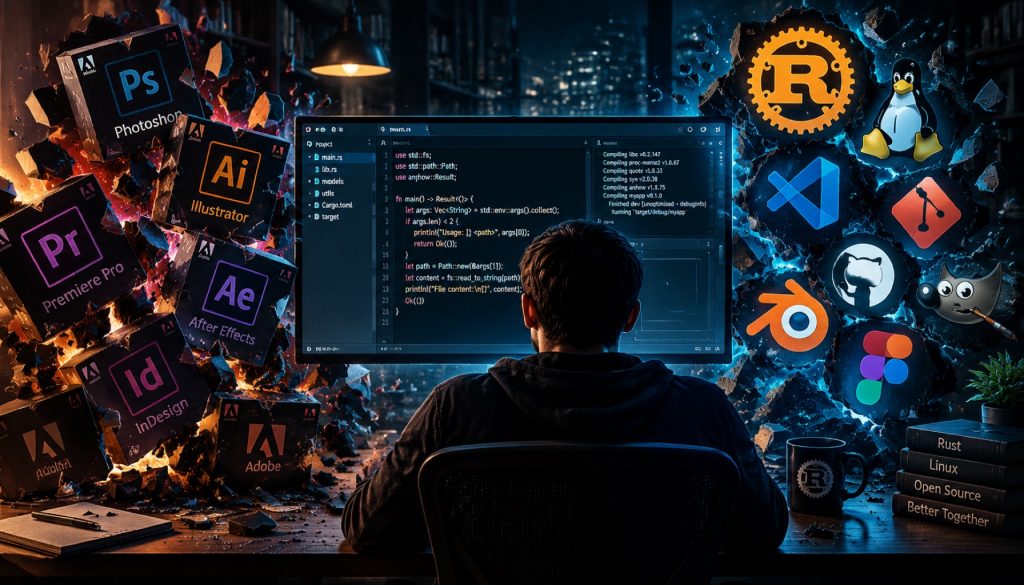
He said he used AI to help him write code and, in a single weekend, cloned seven Adobe applications. Not just any seven, Photoshop, Illustrator, Premiere, Lightroom, After Effects, InDesign, and Acrobat Pro. The full Adobe Creative Suite bundle runs close to two thousand dollars a year. Thomas said his version is open source and free.
The comment sections erupted.
Some said it was impossible. Others called it vaporware. A few downloaded the code, catalogued every missing feature, and posted their findings like a formal indictment. Thomas largely ignored the criticism and kept pushing commits.
None of this will “end software.” But what the story points to is worth taking seriously.
The Missing Features, and That “One Month” Claim
The response on Hacker News was predictable. Engineers downloaded the software, tested it feature by feature, and made lists.
How many tools does Photoshop actually have? How complex is Premiere’s timeline editing logic? How many years did Adobe spend building After Effects’ expression system? The answers all pointed the same direction: this thing is nowhere close.
Thomas did not dispute any of it. On Reddit, he described the current state as a “super early alpha,” then added the line that caught everyone’s attention: “We’re going to reach 100% feature parity within a month.”
A few days later on Hacker News, he softened that slightly: “99% parity will take a while, but I’m sure it’ll be measured in months and not years.”
These two statements land differently depending on who’s reading them.
For skeptics, it reads as classic founder overpromise, bold claims to generate attention, then a slow fade. Photoshop has been in development since 1988. Three decades of features, plugin ecosystems, workflow integrations. Catching up in months is not an engineering challenge. It’s a physics problem.
For others, the claim raises a question worth taking seriously: if AI-assisted coding keeps improving at its current rate, does “this kind of work takes decades” remain a meaningful constraint?
Thomas is betting on the latter. He made the bet in public, with open source code, so anyone can watch.
—
What Adobe Has Been Doing
To understand why this moment happened, it helps to look at what Adobe has been doing over the past two years.
Adobe has been aggressively integrating AI features into Creative Suite under the Firefly brand. The way Firefly 3.0 was rolled out left a lot of designers uncomfortable, not because the features were bad, but because they shifted the default logic of the workflow. AI generation went from an optional tool to something closer to the assumed path.
Adobe’s subscription prices have also kept climbing. Some users found that their annual Creative Cloud bill was approaching what they pay in monthly rent.
The desire to leave Adobe has been real for a while. It just lacked viable exits. Affinity covered some ground. GIMP and Inkscape offered open source options. But each of those required tradeoffs, incomplete features, workflow incompatibilities, or a learning curve steep enough to make switching painful.
Artcraft is taking a different approach. Not a replacement. A clone. The goal is not to build a better image editor, it’s to build one that works exactly like Photoshop. Same interface layout, same tool names, same keyboard shortcuts. From a migration standpoint, that’s the lowest-friction path possible.
The legal exposure is a separate question. Adobe has noticed the project. No action has been taken yet, but that doesn’t mean it won’t be. UI designs are generally not copyrightable, but trademark and patent exposure is more complicated. Thomas invoked the concept of “clean-room replacement” in his responses, a legal strategy with a long history in software, where you implement functionality based on documentation rather than examining the original source code. Whether he actually followed that process is something he would need to be able to prove.
—
The Part That’s Actually Interesting
Reading this as “scrappy underdog challenges tech giant” misses the more interesting layer.
What the story actually demonstrates is a new mode of software development becoming possible.
Historically, building software at Photoshop’s level of complexity required large engineering teams, years of work, and significant capital. Not because the ideas were hard, but because execution required people and time. That constraint built the moat structure of the software industry: first-mover advantage, network effects, ecosystem lock-in, plus the high cost of rebuilding anything from scratch.
AI-assisted coding is eroding that constraint.
Not overnight. Not uniformly. But the premise that “rebuilding this from scratch would be prohibitively expensive” is starting to develop cracks. Thomas’s seven clones, whatever their ultimate fate, send a signal: the labor cost of this category of work is coming down.
What that means for Adobe, for Figma, for Sketch, for Canva, for the whole creative software market, those are questions worth tracking.
One detail stands out: Thomas chose Rust rather than Electron or a browser-native stack. Rust’s performance ceiling is significantly higher. That choice suggests he’s not just building a demo, he’s treating performance as a real constraint. This aligns with another observation about AI-assisted coding: the gains in generating high-performance systems code have been faster than most people expected.
The current state of the software, for what it’s worth, includes real problems. Photoshop’s clone, the one most designers care about most, is missing core features. Layer logic has issues. Color management isn’t complete. These are not minor gaps.
But he’s still shipping.
—
What Happens in a Month
Predicting whether Thomas can deliver on his promise is not the point here.
The more useful question is: if he can’t, then what?
Open source means this project doesn’t die when one person gives up. The code exists. Anyone can continue it. Contributors, curious engineers, other AI tool developers can all build on top of what’s there. That’s the fundamental difference between how open source projects and commercial software fail.
Adobe has been losing users for years, but slowly, because the alternatives weren’t good enough. If an open source clone ever gets good enough for 80 percent of users to cover 80 percent of their needs, that’s when Adobe’s moat starts to matter less.
The line Thomas posted, “software is over”, is a dramatic overstatement, and he probably knows it. But it’s pointing at something real: with AI tools accelerating the pace of software development, the barriers that protected established software for decades are under new pressure.
Adobe spent thirty years building what it built. Someone just announced they plan to clone it in months.
Whatever happens next, that fact alone says something.
(Source: Ars Technica, https://arstechnica.com/ai/2026/10/software-is-over-bold-ai-developer-takes-aim-at-adobe-with-open-source-clones)
Related reading
- The Day AI Learned to Run Your Computer and the Open-Source Fortress Changed Hands
- n8n vs Activepieces: Choosing an Open-Source Workflow Automation Tool for Self-Hosted Teams
- When Documents Pile Up: WeKnora and the Open-Source Platforms Trying to Make Knowledge Actually Useful
- Dagger vs GitHub Actions vs CircleCI: Which One Actually Works for Containerized CI?
- When Easy to Use Becomes a Business Moat: How DX Rewrote the 2026 SaaS Playbook
Stay updated with our latest AI insights