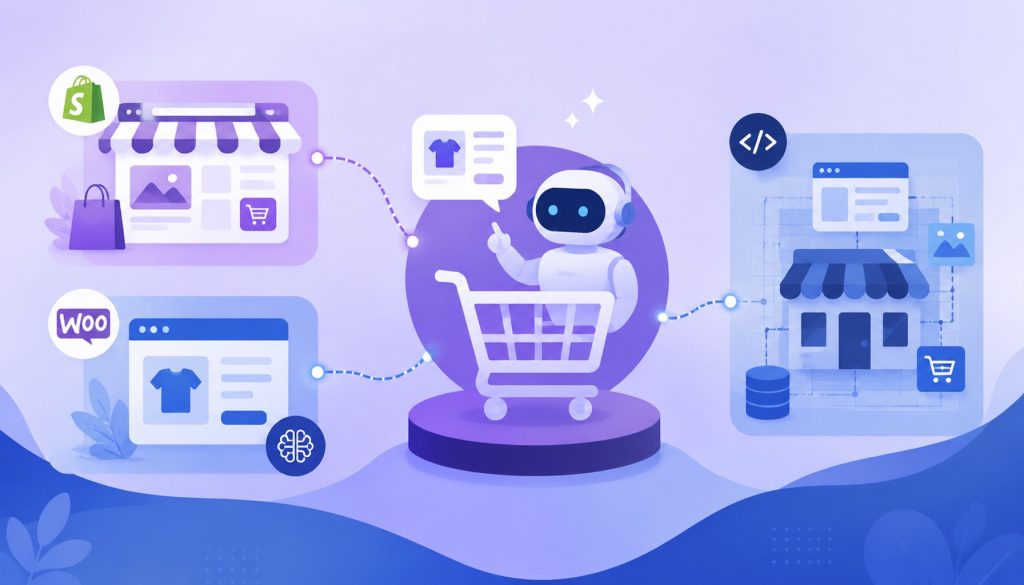
By 2026, AI commerce distribution stopped being a question of “should I look into this” and became “if you don’t pick a lane now, someone else is taking your traffic.”
When Shopify launched Agentic Storefronts in March, the game changed. Your products no longer sit on your site waiting for someone to search. They can surface directly in ChatGPT, Google AI Mode, Gemini, Copilot. A user asks “find me a sunscreen for oily skin” and theoretically your product gets recommended by the AI.
Sounds good.
But sellers don’t care about the concept. They care about execution. How do you actually connect? Should you migrate to Shopify? Can WooCommerce still compete? Does building custom infrastructure still make sense?
This post skips the vision deck and goes straight to the decision.
First, kill the misconception
A lot of people think AI commerce distribution already means “buy directly in ChatGPT.” It doesn’t. At least not yet.
OpenAI dropped Instant Checkout in January. AI can recommend, filter, and redirect, but checkout still happens on your site. Don’t think of today’s AI distribution as the new Amazon. Think of it as a super-powered product discovery layer, not a new checkout counter.
That matters because it tells you where to spend. If AI entry points can’t close the transaction, what drives conversion is still your product page, trust signals, fulfillment, payment flow, and site speed. AI distribution doesn’t replace your website. It moves the “getting discovered” step earlier.
So this choice isn’t about who looks cooler. It’s about who fits your current transaction structure.
The answer for most sellers: prioritize Shopify in 2026, don’t obsess over Woo, don’t rush into custom builds
If you’re a normal DTC brand, indie merchant, or small team running an online store, the safest path is clear.
Want the fastest access to AI distribution? Pick Shopify.
Already on WooCommerce but want to test AI channels? Connect to Shopify’s Agentic Plan first.
Only consider custom builds when you have complex business logic, a strong engineering team, or heavy customization requirements.
Don’t mistake “technical freedom” for “business efficiency.” A lot of teams don’t lose because they lack capability. They lose because they love tinkering.
Here’s the breakdown.
Shopify Agentic Storefronts: the closest thing to a standard answer right now
What makes Shopify strong this time isn’t just a new feature. It built AI distribution into a system.
Three tiers.
Level 1 is the Agentic Plan, focused on catalog sync. You don’t need to migrate your main site to Shopify. You can feed in your product catalog first so AI knows what you sell.
Level 2 starts at Basic+ and above, where you get the full AI distribution capability. This isn’t just “upload your products.” You can use Shopify’s native infrastructure to handle complete traffic and transaction flows.
Level 3 is Hydrogen, the headless and fully custom tier. For teams that want to push deeper into AI distribution, content, memberships, and product configurators.
Shopify’s real advantage is native integration.
It’s not a plugin you bolt on and hope it works. Catalog, merchant data, site structure, distribution endpoints, and landing page handling live in the same system. For AI platforms, that structured data is easiest to work with. For sellers, that “less hassle” is worth real money.
The worst thing about AI distribution isn’t missing features. It’s broken handoffs.
Products show up, but the price is wrong.
Inventory syncs, but variants are scrambled.
The redirect works, but the landing page is slow and ugly.
AI recommendations look sharp, then users bounce the moment they hit your site.
Shopify has fewer of these problems because it already specializes in making eCommerce infrastructure “run out of the box.”
If you ask me what the first choice should be for AI commerce distribution in 2026, I’ll be direct: right now, it’s Shopify.
Not because it’s perfect. Because it’s the most complete.
Shopify has downsides too, or this turns into a pitch deck
Shopify’s biggest strength is convenience. Its biggest cost is also convenience.
You get a smooth, standardized path. But you accept that someone else sets the rules.
Template logic, checkout flow, data boundaries, feature ceilings. You don’t get final say on any of it. That’s fine until your business gets complicated. When you’re dealing with multi-market pricing, complex bundles, or highly customized products, Shopify can go from “this is great” to “this is limiting” fast.
Hydrogen solves part of that, but don’t misunderstand. Hydrogen isn’t “free freedom.” It’s “trade engineering cost for freedom.”
Level 3 is powerful, but not for everyone. If you don’t have frontend, architecture, deployment, and maintenance capability, don’t get too excited. A lot of merchants hear “headless” and jump in, only to realize six months later they’re maintaining an expensive technical toy.
The right way to use Shopify isn’t to rush to the top tier. It’s to climb based on business complexity. If Level 2 solves your problem, don’t force yourself into Hydrogen.
One more thing. A lot of WooCommerce or Magento merchants see the Agentic Plan and get excited, thinking “great, I can tap into AI distribution without migrating.”
You can tap in, but don’t expect too much.
Level 1 is more of a light access layer. It gets you into the game, but it won’t necessarily help you win. Getting displayed in an AI entry point is one thing. What happens when users click through, meaning your page experience, trust signals, and purchase flow, is still decided by your original site. If your site was already bad, connecting to the Agentic Plan just sends more people into a leaky bucket.
WooCommerce AI: functional, but doesn’t feel like the 2026 answer
WooCommerce’s strengths are familiar to veteran sellers.
Cheap, flexible, familiar, huge plugin ecosystem. A lot of content sites, SEO-driven stores, and lightweight indie brands started on Woo. If you want to blend blog, commerce, and content-driven traffic, Woo has always been comfortable.
The problem is AI distribution isn’t Woo’s home field.
The background you provided already makes it clear: WooCommerce requires manual code embedding, and the experience doesn’t match Shopify’s native approach. In plain language, it can connect, but it wasn’t built for this.
That difference matters.
When a new traffic channel emerges, whoever has lower connection costs, cleaner structure, and easier maintenance gets to the upside first. Woo’s problem isn’t that it absolutely can’t connect. It’s that you have to fill in too many gaps yourself.
You need to handle feeds, schema, field mapping, template compatibility, plugin conflicts, cache issues, theme adaptation. You might even worry that an update breaks the code you patched in. The fix you applied today for AI distribution could get blown up by another plugin tomorrow.
Honestly, what does WooCommerce look like in the AI distribution era?
It’s like a car you’ve modified many times. Normally you know it well. You recognize every rattle. You have attachment to it. But when you need to run a new track, it’s not that it can’t run. You just have to tighten a bunch of bolts first.
That tells you who WooCommerce still works for: people already running well on Woo, with existing content assets, who don’t want to migrate immediately, and who have a technical or agency team that understands WordPress and Woo.
If you’re starting from scratch and weighing Woo versus Shopify, I don’t recommend choosing Woo for “flexibility” or “saving the monthly fee.” The SaaS costs you save will probably come back to bite you in plugins, maintenance, troubleshooting, performance tuning, and dev outsourcing.
WooCommerce’s biggest problem isn’t that it’s expensive. It’s that it pretends to be cheap.
That said, it’s not completely out of the running.
If your site is content-driven, like a review site, niche blog, or SEO affiliate store that added commerce, Woo still has life. The core of those businesses isn’t just selling. It’s content traffic, search rankings, long-tail entry points. WordPress still handles that well.
But if you’re discussing “how to pick an AI commerce distribution tool,” not “how to bolt sales onto a content site,” Woo doesn’t rank in the top tier.
Custom builds: maximum freedom, maximum risk of self-destruction
Every time platform solutions come up, someone says: why not build it myself, avoid platform lock-in, and keep full control?
In theory, yes.
You can build your own catalog API, manage your own schema, connect to various AI entry points, design your own PDP, checkout, CRM, recommendation logic, pricing engine, inventory system, even your own agent-facing commerce layer. If you pull it off, it’s powerful.
But here’s the question: are you running a business, or are you doing infrastructure startup cosplay?
The core cost of custom builds was never “can we develop it.” It’s “can we maintain it long-term and keep up with external platform changes.”
AI distribution isn’t a static interface.
Today ChatGPT accepts this field set. Tomorrow Google AI Mode adjusts ranking logic. Next week Gemini emphasizes trusted merchant signals. Then Copilot changes merchant eligibility criteria. You’re not writing once and calling it done. You’re tracking continuously.
That means custom builds only make sense in two situations.
One, you’re big enough that standard platform solutions can’t handle you.
Two, your business is unusual enough that standard SaaS really cannot support it, like complex B2B, configurable products, deep membership systems, cross-system quoting, and enterprise procurement flows.
If you’re an indie brand doing a few hundred thousand to a few million a year in revenue and thinking about building the entire AI distribution stack from scratch, I’d tell you to pump the brakes.
That’s not “having vision.” That’s probably just engineering impulse.
And don’t forget reality: OpenAI already canceled Instant Checkout. The final conversion point is still your own site. Spending huge resources to build a custom distribution layer might not drive higher conversion. Often it just creates a more complex maintenance surface.
Before closed-loop transactions actually happen in AI interfaces, building custom AI distribution systems often means paying expensive tuition for a future that hasn’t arrived.
How to actually choose: three things are enough
Do you need “early access” or “deep control”?
If what matters most right now is getting into the AI traffic pool, Shopify is the obvious fit.
This phase is about speed, stability, and low friction, not technical imagination. Getting products correctly understood, correctly displayed, and correctly redirected by AI matters more than how elegant your backend is.
If you’re already an established brand with strong demands around site experience, frontend-backend coordination, and brand control, consider Shopify Hydrogen or partial custom builds.
But most sellers aren’t there yet.
Is your team operations-heavy or engineering-heavy?
Operations-heavy teams should pick Shopify.
Engineering-heavy teams with sustained investment capacity can look at Hydrogen or custom builds.
Don’t assume “we’ll add technical capacity later.” That sounds motivating, but execution is usually messy. Once you pick the wrong system, migration costs aren’t just money. They’re data, process, and team morale.
Where are your existing assets?
If you already have SEO, content, users, and plugin workflows sunk into WooCommerce, don’t rush to tear everything down. The smarter move is to connect to Shopify’s Agentic Plan first, get your products into AI distribution entry points, then decide based on results whether to migrate your main site to Shopify.
That’s way more rational than full-site migration on impulse.
But if you have no historical baggage right now, don’t create baggage for yourself. Starting directly on Shopify is actually the easiest path.
Specific recommendations for different sellers
If you’re a small to mid-sized DTC brand, SKUs aren’t extremely complex, your team leans operations, and your goal is to catch AI search and AI shopping assistant traffic as quickly as possible, pick the Shopify Basic+ tier. Don’t hesitate.
If you’re already running on WooCommerce, with content, SEO, memberships, or a pile of legacy plugins tied to it, and you don’t want to migrate right away, connect to Shopify Agentic Plan first, secure the AI distribution entry point, then evaluate migration value as you go. That’s the most realistic transition path.
If you have a strong technical team, sell high-ticket, highly configurable, complex-flow products, or you’re already doing headless commerce, look at Shopify Hydrogen and build parts custom when necessary. Don’t go all-in on pure custom builds from the start.
If you just want to build custom because you “hate platform fees” or “want total control,” I’d suggest you shelve that impulse. You probably don’t lack control right now. You lack cheaper, faster, more stable growth.
One last direct recommendation
For this 2026 question, my recommendation is clear.
80% of sellers should bet on Shopify.
15% of legacy WooCommerce sites should connect via Agentic Plan as a bridge.
The remaining 5% with unusually complex needs and engineering strength can talk about custom builds.
Don’t treat AI distribution like a technical ideology war.
At its core, it’s still a traffic play. Whoever connects faster, hits fewer landmines, and converts “getting discovered” into “closed sales” more easily should be the one you pick.
So if you need to decide right now, my answer is this.
If you can get on Shopify, get on Shopify.
If you’re already on Woo, don’t tough it out. Borrow Shopify’s AI distribution capability first.
Custom builds? Wait until you actually need them. Don’t bury yourself in a technical swamp ahead of schedule.
Related reading
- Shopify Agentic Storefronts Put Your Products Inside ChatGPT: What It Means for Ecommerce Distribution in 2026
- Klaviyo vs Omnisend in 2026: Which Email Platform Actually Fits Your Shopify Store
- Klaviyo Alternatives 2026: Which Email Marketing Tool Should Ecommerce Sellers Choose?
- Choosing AI Personalization for Ecommerce: Nosto vs Rebuy vs Bloomreach vs Klevu vs Dynamic Yield (2026)
- The AI Agent App Store Problem: Why Nobody Has Cracked Skill Distribution Yet
Stay updated with our latest AI insights