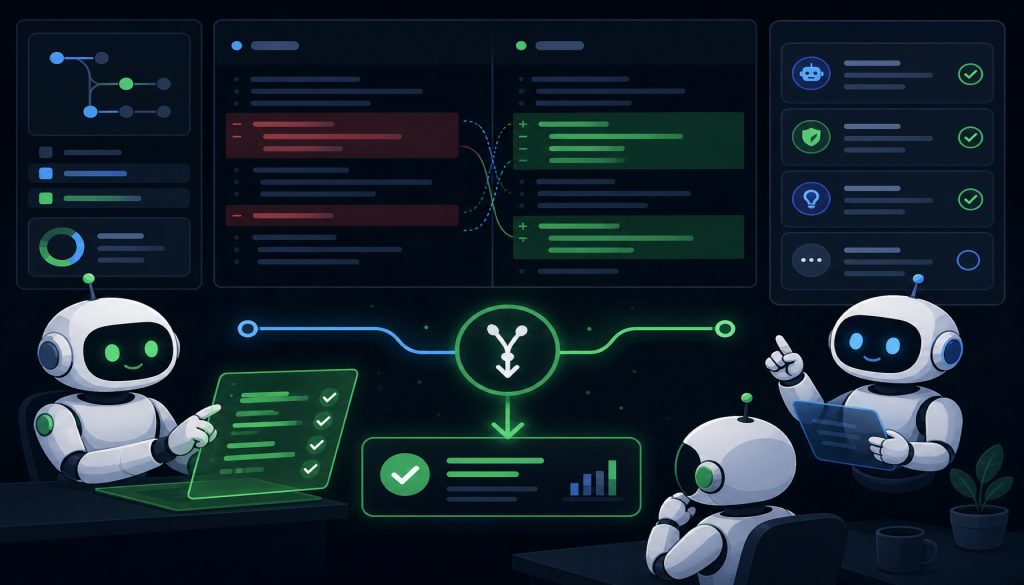
AI writing code is old news in 2026.
The real competitive edge now isn’t about who autocompletes faster. It’s about who catches problems before they merge.
That’s why AI code review has shifted from niche tooling to a serious line item on team budgets.
The challenge is practical. There are plenty of options on the market. But when it comes time to choose, most teams get stuck. CodeRabbit has momentum, Qodo is gaining traction, and Greptile keeps getting praised for “actually understanding codebases.” They all sound compelling, but you can only pay for one.
What makes this harder is that these tools are easy to misjudge from their marketing pages.
Every vendor claims to be smarter, more accurate, and more context-aware. But what actually determines the experience isn’t how new the underlying model is. It’s how the tool integrates with your workflow, how many false positives it generates, whether it can really parse your legacy codebase, and whether its suggestions make engineers want to mute notifications.
The biggest problem with AI review tools has never been whether they can talk. It’s whether they talk nonsense.
If you just want the bottom line, here it is.
If you need something that’s fast to deploy, easy for the team to accept, and reasonably priced, CodeRabbit is still the safest entry point.
If your team has moved past “help us catch bugs” and wants to integrate code review, test generation, and quality governance into a unified flow, Qodo is building toward a platform solution.
If your codebase is large, dependencies are complex, business context runs deep, and you’re sick of “AI commenting without understanding,” Greptile represents a different approach. It’s not the loudest option, but it might be the closest to “actually knows the repo.”
Here’s the detailed breakdown.
Why AI Code Review Still Matters in 2026
People often ask: now that Cursor, Windsurf, Copilot, and Claude Code can all read code, why pay for a separate review tool?
Because writing code and reviewing code are fundamentally different activities.
AI in your IDE acts like a copilot. It helps you move forward, completing code, rewriting snippets, explaining errors. The rhythm is individual.
Code review tools play a different role.
They sit at the PR gate, watching for team standards, potential risks, cross-file impact, and the gray areas that “the author didn’t notice, testing didn’t cover, and reviewers don’t have time to dig into.”
Put simply, IDE AI increases individual output velocity. Review AI reduces team merge accident rates.
These two things overlap, but they don’t replace each other.
Once a team scales beyond a few people, the value of the review stage amplifies suddenly.
If one engineer uses AI to write 20% more code, that doesn’t necessarily make the team’s overall delivery more stable. But if an AI review tool catches obvious bugs, test gaps, permission issues, and dangerous changes before merge, its impact on team rhythm is measurable.
Generating code amplifies speed. Reviewing code controls cost.
So this article isn’t about who writes better. It’s about who’s better at gatekeeping.
CodeRabbit: The One That Feels Ready to Use Today
CodeRabbit has had high visibility over the past two years, and there’s a reason for that.
It has a very practical advantage: low integration cost and low team comprehension cost.
It supports GitHub, GitLab, Bitbucket, and Azure DevOps. For many companies, that sentence alone is attractive. You don’t have to rework your entire repo management setup for one review tool, and you don’t have to force everyone to migrate platforms.
Pricing is straightforward. Pro is $24 per user per month, with free access for open source projects.
That’s not cheap in absolute terms, but it’s not budget-breaking either. Especially compared to heavier platform products, CodeRabbit’s barrier to entry is manageable.
Its biggest strength isn’t that it’s “the best.” It’s that it’s “the easiest to accept.”
Once you install it, PRs quickly start showing comments. Coverage includes bug risk, code quality, security, and test gaps. The first time teams use it, the reaction is often positive: oh, there’s an AI doing the first-pass screening.
At this stage, CodeRabbit’s experience is usually good.
It makes review automation visible and lightweight.
You don’t need to overhaul workflows, set up a bunch of internal rules first, or spend a week on training. It acts like an external contractor reviewer, flagging obvious issues. For teams without mature code review discipline, the improvement can be substantial.
But its limitation is also right there.
In real-world discussions, CodeRabbit’s most common complaint is insufficient context depth and too many false positives. Some comments look like serious reviews, but they’re really “saw the diff, didn’t understand the business.” There’s another annoying pattern: it points out issues that aren’t entirely wrong, but are low priority. Technically debatable, but not worth addressing now.
This leads to a typical outcome.
The first two weeks after installation, the team finds it fresh. A month later, people start skipping its long comments by default. Further down the line, if you haven’t tuned it properly, it shifts from reviewer to noise generator.
This is CodeRabbit’s biggest pitfall.
It’s not unusable. It just requires team tolerance and configuration patience. You have to accept that it will say a lot of useless things early on, and you need to invest time tightening rules, adjusting prompts, and building team consensus on “which suggestions to read, which to skip.”
If you expect buying it to automatically give you a reliable senior reviewer, you’ll probably be disappointed.
CodeRabbit at its best is like the most diligent intern on your team. At its worst, it really is like that intern.
Who’s it for?
Teams that want to deploy AI review quickly, organizations with repos spread across multiple platforms, and teams still in exploration mode looking for low-friction pilots.
Who’s it not for?
Teams that are highly sensitive to false positives, where PR quality is already high and review culture is mature. These teams have low tolerance for “one extra useless comment.” If CodeRabbit doesn’t hit the mark, it gets in the way.
Qodo: Not Just a Reviewer, But an AI Validation Layer
Qodo used to be called CodiumAI. After the rebrand, its direction became clearer.
It’s not trying to be just a PR comment bot. It wants to occupy a bigger space: AI validation.
That sounds abstract, but in plain terms, it means Qodo isn’t satisfied with “reviewing code and offering suggestions.” It wants to connect review, testing, quality control, and governance into a more complete engineering quality system.
TechCrunch recently covered it, which signals the market is buying this narrative.
Qodo’s PR-Agent is open source, and that matters.
Open source means two things.
First, it’s easier to enter technical teams’ consideration sets, especially at companies that distrust pure black-box SaaS. Second, it gives teams a chance to try it, modify it, and embed it in their workflows before deciding whether to upgrade to the full commercial offering.
That’s smarter than products that push “all-in subscription bundles” from day one.
Qodo’s style is noticeably different from CodeRabbit.
CodeRabbit says, “Let me help you review this PR.” Qodo says, “I can touch every part of your development quality workflow.”
So beyond review, it emphasizes test generation, validation logic, rule enforcement, and enterprise governance capabilities. For engineering leaders, that story is appealing because the budget justification is easier: I’m not buying a comment bot, I’m buying an AI-assisted quality platform.
The catch is this.
Platforms like this typically require more work to deliver value.
Qodo isn’t the kind of tool everyone applauds immediately after installation. It’s more like a component that needs to be designed into your process. You have to think through what you want it to catch, generate, and validate, and how it fits with your existing CI, tests, and review policies.
If your team is still at the “everyone writes a PR and casually reviews each other” stage, Qodo might feel heavy.
Not because it’s bad. You’re just not at that stage yet.
But if your team is running into these problems, AI-generated code is increasing and manual reviewers can’t keep up, test coverage constantly lags, quality standards vary across repos, and leadership is asking “how do we govern AI development,” then Qodo looks more like a long-term solution than CodeRabbit.
Its strength isn’t writing prettier comments. It’s closer to being a “quality control hub.”
Of course, it has the usual platform product challenges.
Bigger concepts, stronger sales narratives, and outcomes that depend heavily on organizational maturity. If the team doesn’t have a clear owner, no one to continuously tune rules, monitor results, and refine processes, Qodo can become another “feature-rich platform nobody actually uses fully.”
This isn’t unique to Qodo. It’s a trap all engineering platform tools fall into.
Who’s it for?
Mid-to-large teams, companies that have already integrated AI coding into production and are starting to care about verification and governance. Also fits technical organizations that want to start with open-source PR-Agent and scale up gradually.
Who’s it not for?
Small teams just getting started, or teams that “just want AI to catch a few bugs in PRs.” If all you want is an electric scooter, and they’re offering a modified pickup truck, it’s powerful but not convenient for city commuting.
Greptile: If Context Matters Most, It’s Hard to Skip
Greptile’s label is clear: codebase-aware.
Those four words aren’t just marketing spin. At least directionally, they’re not.
Because the real pain point with AI review often isn’t in the diff itself. It’s outside the diff.
A change looks fine in isolation, but in the context of the whole repo, it might break things. A naming change happens, and another module has been relying on that convention. An interface parameter adjusts, and a chain of upstream and downstream callers are affected. Human reviewers are valuable because they carry “a map of the entire codebase” in their heads.
Most AI review tools can’t reach this level, or they do it superficially.
Greptile is betting on this gap.
It’s not trying to solve “can I leave comments on PRs.” It’s trying to solve “can I understand this repo before commenting.”
If this works, the experience gap with typical AI reviewers becomes significant.
Because it’s not just staring at changed lines. It tries to understand the change within the codebase context. In theory, this reduces low-quality comments that come from “pontificating without understanding the full picture.”
This is why Greptile appeals especially to teams with complex monorepos, large backend systems, and heavy legacy debt.
What do these teams fear most?
Not that AI stays silent. That AI understands halfway.
They’d rather have a tool that’s slower, more expensive, and comments less, than see a flood of context-free suggestions. Because those suggestions aren’t just unhelpful. They waste reviewer attention.
Greptile’s thinking on this dimension is correct.
But the challenge is practical.
“Understanding codebases better” usually means heavier indexing, more complex integration, more upfront prep, and potentially longer feedback loops. If you want the tool to really absorb codebase context, you have to accept it won’t be as plug-and-play as a lightweight bot.
In other words, Greptile’s value typically correlates with codebase complexity.
The simpler the repo, the less obvious its advantage. The smaller the team, the harder to justify ROI. But once your system is complex enough, it might be the strongest contender.
Many AI tools lose by talking too much. Greptile is trying to win by saying less nonsense.
Who’s it for?
Large codebases, complex business systems, teams that heavily depend on context understanding. Especially fits people who’ve already been burned by shallow AI review.
Who’s it not for?
Lightweight product teams, short-cycle projects, companies whose repo structure isn’t that complex. You’re paying for “context.” If you don’t have much complex context, the money isn’t going to the sharp edge.
Comparing All Three: Where the Real Differences Are
If you put them on the same conceptual map, it’s easy to understand.
CodeRabbit sells universality and low barriers.
Qodo sells quality systems and platform extensibility.
Greptile sells codebase understanding depth.
This isn’t empty talk. From a procurement perspective, the differences are large.
CodeRabbit is more like a SaaS tool you can deploy today. It wins on fast setup, multi-platform support, and low cognitive load. You don’t have to solve a bunch of organizational issues first. Install it and you can see value.
Qodo is more like what you’d consider when you’re serious about building an AI quality workflow. Its value isn’t single-point. It’s about turning review into a more complete validation stage.
Greptile is more like a “context-first” specialist tool. It doesn’t try to please everyone, but in complex codebase scenarios, it might be closest to a substantive reviewer.
So don’t ask “who has the best technology.”
That question is too vague.
Ask instead: what does your team lack right now?
Lacking a cheap, easy-to-deploy AI reviewer? Look at CodeRabbit.
Lacking a system that ties together testing and governance? Look at Qodo.
Lacking reliable understanding of full-repo context? Look at Greptile.
Don’t Confuse Agent Tools Like Claude Code With These
There’s a common misconception worth clearing up.
Some people say, Claude Code does more accurate reviews, so why not skip these tools entirely?
That’s only half right.
Agent-style tools like Claude Code can indeed be more accurate in some complex review scenarios. Especially when you give it enough context, let it actively explore the repo, and tell it explicitly what to check, its judgment quality is often higher than many “auto-comment” tools.
There’s similar feedback on Reddit.
But the problem is, it’s more manual.
You have to actively invoke it, organize context, and guide how it investigates. Sometimes that’s actually an advantage, because it’s controllable, detailed, and can dig deep. But once you try to scale this into team processes, this approach becomes less convenient.
Having engineers manually pull in an agent review for every PR? People will start finding it tedious quickly.
So tools like Claude Code are better suited for high-value PRs, critical modules, difficult changes, and pre-launch specialized checks. It’s like calling in an expert consultant.
Tools like CodeRabbit, Qodo, and Greptile are about embedding review capability into daily pipelines. They don’t replace deep agents. They handle routine gatekeeping.
Often, the best approach isn’t either/or.
It’s using automated review for baseline screening day-to-day, then bringing in agents for deep dives on critical PRs.
Real Selection Advice: Don’t Buy Based on Hype, Buy Based on Team Stage
If you’re a 5 to 30 person product development team, repo platforms might not be fully unified yet, and review processes aren’t complex enough to need a governance system, then just go with CodeRabbit. It’s usually the safest bet.
It’s not the smartest, but it’s the least likely to fail because it’s “too heavy.”
You have to accept it will have false positives and noise, but it can quickly establish the habit of “AI does a first pass.” That step alone is valuable.
If you’re a more mature engineering organization, no longer satisfied with PR comments, and starting to care about how AI-generated code gets verified, how tests get supplemented, how rules get unified, and how compliance gets implemented, then seriously look at Qodo.
It’s more like a long-term investment.
The prerequisite is, don’t expect it to work automatically after purchase. Someone needs to actually integrate it into the process, or you’ll easily spend platform money and only use 30% of the bot’s functionality.
If you’re a complex codebase team, especially backend platforms, infrastructure, finance, data systems, or giant monorepos, I’d prioritize looking at Greptile.
Because these teams feel “context misjudgment” pain most acutely. Shallow review tools seem cheap, but they might generate cognitive noise daily. That invisible cost is more annoying than subscription fees.
Conclusion: How to Choose Without Regret in 2026
Here’s the straightforward version.
For a default recommendation, choose CodeRabbit.
It’s not the deepest or most context-aware, but it’s the easiest to deploy, easiest for teams to accept, and has the lowest overall risk among the three. For most teams still building AI review habits, that’s already important enough.
For long-term platform capability, choose Qodo.
The prerequisite is you’ll actually push testing, validation, and governance forward together. Otherwise much of its value stays at the PowerPoint level. Looks big, but you’re only using a corner.
For real understanding in complex codebases, choose Greptile.
If your biggest pain is “AI keeps misunderstanding,” it’s probably the one most worth trying. Not because it markets best, but because it’s betting on the hardest part of AI review: context.
If you force me to give one clear recommendation, here it is.
Small to mid teams, want something usable first, buy CodeRabbit.
Mature organizations, want to build a quality platform, buy Qodo.
Complex repos, hate misjudgments, look straight at Greptile.
Stop asking which one is “comprehensively superior.” AI code review isn’t a beauty pageant. It’s hiring a gatekeeper. What’s gone missing at your door determines who’s right for the job.
Related reading
- Snyk vs SonarQube vs CodeRabbit vs Qodo: Compared (2026)
- Cursor vs Windsurf vs Zed vs Continue: Picking the Right AI Code Editor for Your Team
- AI-Native Dev Platforms in 2026: From Code Assistants to AI as Your Engineering Team
- Cursor vs Copilot vs Claude Code vs Windsurf: Which AI Coding Tool Is Right for You in 2026?
- Notion Alternatives 2026: Coda vs Slite vs Confluence vs Guru for Your Team Wiki
Stay updated with our latest AI insights