Your team has a knowledge problem. Important docs live in Slack threads nobody can find. Answers sit in Notion pages that haven’t been updated since Q2. Someone wrote the perfect onboarding guide in Google Drive, but good luck searching for it when the new hire starts Monday.
AI enterprise search tools promise to fix this. They connect your scattered data sources, index everything, and let people ask questions in plain English instead of guessing which folder to check. The market has exploded with options, and four names keep coming up: Glean, Guru, Coveo, and AlphaSense.
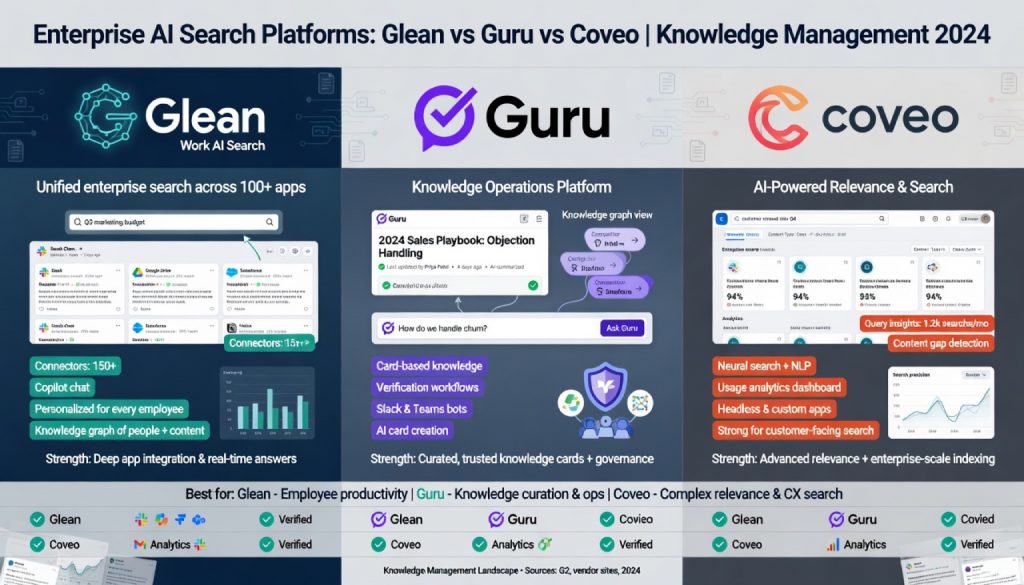
Each takes a fundamentally different approach. Glean wants to be your all-in-one workplace AI. Guru bets on human-verified knowledge cards. Coveo targets complex enterprise scenarios with search plus recommendations. AlphaSense specializes exclusively in financial research. The right choice depends on your team size, budget, and what “search” actually means for your workflow.
Here’s how they compare on the dimensions that matter most for B2B SaaS buyers.
Glean: The $4.6B Workplace AI Bet
Glean hit a $4.6B valuation in 2024, and the hype isn’t entirely unearned. The product connects to nearly everything: Slack, Google Drive, Notion, Jira, Confluence, Salesforce, and dozens of custom internal systems through APIs. Once connected, their AI layer lets you search across all of these tools simultaneously using natural language.
What it costs: Base pricing starts around $45-50 per user per month. The full generative AI features (their Work AI suite) add roughly $15/user/month on top of that. For a 100-person team, budget at least $70-80K annually. High data volume or on-prem deployment can push that number significantly higher. Pricing is opaque and requires sales negotiation.
Where it works well: The integration breadth is real. If your company runs 15+ SaaS tools and your biggest pain point is “I know we discussed this somewhere but can’t find it,” Glean solves that problem faster than any alternative. The AI search understands natural language queries well, and the interface is modern enough that adoption isn’t a fight.
Where it falls short: Deployment takes 2-4 weeks minimum, often longer for complex environments. Several users on G2 and Reddit report that AI-generated answers occasionally hallucinate, pulling in sources that don’t actually support the claim. And the pricing opacity is frustrating. You won’t get a number without talking to sales, and the number you get will depend on how well you negotiate.
Who should buy it: Mid-to-large tech companies (50-500+ employees) with complex tool stacks and budget to match. If your team is under 50 people or you’re watching every dollar, Glean is likely overkill for what you need.
Guru: Knowledge Cards with Built-in Accountability
Guru has been in the knowledge management space since 2016, which makes it ancient by AI startup standards. Their philosophy diverges sharply from Glean’s “index everything” approach. Instead, Guru has teams proactively create “knowledge cards,” each with an assigned owner who must periodically verify the content is still accurate.
This sounds like more work upfront, and it is. But the payoff is that when someone finds an answer in Guru, they know a human reviewed it within the last verification cycle. No hallucination risk. No outdated wiki pages masquerading as current policy.
What it costs: $10-20 per user per month. Dramatically cheaper than Glean, and accessible for teams of any size.
Where it works well: The verification system is Guru’s killer feature for teams that care about accuracy over speed. Customer support teams love it because when a rep gives a customer an answer from Guru, they can trust it’s been verified by someone who owns that knowledge area. Their March 2026 Slack MCP integration is also worth watching. It lets Guru participate in Slack conversations in real time, surfacing relevant cards as people discuss topics, rather than requiring people to leave their workflow and search manually.
Where it falls short: The AI capabilities are weaker than Glean’s. Guru is closer to “smart knowledge base with search” than “AI assistant that can reason across your data.” And the entire system depends on your team actually maintaining those knowledge cards. If your company culture doesn’t support documentation discipline, Guru will slowly rot into another abandoned wiki.
Who should buy it: Customer support, operations, and sales teams that need standardized, verified answers. Also a strong fit for any organization where documentation accuracy matters more than AI-powered synthesis. If people on your team willingly write things down, Guru amplifies that behavior. If they don’t, no tool can fix the underlying problem.
Coveo: Enterprise Search for Regulated Industries
Coveo has been building enterprise search for over a decade. Their scope goes beyond internal knowledge search into customer-facing use cases: product recommendations for e-commerce, smart answer suggestions in support portals, personalized content delivery. Think of them as the enterprise-grade search infrastructure layer, not a consumer-friendly AI assistant.
What it costs: Entry-level pricing starts at $600/month, but that buys you very little. Real deployments are custom-quoted based on query volume, data volume, and user count. Expect to talk to sales, run a proof of concept, and budget in the six figures for anything meaningful. Small companies should skip this entirely.
Where it works well: If you need search that handles complex permission models, compliance requirements, and multi-tenant data isolation, Coveo is built for exactly this. Financial services firms, insurance companies, and large e-commerce operations make up their core customer base. The combination of search plus personalized recommendations in a single platform is something the other tools on this list don’t offer.
Where it falls short: Deployment is measured in months, not weeks. You’ll need dedicated technical staff to maintain and tune the system. Multiple users report frustrations with API rate limiting during data imports. The learning curve is steep, and “plug and play” is not in Coveo’s vocabulary.
Who should buy it: Large enterprises in finance, insurance, e-commerce, or any regulated industry where you need both internal search AND customer-facing search/recommendations in one platform. You also need a technical team that can own the deployment. If you just want your employees to find internal docs faster, Coveo is too much machine for that job.
AlphaSense: Wall Street’s Research Engine
AlphaSense is a different animal from the other three. It’s not a general enterprise search tool at all. It’s a specialized financial research platform that covers earnings transcripts, analyst reports, SEC filings, expert interview transcripts, news, and proprietary datasets. AI helps financial professionals extract insights from this mountain of data quickly.
What it costs: Pricing is the least transparent of the four. Annual subscriptions for small teams (10-25 people) typically start around $40-50K/year. Large institutional packages exceed $100K. There’s no cheap entry point.
Where it works well: The financial data coverage is unmatched for its purpose. Their January 2026 next-generation search can run end-to-end research workflows automatically, pulling together findings across multiple source types. 85% of S&P 100 companies use AlphaSense, which tells you something about product-market fit in that vertical.
Where it falls short: If you’re not in financial services, there’s nothing here for you. The platform is purpose-built for investment research, competitive intelligence, and corporate strategy in finance-adjacent roles. It’s also expensive with no budget-friendly tier, and new users report a moderate learning curve before they’re productive.
Who should buy it: Investment firms, private equity, investment banks, and corporate strategy departments that do heavy industry research. If your analysts currently spend hours digging through SEC filings and earnings transcripts, AlphaSense pays for itself in time savings. Everyone else can ignore this option completely.
Head-to-Head Comparison
| Tool | Pricing | Core Strength | Main Weakness | Best Fit |
|---|---|---|---|---|
| Glean | $45-65/user/mo | Broad integration, strong AI search | Expensive, slow deploy, opaque pricing | Mid-large tech cos with complex tool stacks |
| Guru | $10-20/user/mo | Verified knowledge, affordable | Weaker AI, depends on team discipline | Support, ops, sales teams |
| Coveo | $600/mo+ (enterprise) | Search + recommendations, compliance | Complex deployment, steep learning curve | Finance, e-commerce, large enterprises |
| AlphaSense | $40-125K/year | Deep financial data, AI-powered research | Finance-only, high price | Investment firms, banks, strategy depts |
How to Choose: Decision Framework by Company Type
50-500 person tech company, $70K+ annual budget, 10+ tools in use: Glean gives you the fastest path to “search everything from one place.” The price hurts, but the ROI calculation is straightforward once you factor in time spent searching across fragmented tools.
Small-to-mid team, budget under $30K, process-heavy work: Guru at $10-20/user/month is the clear value play. Don’t get distracted by Glean’s AI features if what your team actually needs is reliable, verified answers to recurring questions. A well-maintained Guru instance beats an expensive AI assistant that occasionally makes things up.
Finance, e-commerce, or insurance with customer-facing search needs: Coveo is the professional choice, but go in with eyes open about the implementation timeline and ongoing maintenance cost. Budget 1-3 months for deployment and assign dedicated technical staff.
Investment research or corporate strategy in financial services: AlphaSense. There’s no real alternative at the same depth of financial data coverage. The cost is high, but measure it against what you currently pay analysts to manually dig through filings and transcripts.
One Piece of Advice That Applies to All Four
Don’t buy based on feature comparisons alone. Every one of these tools offers demos or trial periods. Get the actual end users into the product. Watch how they search, what they find, where they get stuck. A tool that’s theoretically more powerful but sits unused because people find it confusing is worth exactly nothing. The best enterprise search tool is the one your team actually opens every day.
Frequently Asked Questions
How do these tools handle data security?
All four support enterprise security standards (SOC 2, GDPR). Glean and Coveo also offer private/on-premise deployment options for organizations with strict data residency requirements. For specific compliance needs (HIPAA, FedRAMP, industry-specific regulations), verify directly with each vendor’s security team before signing.
Can they connect to our custom internal systems?
Glean and Coveo both support custom API integrations for proprietary systems. Guru and AlphaSense focus primarily on standard SaaS tool integrations. If you run significant custom internal tooling, confirm integration feasibility with vendors during the evaluation process.
Do we need dedicated staff to maintain these tools?
Glean and Guru are relatively low-maintenance after initial setup (mainly permission management and configuration). Coveo requires dedicated technical staff for ongoing tuning and maintenance. AlphaSense needs minimal technical maintenance but benefits from user training to get full value from the platform.
How long does deployment take?
Guru: 1-2 weeks. Glean: 2-4 weeks. AlphaSense: 1-2 weeks. Coveo: 1-3 months depending on complexity. These are baseline estimates. Actual timelines scale with your data volume, number of integrations, and internal approval processes.
Related Reading
- Notion AI vs Guru vs Rovo vs Slab: Which AI Knowledge Management Tool Fits Your Team in 2026
- Anaplan vs Pigment 2026: Why the Biggest Risk in Enterprise Planning Is Not Picking the Wrong Tool
Stay updated with our latest AI insights