Last weekend, a friend who builds indie products called me to vent. He’d spent three months fine-tuning an image style transfer model. The results looked good, and he wanted to package it as an API service for designers. When he opened his browser and searched “GPU deployment platform,” a dozen names flooded his screen. Modal, Replicate, Baseten, RunPod, Lambda, Beam. Every single one claimed to be cheap, fast, and easy to use. He spent the entire weekend bouncing between four platforms. By Sunday night, he’d registered five accounts but hadn’t deployed a single line of code.
This scenario plays out constantly in 2026. The GPU cloud market is more crowded than a Starbucks at 8am. But if you look closely, these platforms are built on completely different design philosophies despite all selling “GPU compute.” Choosing the wrong one won’t necessarily kill your project, but it will almost certainly cost you more money, more debugging time, and more late nights than necessary.
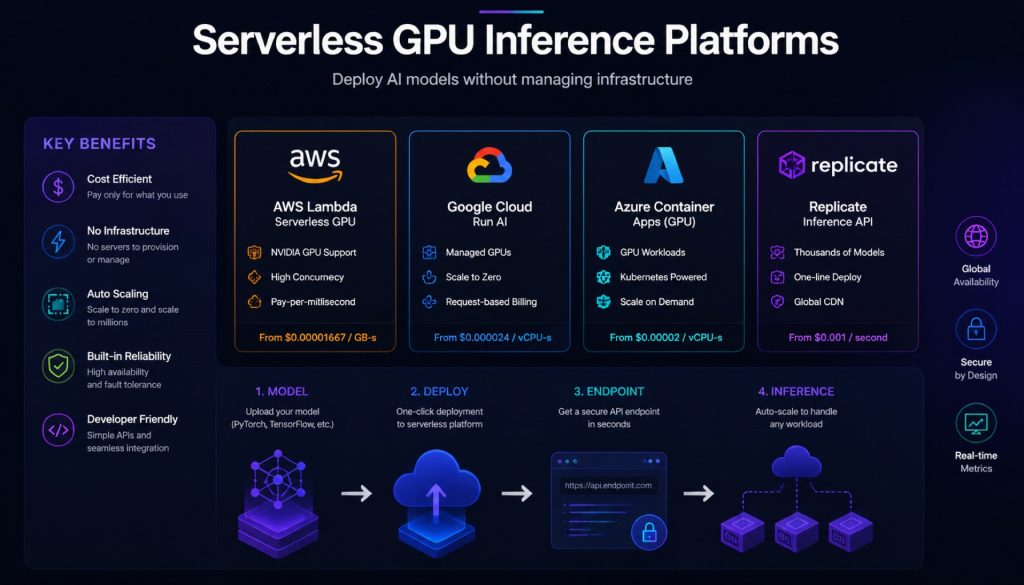
This article breaks down the four platforms developers talk about most: Modal, Replicate, Baseten, and RunPod. Instead of dry spec comparisons, we’ll approach this from real usage scenarios to help you figure out which platform actually fits your model, your traffic patterns, and your budget.
Modal: When Writing Python Is Writing Infrastructure
Picture this scenario. You have a text-to-speech model that sits idle most of the time but occasionally gets bursts of requests. You don’t want to rent a GPU server 24/7 for this. You also don’t want to mess with Docker, Kubernetes, or any of that orchestration complexity. You just want to write Python code, run one command to deploy it, and let it handle itself.
Modal was designed for exactly this person. The core philosophy is “Python-native.” You use decorators to mark which functions need GPUs, and Modal handles containers, scheduling, and autoscaling behind the scenes. Writing code feels like writing a local script, but execution is distributed.
What hooks developers on Modal is the billing model. Per-second pricing with no minimum spend. Your function runs for 3 seconds, you pay for 3 seconds, then resources release. When there are no requests, your cost is zero. An H100 runs around $3.95/hour, an A100 80GB about $2.50/hour, an A10 about $1.10/hour. These are hourly rates but billing is precise to the millisecond.
For cold starts, Modal uses something called memory snapshots. It captures a memory snapshot after your model loads the first time, then restores from that snapshot on subsequent starts. This skips the lengthy model loading process. For medium-sized models, cold starts typically land in the few-second range.
Modal has limitations. It’s a fully managed platform with no BYOC option (bring your own cloud account). This means you’re always stuck with Modal’s pricing. You can’t leverage reserved instances you already have on AWS or GCP to save money. When your model’s GPU utilization crosses roughly 50-60%, Modal’s per-second billing actually costs more than renting a dedicated GPU. And if you want to migrate your model off Modal, you’ll find your deployment logic is tightly coupled to the Modal SDK.
Who should use Modal? Developers with unstable traffic who prefer Python-first experiences and want to avoid DevOps entirely. Batch processing jobs, intermittent inference APIs, data pipelines. For these scenarios, Modal is often the most elegant choice.
Replicate: The App Store for Models
If Modal is built for Python developers who want hands-on control, Replicate takes a different path. It’s more like an App Store for models.
Replicate hosts over 50,000 public models. Stable Diffusion, Whisper, Llama, you name it. Popular open source models are almost always available. You don’t need to package anything or deploy anything yourself. Find the model you want, call an API, done. For many developers without ML backgrounds, this is paradise.
Billing is also per-second. Public models charge based on underlying hardware. An A100 80GB costs $0.0014 per second (roughly $5.04/hour), an H100 costs $0.001525 per second (roughly $5.49/hour). Some popular models offer per-output pricing. For example, the FLUX image generation model costs around $0.025-$0.04 per image.
If you want to deploy your own model, Replicate uses an open source packaging framework called Cog. You wrap your model in a Cog package, push it up, and it becomes an API. The entire process is even simpler than Modal. You barely need to write any deployment code.
But there’s a catch. Replicate’s pricing is significantly more expensive than Modal. For the same H100, Replicate’s serverless price is around $5.49/hour versus Modal’s $3.95/hour. That’s nearly a 40% difference. If your call volume is high, this gap can add up to thousands of dollars per month.
Another thing to watch is that Replicate’s cold starts can be slow in certain scenarios. While they’ve introduced a fast-booting mechanism, if you’re using a less popular model, the first request might take ten seconds or even longer. Popular models generally don’t have this problem because someone is always using them.
Who should use Replicate? Product managers and full-stack developers who want to validate ideas quickly. You just want to call Stable Diffusion to generate images or use Whisper for speech-to-text? Replicate gets you running in minutes. It’s also great for AI founders building MVPs. Validate demand on Replicate first, then consider migrating to a cheaper solution once you have traction.
Baseten: The Production-Grade Option
When we talk about Baseten, the conversation shifts. If Modal and Replicate target indie developers and small teams, Baseten aims at companies that have moved past the MVP stage and need to run models in serious production environments.
Baseten’s core selling point is “production-grade inference infrastructure.” It uses an open source framework called Truss to package models. You wrap your model in a Python class with load() and predict() methods, add a config.yaml describing hardware requirements, and Baseten deploys it as a production endpoint with autoscaling, observability, and tenant isolation built in.
On pricing, Baseten charges per minute. An H100 costs $0.10833/minute (roughly $6.50/hour), a B200 costs $0.16633/minute (roughly $10/hour). At first glance, this is more expensive than both Modal and Replicate. But Baseten isn’t just selling compute. It’s selling a complete production operations stack. SOC 2 Type II and HIPAA compliance come out of the box. Enterprise SLAs (99.95% availability) are standard. They even support BYOC, letting you run Baseten’s control plane inside your own cloud account.
Another Baseten feature is its Model APIs catalog. Similar to Replicate’s model marketplace, you can directly call pre-deployed open source models with per-token billing. But if you have custom models, the Truss packaging plus dedicated deployment path is the core product.
Where are the downsides? First, price threshold. For individual developers, $6.50/hour for an H100 isn’t cheap. Second, Baseten’s per-minute billing is coarser than Modal’s per-second approach. If your inference tasks are very short (say, just a few seconds), you get rounded up to a full minute each time. Actual costs will run higher. Third, while the Truss framework is open source, the deployment logic you build on top of it is largely tied to Baseten.
Who should use Baseten? Startups with stable users who need formal SLAs. Teams with compliance requirements (healthcare, finance). Mid-sized technical teams that don’t want to operate their own GPU clusters but need production-grade reliability.
RunPod: The Budget Option
If the first three platforms follow the “serverless” philosophy (they manage everything, you just write code), RunPod flips the script. It gives you a bare-metal GPU instance and you handle the rest yourself.
What makes RunPod compelling is price. An H100 SXM on Community Cloud costs just $2.69/hour. An A100 SXM costs just $1.39/hour. That’s over 30% cheaper than Modal’s H100 and nearly 60% cheaper than Baseten’s. If you’re willing to use Community Cloud (which means instances can be preempted), prices drop even further.
RunPod offers two usage modes. One is Pods, traditional GPU cloud instances. You rent a machine with a GPU like you’d rent a VPS, install whatever environment you want, run whatever code you want. The other is Serverless, which also supports scale-to-zero with per-second billing. However, serverless H100s cost around $4.55/hour, noticeably more expensive than bare Pods.
RunPod’s serverless has a feature called FlashBoot that achieves sub-second startup times on warm endpoints. But for completely cold starts (model not preloaded), large models still take tens of seconds to spin up.
RunPod has a strong community vibe. The Discord is active and documentation is fairly comprehensive. Many indie developers training Stable Diffusion models use RunPod because it’s cheap, flexible, and doesn’t restrict how you use it. You can run ComfyUI on it, do LoRA training, build private inference services. Tinker however you want.
But cheap comes with tradeoffs. Pods don’t autoscale. You write your own Dockerfiles for model deployment. You build your own monitoring and alerting. Community Cloud instances can get reclaimed during peak hours. Network storage costs $0.07/GB per month, and this charges even when Pods are stopped. That’s a hidden cost many people miss.
Who should use RunPod? Budget-conscious indie developers and students. Teams that need to run long training jobs. Engineers with their own DevOps skills who just need GPU compute. If you’re running a 72-hour fine-tuning job, RunPod’s Pod mode is probably the highest value option.
Four Platforms at a Glance
After all this discussion, here’s a quick reference table:
| Dimension | Modal | Replicate | Baseten | RunPod |
|---|---|---|---|---|
| Billing method | Per-second, no minimum | Per-second / per-output | Per-minute | Pod per-hour, Serverless per-second |
| H100 hourly rate | ~$3.95 | ~$5.49 | ~$6.50 | $2.69-$3.29 (Pod) / ~$4.55 (Serverless) |
| Cold start | Memory snapshots, typically seconds | Fast for popular models, slow for niche ones | Configurable warm pool | FlashBoot (sub-second warm, slower cold) |
| Packaging approach | Modal SDK (Python decorators) | Cog framework | Truss framework | Custom Docker / Handler |
| GPU options | T4 to B200 full coverage | T4, A100, H100, L40S | A10G to B200 | RTX 3090 to B200, widest selection |
| Best fit | Serverless Python, batch jobs | Quick access to open source models, MVPs | Production inference, enterprise compliance | Training, long-running tasks, budget-limited |
This table helps with quick orientation, but real decisions need to factor in your specific scenarios.
So How Do You Actually Choose?
Here is how each platform maps to common scenarios:
Scenario one: You just fine-tuned a model and want to turn it into an API as fast as possible for friends to test. Use Replicate. Cog packaging takes minutes. Push it up and you have an API with auto-generated documentation. If you want to get serious later, you can migrate then.
Scenario two: You’re building an AI SaaS product with unstable traffic. Sometimes you get dozens of requests per day, other times you get bursts of thousands. Use Modal. Per-second billing combined with scale-to-zero is the most friendly combination for unpredictable traffic. The Python-native experience also lets you iterate quickly.
Scenario three: Your product already has paying users. You need SLA guarantees. Customers ask where their data is stored and whether you have compliance certifications. Use Baseten. It’s pricier, but SOC 2 plus HIPAA plus enterprise support saves you enormous compliance headaches. And models packaged with Truss aren’t completely locked in. If you really need to migrate to self-hosted vLLM later, it’s not that hard.
Scenario four: You need to run a large model fine-tuning job. Four A100s for three days. Use RunPod. Pod mode bills by the hour. GPU selection is wide, prices are low, and the community has tons of training templates you can reference.
Scenario five: You’re building an image or video generation product. You mainly call open source models but occasionally need to deploy your own. This scenario makes both Replicate and Modal worth trying. If you’re primarily calling existing models and want simplicity, Replicate’s experience is unmatched. If you need more custom logic (like preprocessing and postprocessing chains), Modal offers more flexibility.
One Deeper Piece of Advice
Don’t just pick a platform for today. Think one step ahead. How will your traffic curve evolve?
If you currently have sparse traffic, Modal’s scale-to-zero helps compress costs to nearly nothing. But if your product takes off and GPU utilization stabilizes above 50%, serverless per-second billing actually becomes more expensive than renting a dedicated GPU. At that point, you should consider migrating to RunPod’s Pod mode or moving to Baseten’s BYOC offering.
Also, don’t be afraid of migration. All four platforms use standard PyTorch/TensorFlow models on NVIDIA GPUs under the hood. What’s actually hard to migrate isn’t the model itself but the glue code you wrote around platform SDKs. So from day one, keep your core inference logic separate from platform-specific binding code. Future platform switches will be much easier.
Finally, don’t just look at numbers on pricing pages. Billing granularity (per-second vs per-minute), idle costs during cold starts, hidden fees for network storage, region surcharges. These are what actually determine your end-of-month bill. Every platform offers free credits. The most reliable method is to run your actual workload on each one and let the real bills do the talking.
Go try them. $30 in free credits won’t bite you. But choosing the wrong platform and wasting time and money will.
Related reading
- Supabase vs Neon 2026: Which Serverless Postgres Wins for Next.js Full-Stack?
- LLM Inference Cost Is Collapsing: What Happens When AI Is Nearly Free in 2026
- On-Device AI Is Eating Cloud Inference From the Inside Out
Stay updated with our latest AI insights