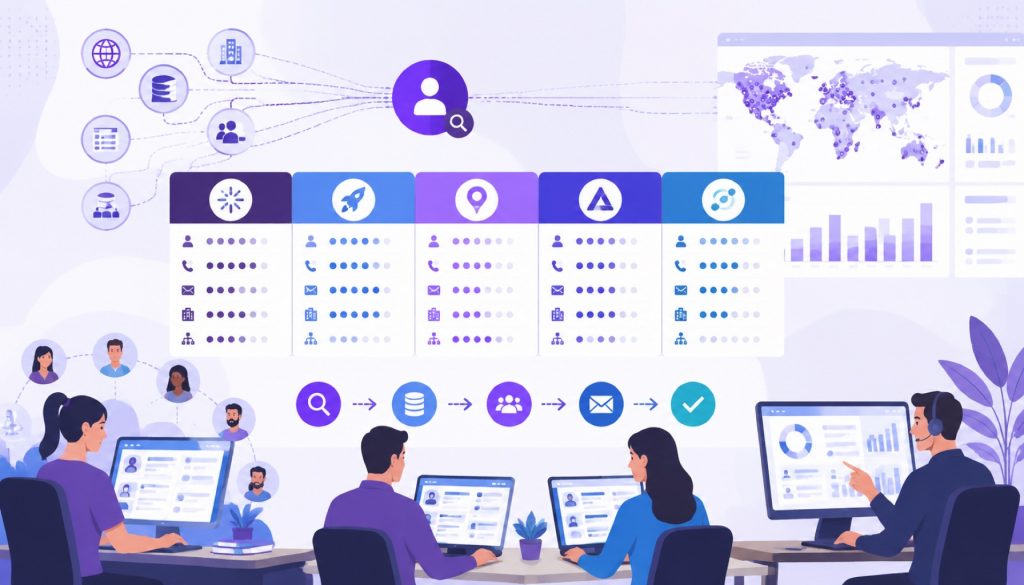
Clay is the most flexible B2B data orchestration tool on the market. That doesn’t make it the right choice for your team. If you’re running fewer than five SDRs, don’t have dedicated RevOps support, or need to stay under $500/month, Clay’s learning curve and hidden costs will eat the time you thought you were saving.
This guide does one thing: help you pick the right alternative based on your team size, budget, and workflow complexity.
What You Actually Need
Before comparing tools, answer three questions. How many leads does your SDR team process each month (under 1,000, 1,000-5,000, or 5,000+)? Do you need data enrichment only, or the full stack from prospecting to email sequences? Does anyone on your team have time to build and maintain automation workflows?
Clay’s core strength is data orchestration. It pulls information from 150+ data sources, cleans it, stitches it together, and exports it to your downstream tools. What it doesn’t do: send emails, make calls, or act as your CRM. The real cost of using Clay equals your Clay subscription plus Sales Navigator plus an email tool plus a dialer. A five-person team can easily hit $2,000-4,000/month.
If you need a platform where you can log in and start working immediately, Clay might be the wrong answer from the start.
Seven Alternatives Compared
| Tool | Core Focus | Starting Price | Database Size | Best For |
|---|---|---|---|---|
| Apollo.io | All-in-one prospecting | $49/month | 270M+ contacts | Budget-conscious small and mid-size SDR teams |
| Common Room | Signal-driven outreach | $625/month | Community + product signals | PLG companies, DevTool teams |
| Persana AI | AI-powered lead gen | $85/month | 700M+ contacts | Teams wanting AI without Clay’s complexity |
| Coldreach | Intent signals + personalization | $297/month | Intent data focus | AE teams prioritizing buyer intent |
| Lusha | Contact data verification | $49/month | 100M+ | Teams needing accurate phone and email only |
| Ocean.io | Lookalike company discovery | $199/month | Company profile matching | ABM teams finding companies like their customers |
| MarketBetter | Full-stack SDR platform | $299/month | Multi-source aggregation | Small teams wanting one platform for everything |
Breaking Down Each Option
Apollo.io: Best Value, But Data Quality Has Limits
Apollo is the most common Clay comparison, but they operate in different dimensions.
Apollo gives you an out-of-the-box prospecting workstation. Find contacts, verify emails, build sequences, send messages, track replies. Everything happens in one interface. The $49/month Basic plan is enough to get started, which means almost no barrier to entry for early-stage teams.
The database includes 270M+ contacts with broad coverage. The platform has built-in email sequencing and a dialer, so you don’t need to connect third-party tools. Pricing is transparent, with most teams covered between $49 and $119/month.
The data accuracy runs around 85-90%, which falls short of Clay’s multi-source cross-verification results. Personalization capabilities are weak, and templates feel generic. Advanced filtering and AI features are locked behind expensive plans.
Apollo works best for teams under five SDRs with budgets under $200/month who need to ramp volume quickly.
Common Room: Signal-Driven Prospecting for PLG Teams
Common Room doesn’t follow the traditional “database plus outreach” model. Instead, it monitors signals across community channels, product usage, GitHub, Discord, and other platforms to identify who’s paying attention to you. Then it helps you reach out at the right moment.
Signal quality is high, and timing is precise. The platform integrates deeply with Slack, Discord, and GitHub. This makes it ideal for DevTool, open-source, and PLG companies.
Pricing starts at $625/month, which isn’t cheap. If your customers don’t engage in community channels, your signal sources dry up. The platform doesn’t fit traditional outbound strategies.
Common Room makes sense for PLG companies, DevTool teams, and B2B SaaS businesses with active communities.
Persana AI: AI Without the Clay Learning Curve
Persana’s pitch is simple: AI automates what you’d have to build manually in Clay. The platform includes a 700M+ contact database plus AI-driven lead scoring and personalization suggestions.
The database is large. AI generates personalized openers automatically. You don’t need to build waterfall enrichment logic like you do in Clay.
The product is relatively new, so stability hasn’t been fully proven. AI-generated content can feel templated. The integration ecosystem isn’t as rich as Apollo or Clay.
Persana fits teams of two to three people who want AI capabilities without investing time to learn Clay.
Coldreach: Intent Signal Specialist
Coldreach differentiates itself through intent data. It doesn’t just tell you “this person is a VP of Sales.” It tells you “this person compared your competitors on G2 last week.”
Intent signal granularity is detailed. The platform auto-generates personalized messaging based on intent. CRM integration is smooth.
Pricing starts at $297/month, which requires consideration for smaller teams. Intent data coverage is limited and doesn’t work equally well across all industries. The platform suits AEs better than pure SDRs.
Coldreach works for B2B teams with high deal values, long sales cycles, and a need for precise timing.
Lusha: Accurate Data, Nothing Else
Lusha is the most focused option. It does one thing: provides accurate contact information. Phone numbers, email addresses, company data. Verification rates are high, and API integration is straightforward.
Data accuracy leads the industry. The Chrome extension works well, with one-click capture from LinkedIn. Pricing starts at $49/month with pay-as-you-go options.
Lusha doesn’t build sequences, doesn’t automate workflows, doesn’t personalize outreach. The database is smaller than Apollo’s. You need to combine it with other tools to build a complete workflow.
Lusha fits teams that already have email tools and just need accurate contact data.
Ocean.io: Lookalike Company Discovery for ABM
Ocean.io’s core capability is finding companies that resemble your existing customers. You upload a list of won deals, and it uses AI to match similar companies.
The lookalike matching algorithm is strong. The platform fits ABM strategies well. Salesforce and HubSpot integrations work smoothly.
Pricing starts at $199/month for relatively narrow functionality. Contact-level data needs to be filled in separately. The platform doesn’t suit spray-and-pray SDR tactics.
Ocean.io works for mid-to-large teams running ABM with clear ICPs who need to expand similar customer pools.
MarketBetter: Full-Stack New Player
MarketBetter aims to be “one platform instead of Clay plus Apollo plus email tools.” Data, enrichment, sequences, AI personalization, all included.
Full workflow coverage means you don’t need to assemble a tool stack. AI personalization capabilities are solid. Most features are included at $299/month.
The product is newer with less market validation. Data source depth doesn’t match Clay. Larger teams might find flexibility lacking.
MarketBetter suits teams of three to eight people who want one platform and don’t want to maintain complex tool stacks.
Decision Framework: Three Paths
Path A: Budget Priority (Under $200/Month)
Choose Apollo.io or Lusha paired with a free email tool.
Path B: Efficiency Priority ($300-800/Month)
Choose Persana AI or MarketBetter for full-stack, or Coldreach for intent-driven outreach.
Path C: Flexibility Priority ($800+/Month, With RevOps)
Stay with Clay, or combine Clay with Apollo.
Common Questions
Can you use Clay and Apollo together?
Yes, and many advanced teams do exactly this. Apollo serves as the database and email engine while Clay handles deep enrichment and personalization for high-priority accounts. This means paying for two subscriptions.
How steep is Clay’s learning curve really?
If you’ve used Airtable or Notion databases, onboarding isn’t hard. Building waterfall workflows that actually save time usually takes two to four weeks of exploration, or hiring a Clay-certified freelancer to set things up.
Which tool has the most accurate data?
For email accuracy, Lusha and Clay (using multi-source cross-verification) rank highest. Apollo has volume but slightly lower accuracy. For phone numbers, Lusha leads.
What’s the best choice for a small team of two to three people?
Apollo.io. It works out of the box, pricing is friendly, and features cover what you need. When your team reaches five people and workflows get more complex, consider Clay or Persana.
Does Common Room fit traditional outbound?
Not really. The platform’s core model is “wait for signals, then reach out.” If your strategy involves high-volume cold outreach, Apollo or MarketBetter fits better.
The Real Question
You don’t need to pick the most powerful tool. You need the tool that matches where your team is right now. Clay’s flexibility becomes valuable when you have the resources to use it. Until then, a simpler platform that your team can actually use will outperform a sophisticated one that sits half-configured.
Start with budget and team size. Add complexity only when the simple solution stops working.
Related reading
- Clay Alternatives for B2B Data Enrichment: A Real 2026 Comparison
- AI Sales Intelligence Tools: Clay vs Apollo vs Common Room vs Unify, Which Fits Your Prospecting in 2026?
- Okta Alternatives 2026: Clerk vs Auth0 vs WorkOS vs Descope vs FusionAuth for SaaS Teams
Stay updated with our latest AI insights