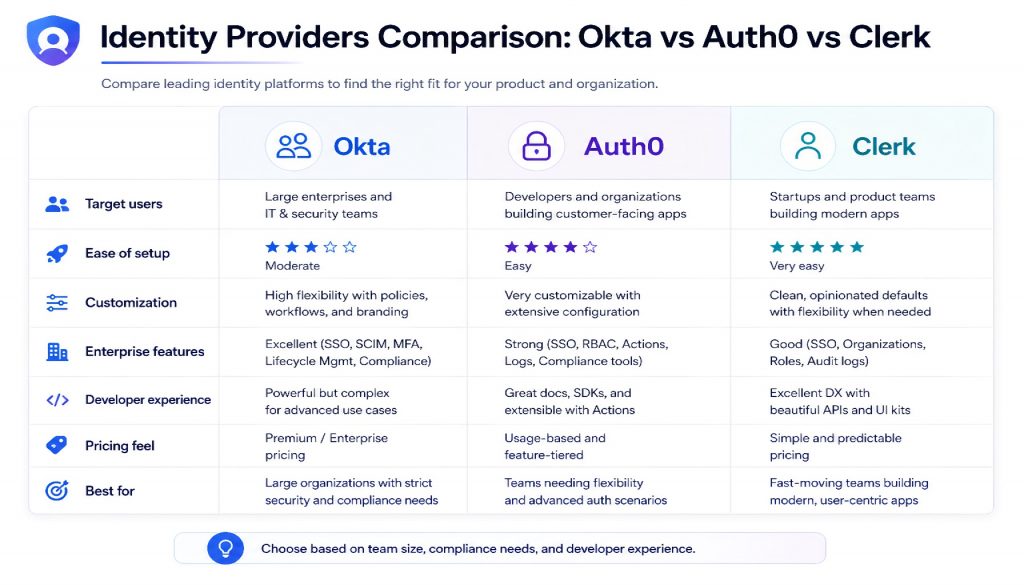
If you’re building a B2B SaaS product in 2026, authentication is one of those decisions that feels simple at first and then haunts you for years. Pick the wrong identity provider and you’ll either lose enterprise deals because you can’t support SAML, or burn engineering weeks wrestling with a system designed for Fortune 500 IT departments when your customers are 10-person startups.
Okta, Auth0, and Clerk each serve a different stage of company and a different type of buyer. This breakdown covers where each one fits, where it breaks down, and how to avoid the migration tax that hits teams who guess wrong.
Okta: The Enterprise Gatekeeper
Okta owns the enterprise identity market. Its Workforce Identity Cloud handles SAML, OIDC, SCIM, Active Directory, LDAP, and HR system integrations. If your buyers are large organizations, their IT teams already have Okta on the approved vendor list.
The SSO catalog is the main draw: 7,000+ pre-built integrations covering everything from Salesforce to legacy on-prem systems. Compliance certifications are complete (SOC 2 Type II, ISO 27001, FedRAMP, HIPAA). Multi-tenant support handles complex org hierarchies and permission models that smaller providers can’t match.
The tradeoff is developer experience. Okta’s documentation reads like an enterprise software manual. The concept model layers Applications, Authorization Servers, Policies, and Rules in ways that take days to untangle. There are no drop-in UI components. Integrating with Next.js means hand-rolling session management, callbacks, and token refresh logic.
Pricing: Workforce Identity starts at $6/user/month (Starter), but most teams need the Essentials tier at $17/user/month. A 50-person team runs $10,200/year minimum. Customer Identity (the Auth0-based product) charges by MAU: free up to 7,500, then roughly $0.05-0.07 per MAU beyond that.
Best fit: Teams of 50+ selling to enterprises that require SAML SSO and SCIM provisioning in their procurement process. If “must support Okta integration” shows up in your sales cycle, the decision is already made.
Auth0: The Middle Ground
Auth0 operates independently under Okta’s umbrella and occupies a useful middle position: strong developer experience with legitimate enterprise capabilities. The documentation is the best of the three. Quick Start guides get authentication running in under 15 minutes.
SDKs cover 20+ languages and frameworks with official packages for React, Next.js, and Vue. Auth0 Actions let you inject custom logic at any point in the authentication flow, whether that’s validating email domains, calling a fraud detection API, or pushing events to Segment. Universal Login gives you a customizable hosted login page with passwordless, social login, and MFA baked in.
On the enterprise side, Auth0 supports SAML and OIDC SSO, though the pre-built integration catalog is much smaller than Okta’s (around 30 vs. 7,000). The Organizations feature handles multi-tenancy, but RBAC and permission granularity don’t match what Okta offers.
Pricing: Free tier at 7,500 MAU, then usage-based billing. At 20,000 MAU, expect around $1,400/month. The hidden cost is how Auth0 counts MAUs: every login event counts, including token refreshes. Teams running high-frequency apps (collaboration tools, real-time dashboards) routinely see actual MAU numbers run 30-50% above their user count.
Best fit: Growth-stage teams (10-50 people) with a mixed customer base of SMBs and some enterprise accounts. You want fast time-to-market now with the option to flip on SAML integrations when that first big contract lands.
Clerk: Speed Above Everything
Clerk is the youngest of the three, and it’s become the default choice in the Next.js ecosystem. The pitch: authentication should work like a UI library. Install the package, add a few lines, and you’re done.
The integration with Next.js App Router is best-in-class.
In 2026, Clerk closed its biggest gap by adding SAML and OIDC enterprise SSO. You can now connect Azure AD, Google Workspace, and Okta as identity providers. Custom IdP configuration is straightforward.
What Clerk still lacks: SCIM automated user provisioning, audit logging, and advanced compliance certifications. If your buyer is a Fortune 500 company with a security review process, Clerk will likely stall the deal.
Pricing: The free tier jumped to 50,000 MAU in 2026 (up from 10,000). Beyond that, it’s $0.02/MAU, roughly 70% cheaper than Auth0 at scale. At 100,000 MAU, Clerk costs around $2,025/month where Auth0 would bill approximately $7,000/month.
Best fit: Early-stage SaaS (pre-seed through Series A), indie developers, and teams building on Next.js or React. Your customers are primarily SMBs or individual users. If you’re building AI tools, developer tools, or vertical SaaS and need to ship authentication in a day instead of a week, this is where to start.
Head-to-Head Comparison
| Dimension | Okta | Auth0 | Clerk |
|---|---|---|---|
| Developer experience | Poor. Steep learning curve, outdated APIs, no UI components | Good. Strong docs, 20+ SDKs, 15-min quickstart | Excellent. 3-line integration, pre-built components, Next.js native |
| SSO integrations | 7,000+ pre-built | ~30 pre-built | Manual configuration (SAML/OIDC supported since 2026) |
| Multi-tenancy | Complex org hierarchies, requires higher-tier plan | Organizations feature, solid RBAC | Built-in Organizations with invites and roles |
| Compliance | SOC 2 Type II, ISO 27001, FedRAMP, HIPAA | SOC 2, ISO 27001 | SOC 2 only |
| Free tier | None (trial only) | 7,500 MAU | 50,000 MAU |
| Cost at 100K MAU | Contact sales (estimate $5,000-8,000/mo) | ~$7,000/month | ~$2,025/month |
| SCIM provisioning | Full support | Supported | Not available |
| Custom auth flows | Policy/Rule system (complex) | Actions (flexible, code-based) | Webhooks and middleware |
| Framework support | Broad but dated | 20+ with official SDKs | Next.js/React focused, expanding |
What 2026 Changed
Three shifts notable this year:
Clerk added enterprise SSO, which removed the most common reason teams migrated away from it. The free tier increase to 50,000 MAU also means most startups won’t hit a paywall until well past product-market fit.
Auth0 launched “Auth0 for AI Agents” with agent identity authentication and a Token Vault. If you’re building agentic applications where AI systems need their own authenticated sessions, Auth0 is currently the only provider with a purpose-built solution.
Okta’s developer experience improvements remain slow. Community complaints about documentation staleness and SDK update cadence haven’t been addressed.
Migration Stories from the Field
Clerk to Auth0 (forced upgrade): A collaboration tool shipped with Clerk and reached 500 paying teams in six months. Then a 500-person enterprise prospect required SAML SSO with SCIM automated provisioning. This was before Clerk’s 2026 SSO addition, and SCIM still isn’t available. The team spent two weeks migrating to Auth0 to close the contract. The lesson: if “sign enterprise customers” is anywhere on your 12-month roadmap, start with Auth0 or accept that a migration is coming.
Okta to Clerk (intentional downgrade): A developer tools company chose Okta because the founding team came from enterprise backgrounds. Eight months in, every identity-related feature took 2-3 days longer than it should have. After migrating to Clerk, feature shipping time dropped by 60%. Their entire customer base was developers who didn’t need enterprise SSO. The lesson: don’t buy insurance for a risk you don’t actually face.
Auth0 cost surprise: A real-time collaboration SaaS discovered that Auth0’s MAU counting includes token refresh events. Users opening the app triggered refreshes that Auth0 counted as active sessions. Projected cost at 20,000 users was $1,400/month. Actual bill: $2,300/month because real MAU hit 35,000. The team eventually optimized their token refresh strategy, but the gap between expected and actual cost was a quarter-planning problem for months.
Decision Framework
The choice maps to three questions: who are your buyers, what’s your stack, and what does your next 12 months look like?
Your buyers are Fortune 500 enterprises, or you’re in a regulated industry (healthcare, finance, government). Go with Okta. The cost is high and the developer experience is rough, but your enterprise customers will pay enough to justify both. Their security teams will require the compliance certifications and SCIM support that only Okta provides at full depth.
Your buyers are a mix of SMBs and mid-market, with enterprise deals on the horizon. Auth0 is the pragmatic choice. You get a fast start with social login and email verification, then flip enterprise SSO on per-customer when the contracts justify it. The Actions system handles complex auth flow customization without forcing you into Okta’s policy maze.
Your buyers are SMBs, individual users, or developers. Your stack is Next.js. Clerk saves you 2-3 weeks of development time and costs 70% less than Auth0 at scale. The 50,000 MAU free tier means authentication costs zero until you have real traction.
You’re building AI-native applications with agent authentication needs. Auth0 is the only provider with a dedicated agent identity solution today.
Your app is high-frequency (real-time collaboration, monitoring dashboards, tools users keep open all day). Avoid Auth0’s MAU-based pricing or budget for 30-50% overage on your user count. Clerk’s simpler MAU calculation and lower per-unit cost handle this pattern better.
The Bottom Line
All three platforms solve authentication. The differences are about who you’re selling to and how much time you want to spend on identity infrastructure vs. your core product.
Okta is for teams that have already closed enterprise contracts and need the compliance and integration depth those buyers demand. Auth0 is for teams that want a capable middle ground with room to grow into enterprise features. Clerk is for teams that want authentication solved in an afternoon so they can get back to building.
Pick based on your current customers and your next four quarters. Not on where you hope to be in three years. If your needs change, migration is painful but survivable. Picking an identity provider that’s two stages ahead of your actual business is a worse outcome than migrating later, because you’ll pay the complexity tax every single day until then.
Related Reading
- Okta vs Auth0 vs Clerk: Choosing SaaS Authentication in 2026
- Okta vs Auth0 vs Clerk in 2026: Which SaaS Authentication Provider Actually Fits Your Stage?
Stay updated with our latest AI insights