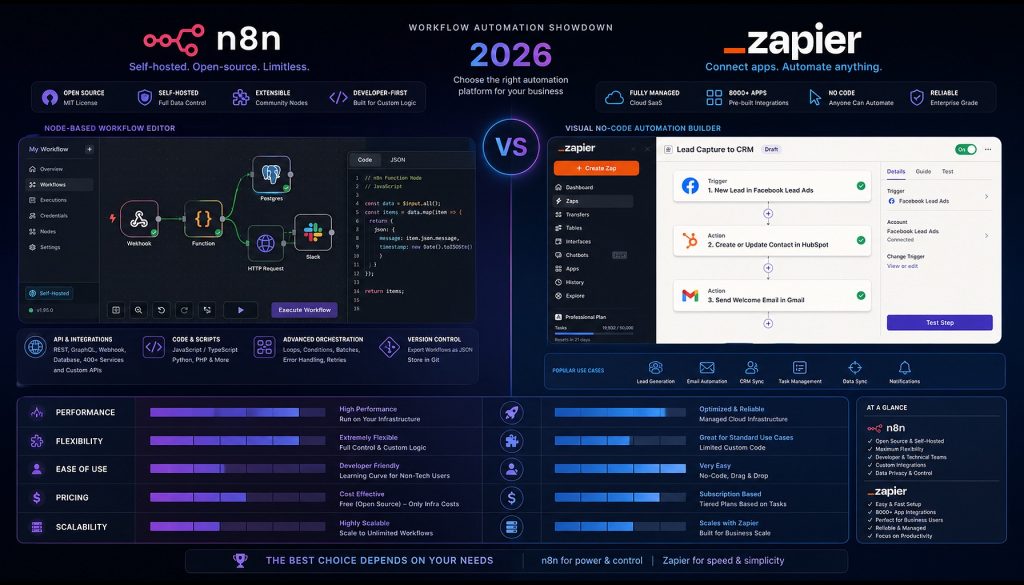
Here’s the short version: if anyone on your team can write basic code, n8n will save you thousands of dollars a year. If your team is entirely non-technical, Zapier’s 7,000+ pre-built connectors and zero-friction setup still get you automating fastest.
This isn’t a wishy-washy “both are great, depends on your needs” article. We’re comparing real pricing, real use cases, and real limitations to help you make a clear decision.
Pricing in 2026: The Gap Is Bigger Than You Think
Let’s talk numbers.
n8n offers a completely free self-hosted version that runs comfortably on a $10/month VPS. The cloud-hosted Starter plan costs $20/month for 2,500 executions, and the Pro plan runs $50/month for 10,000 executions.
Zapier Professional starts at $19.99/month for just 750 tasks. The Team plan costs $69/month for 2,000 tasks.
The prices look similar at first glance. They’re not. The difference is in how each platform counts usage.
How Billing Works
| Platform | Billing Unit | What It Means |
|---|---|---|
| n8n | Per workflow execution | A 20-step workflow processing 500 records = 1 execution |
| Zapier | Per action step | A 5-step Zap running once = 5 tasks consumed |
This difference compounds fast. Let’s run a realistic scenario:
10,000 workflow runs per month, 8 steps each:
- n8n self-hosted: $10–15/month (server costs only)
- n8n Pro cloud: $50/month
- Zapier: 80,000 tasks consumed — well beyond any standard plan, costing $250–400+/month
Same workload, 5–8x cost difference. And automation usage scales linearly with business growth, so this gap only widens over time.
Integrations: Zapier Wins on Quantity, n8n Wins on Flexibility
Zapier boasts 7,000+ pre-built connectors. n8n offers 400+ native nodes plus 600+ community-built nodes.
On paper, Zapier dominates. In practice, it’s more nuanced.
Where they’re equal: Every mainstream tool — Slack, HubSpot, Salesforce, Gmail, Notion, Airtable, Shopify, Google Sheets — has native support on both platforms. If your stack consists of popular SaaS tools, you won’t notice a difference.
Where Zapier wins: Niche SaaS tools. If you need to connect an obscure industry-specific app without public API documentation, Zapier likely has a pre-built connector. n8n probably doesn’t.
Where n8n wins: Custom APIs and internal systems. n8n’s HTTP Request node connects to any REST or GraphQL API with full control over authentication, headers, and data transformation. If your workflows touch internal databases, private APIs, or custom authentication schemes, n8n handles it far more gracefully than Zapier’s Webhooks.
Bottom line: For most teams, integration count isn’t the bottleneck. The tools you actually use daily are supported on both platforms. The real question is whether you can (and want to) write a bit of code to fill gaps.
AI Capabilities: n8n Is a Generation Ahead
This is the most significant differentiator in 2026.
n8n: Built for AI Agents
n8n ships with a full AI Agent architecture:
- Native LangChain integration
- 70+ AI-specific nodes
- Support for GPT-4, Claude, Mistral, Gemini, and local Ollama models
- Autonomous agent workflows that decide which tools to call based on input data
- Built-in vector store connections for RAG (Retrieval-Augmented Generation)
You can build AI agents that autonomously route decisions — choosing which database to query, which API to call, or which team to notify — all within the visual workflow editor.
Zapier: AI as an Assistant Layer
Zapier’s AI capabilities focus on making automation easier to create, not on making automations smarter:
- Copilot generates Zaps from natural language descriptions
- Zap Guesser recommends automations based on connected apps
- OpenAI and Anthropic API actions available as individual steps
You can call AI APIs, but there’s no native agent architecture. Complex AI logic must be manually choreographed across individual action steps.
What This Means for You
If your workflows need AI to make decisions — chatbots, intelligent document processing, RAG systems, autonomous routing — n8n has a structural advantage. If you just need to run a prompt through GPT-4 as one step in a larger workflow, both platforms handle that fine.
Self-Hosting: n8n’s Unique Advantage
n8n is open-source (fair-code license) and deploys anywhere — Docker, npm, any cloud VPS, Kubernetes.
Zapier is pure SaaS. No self-hosting option exists.
This matters for three reasons:
Data sovereignty. Self-hosted n8n keeps all data on your own infrastructure. For teams handling sensitive data in healthcare, finance, or legal — this isn’t a nice-to-have, it’s a compliance requirement.
Cost ceiling. Self-hosted n8n costs scale with server resources, not workflow volume. Running 100 workflows vs. 10,000 workflows might only double your server bill. On Zapier, 100x more workflows means roughly 100x more cost.
Customization freedom. You can modify source code, build custom nodes, and integrate with any internal system. Zapier’s customization is limited by its SaaS architecture.
The trade-off: self-hosting means you own maintenance, upgrades, and backups. If your team lacks DevOps capacity, this becomes a burden rather than an advantage.
Ease of Use: Zapier Still Has the Lowest Barrier
Zapier’s core strength has never been raw power — it’s accessibility.
A marketing manager can open Zapier and build a “new lead in HubSpot → Slack notification” automation in 5 minutes. No API knowledge needed. No code. No deployment. No server.
n8n has a steeper learning curve. While it offers a visual drag-and-drop editor, unlocking its full potential requires understanding:
- JSON data structures
- Basic API concepts (endpoints, authentication, headers)
- Some JavaScript for custom logic
This isn’t about which tool is technically better — it’s about team composition. A team of marketers and salespeople will get more value from Zapier. A team with even one developer will unlock dramatically more from n8n.
Head-to-Head Comparison
| Criteria | n8n | Zapier |
|---|---|---|
| Starting price | Free (self-hosted) / $20/mo (cloud) | $19.99/month |
| Cost at scale (10K runs/mo) | $15–50/month | $250–400+/month |
| Billing model | Per workflow execution | Per action step |
| Native integrations | 400+ nodes + 600+ community | 7,000+ connectors |
| AI Agent support | Native LangChain + 70+ AI nodes | API calls only, no agent framework |
| Self-hosting | Yes (Docker, npm, K8s) | No |
| Data privacy | Full control (self-hosted) | Third-party hosted |
| Learning curve | Moderate (some code helps) | Low (fully no-code) |
| Complex logic | IF/Switch/Function nodes + code | Paths + Filters (limited) |
| Enterprise features | SSO, audit logs, LDAP | SSO, admin console, SCIM |
Real-World Scenario: Lead Routing Automation
Consider a common workflow: new lead arrives → evaluate source and company size → route to appropriate sales rep → update CRM → send notification.
Zapier implementation: 5-step Zap using Filter and Path actions for conditional branching. Each run consumes 5 tasks. Simple, visual, done in 10 minutes.
n8n implementation: IF nodes and Switch nodes for branching, HTTP Request nodes for CRM API calls, Function nodes for custom scoring logic. Each run consumes 1 execution. Takes 30 minutes to build, but costs 80% less to operate long-term.
Zapier is faster to build. n8n is cheaper to run. Which matters more depends on whether your time or your budget is the bigger constraint.
Who Should Choose n8n
- Teams with at least one developer or technical ops person
- Complex workflows with many steps, branches, and conditional logic
- High execution volume where per-task pricing gets expensive
- AI-powered automation that requires agent decision-making
- Compliance requirements demanding self-hosted data processing
- Organizations wanting long-term cost control without SaaS lock-in
Who Should Choose Zapier
- Fully non-technical teams with no coding capacity
- Heavy reliance on niche SaaS tools that need pre-built connectors
- Simple, low-volume workflows (under 1,000 runs/month)
- Teams that prioritize speed of setup over long-term cost savings
- No self-hosting requirements or data residency concerns
FAQ
Can n8n fully replace Zapier?
Technically, yes. n8n can do everything Zapier does and more. But “can replace” and “should replace” are different questions. If your team lacks the technical capacity to maintain n8n, forcing a migration creates friction that outweighs cost savings.
How hard is migrating from Zapier to n8n?
Moderate difficulty. There’s no one-click import — you’ll need to rebuild workflows manually. The good news: most Zap logic has direct equivalents in n8n nodes. Budget 1–2 hours per complex Zap for migration.
Are n8n cloud and self-hosted versions feature-equivalent?
Core features are identical. Cloud adds managed hosting and basic logging. Enterprise adds SSO, audit logs, and dedicated support. Self-hosted gives you the most flexibility but you handle ops yourself.
Is Zapier’s AI Copilot actually useful?
For beginners, yes — describing what you want in plain English and getting a working Zap is genuinely helpful. But Copilot is a creation assistant, not an AI agent. Complex automation logic still requires manual setup.
Should I use both platforms together?
You can, but maintaining two automation platforms creates cognitive overhead that most teams underestimate. Pick one as your primary system and use the other only for edge cases where it clearly excels.
The Verdict
The decision framework is straightforward:
Choose n8n if you have technical capacity and want to save 5–8x on automation costs while getting superior AI agent capabilities and full data control.
Choose Zapier if speed matters more than cost, your team is non-technical, and you need the broadest possible pre-built integration library.
For most growing teams in 2026, n8n represents the better long-term investment. The initial learning curve pays for itself within months through dramatically lower operating costs and far more powerful AI automation capabilities. But if nobody on your team can handle a JSON object, Zapier remains the pragmatic choice — and there’s no shame in that.
Related Reading
- Zapier vs Make vs n8n: Which Automation Tool Actually Saves You Money in 2026?
- n8n vs Zapier vs Make: Which Automation Tool Is Worth Your Money in 2026?
Stay updated with our latest AI insights