These four tools keep showing up in the same “best QA software” listicles, but they are not selling the same thing. One is a deeply customizable quality platform. One is Zendesk’s native QA layer. One is a full-stack conversation intelligence suite. And one bundles QA coverage, coaching, and BI into a single operational package.
If you only compare them on “can it auto-score tickets,” you will buy the wrong product.
This guide breaks down what each platform actually does best, where it falls short, and which team profile it fits — so you can skip the generic feature matrix and make a decision that sticks.
The Core Problem: “QA Tool” Is No Longer a Single Category
In 2026, the customer service QA market has clearly split into distinct layers:
- Customizable quality platforms that let you build scoring rubrics from scratch
- Ecosystem-native QA that lives inside your existing helpdesk
- CX intelligence suites where QA is one module in a broader analytics layer
- Operational QA + coaching combos that prioritize coverage and agent development together
MaestroQA, Klaus, Level AI, and Scorebuddy each occupy a different layer. Treating them as interchangeable leads to expensive mismatches between what your team actually needs and what the software delivers.
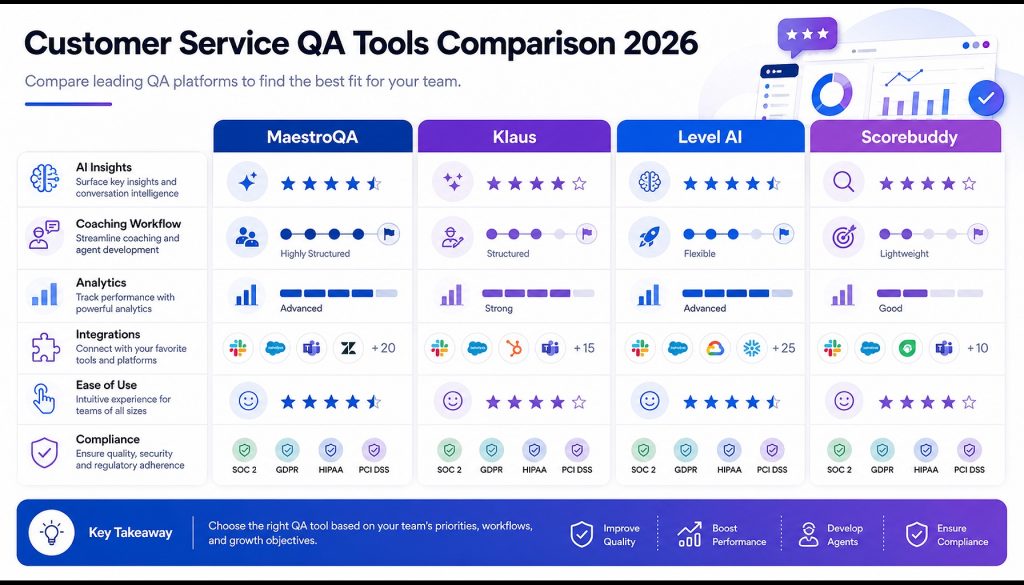
Quick Comparison: Four Tools, Four Philosophies
| Dimension | MaestroQA | Klaus (Zendesk QA) | Level AI | Scorebuddy |
|---|---|---|---|---|
| Core positioning | Highly customizable quality platform | Native QA inside the Zendesk ecosystem | CX intelligence + automated quality | QA + coaching + BI platform |
| Primary narrative | Customizable AutoQA, AI prompting, hybrid stack support | Review every conversation, boost CSAT, spot critical issues | Automated quality, VOC, agent assist, business insights | 100% coverage, human-in-the-loop, custom scorecards, LMS |
| Best-fit scenario | Complex rubrics, multi-system support stacks | Teams already deep in Zendesk | Teams connecting QA to broader CX intelligence | Contact centers needing fast coverage + coaching loops |
| AutoQA approach | High customizability, editable classifiers | Standardized, out-of-the-box | Built on full conversation analytics | Emphasizes speed, coverage, and transparency |
| Coaching capabilities | Scoring and ops-oriented | Integrated within Zendesk QA workflows | Rich suggestions and insights | Coaching + dashboards + built-in LMS |
| Key limitation | Requires intentional implementation design | Less flexible outside Zendesk ecosystem | May feel heavy for pure QA use cases | Large enterprises may need more governance depth |
| Pricing model | Custom (typically per agent/month) | Bundled with Zendesk Suite or add-on | Custom (platform pricing) | Per agent/month, transparent tiers |
MaestroQA: The Quality Operations System
MaestroQA does not want to be your auto-scoring plugin. It wants to be the operating system for how your entire quality program works.
What Makes It Different
MaestroQA’s competitive edge lives in customization depth. Its comparison pages explicitly lean on editable AI prompting, configurable AutoQA rubrics, screen capture for visual workflows, and support for hybrid tech stacks. This is not a tool that assumes everyone runs a single Zendesk queue.
For teams juggling email, live chat, back-office operations, policy reviews, and escalation workflows across multiple platforms, MaestroQA’s flexibility matters. You can define exactly how scoring logic works, build multi-layered rubrics that reflect your actual business processes, and generate reports that map quality to operational outcomes.
Where It Shines
- Complex, multi-criteria scoring rubrics that go beyond binary pass/fail
- Teams running hybrid support stacks (Zendesk + Salesforce + custom tools)
- Organizations that already know what their QA framework should look like
- Support operations where screen capture and visual verification matter
The Trade-Off
MaestroQA is a system, not a switch you flip. You need to know what your quality standards are before the platform can deliver its full value. Teams without a clear QA philosophy may find themselves with a powerful tool and no roadmap for using it. Implementation requires design thinking upfront.
Klaus (Zendesk QA): The Path of Least Resistance for Zendesk Teams
Klaus was acquired by Zendesk and now operates as Zendesk QA. The practical implication: if your support organization already lives inside Zendesk, this is the lowest-friction path to automated quality assurance.
What Makes It Different
Klaus emphasizes reviewing every single conversation, spotting critical issues automatically, detecting knowledge gaps, and accelerating new agent onboarding. The value proposition is not “most customizable” — it is “fastest time to value within the Zendesk ecosystem.”
For many support teams, the real blocker is not lacking a sophisticated scoring engine. It is still running manual spot-checks on 2-5% of tickets. Klaus solves that specific problem by turning sample-based QA into full-coverage monitoring without forcing a platform migration.
Where It Shines
- Teams already using Zendesk as their primary support platform
- Organizations that want standardized QA without heavy configuration
- Support leaders who need to move from sampling to full coverage quickly
- New team managers looking for faster agent ramp-up signals
The Trade-Off
The Zendesk-native advantage becomes a limitation if your support stack is heterogeneous. Teams that need editable classification logic, deeply custom scoring frameworks, or multi-platform analysis will find Klaus less flexible than MaestroQA. You are trading customization ceiling for integration speed.
Level AI: QA as an Entry Point to CX Intelligence
Level AI plays a different game entirely. Its homepage pitches Automated Quality alongside AI Virtual Agent, Agent Coaching, Voice of the Customer, Business Insights, and Agent Assist — all in the same breath. QA is not the destination here; it is the on-ramp.
What Makes It Different
Level AI builds its quality automation on top of full semantic conversation analysis. That means your QA scores are not isolated numbers — they connect to customer sentiment trends, root cause identification, topic clustering, and real-time agent guidance. The platform thinks in terms of “why is this happening across thousands of conversations” rather than “did this agent follow the script.”
For teams already thinking about voice-of-customer programs, conversation intelligence, and proactive coaching based on interaction patterns, Level AI offers a unified layer instead of stitching together separate point solutions.
Where It Shines
- Teams that want QA, VOC, and coaching insights in one platform
- Organizations already investing in conversation intelligence
- Support leaders who care about root cause analysis, not just scores
- Companies ready to connect quality data to broader business outcomes
The Trade-Off
If you just need to get from 3% manual sampling to 100% automated coverage — and that is genuinely your only goal right now — Level AI may feel like buying a commercial kitchen when you need a microwave. The platform’s breadth becomes overhead if your immediate need is narrow.
Scorebuddy: The Operational Pragmatist
Scorebuddy’s pitch is refreshingly grounded: 100% QA coverage, half the cost, human-in-the-loop validation, 90%+ AI auto-scoring accuracy, customizable scorecards, integrated coaching, built-in LMS, and business intelligence dashboards. No grand platform narrative — just the outcomes contact centers actually measure.
What Makes It Different
Scorebuddy bundles the three things most QA managers ask for simultaneously: broader coverage, faster feedback to agents, and reporting that connects to business KPIs. Its built-in LMS means coaching is not a separate tool you need to integrate. Its BI layer means you do not need to export data to build operational dashboards.
For mid-to-large contact centers where the bottleneck is “we know what the problems are but cannot close the loop fast enough,” Scorebuddy’s integrated approach removes friction between identifying issues and driving improvement.
Where It Shines
- Contact centers that need coverage expansion without proportional headcount growth
- Teams where coaching and training are bottlenecks, not just scoring
- Organizations that want QA, LMS, and BI without managing multiple vendor relationships
- Budget-conscious teams that need transparent, predictable pricing
The Trade-Off
If you need enterprise-grade workflow governance, complex approval chains, or deep multi-tenant configurations, Scorebuddy may not have the depth of a pure platform play like MaestroQA. It optimizes for practical impact over architectural flexibility.
How to Choose: Match the Tool to Your Actual Bottleneck
Stop comparing feature lists. Start by identifying where your quality program is actually stuck.
Scenario 1: You live in Zendesk and need QA that just works
Go with Klaus (Zendesk QA).
The switching cost is minimal, the learning curve is low, and you will get from sample-based reviews to full-coverage monitoring faster than with any other option. You are not buying the most powerful tool — you are buying the fastest path to operational QA.
Scenario 2: You have complex scoring needs and a multi-platform stack
Go with MaestroQA.
Your QA framework should reflect your business, not your software’s default templates. If you already know what good looks like and need a platform that can encode it faithfully across multiple channels and systems, MaestroQA’s customization depth is the differentiator.
Scenario 3: You want QA connected to VOC, insights, and real-time coaching
Go with Level AI.
If your ambition extends beyond scoring into understanding why customer experience breaks down and how to fix it systemically, Level AI’s broader intelligence layer will save you from stitching together five different tools later.
Scenario 4: You need coverage, coaching, and reporting — all practical, all now
Go with Scorebuddy.
If your team’s pain is “we cannot review enough, we cannot coach fast enough, and leadership wants dashboards,” Scorebuddy delivers all three without requiring a six-month implementation project or a platform migration.
The Real Question: Auto-Scoring or Quality Operations?
Before you demo any of these tools, answer one question honestly: are you buying auto-scoring, or are you building a quality operations practice?
- If you just need automated scoring at scale: Klaus and Scorebuddy both deliver fast, practical coverage expansion.
- If you need deeply customizable evaluation logic: MaestroQA gives you the control surface to build exactly what your business requires.
- If you want QA to feed into broader customer experience intelligence: Level AI connects quality data to VOC, coaching, and business insights in a single layer.
The worst outcome is buying a CX intelligence platform when you need a scorecard tool — or buying a scorecard tool when your real problem is systemic customer experience drift.
Bottom Line
The customer service QA market in 2026 is no longer one category. It is four distinct product philosophies competing under the same label:
- MaestroQA = customizable quality platform for teams that know exactly what they want to measure
- Klaus / Zendesk QA = native, standardized QA for Zendesk-first organizations
- Level AI = CX intelligence layer where QA is one module in a broader system
- Scorebuddy = pragmatic QA + coaching + BI bundle for contact centers that need results now
Choose based on where you are stuck — scoring logic, ecosystem fit, intelligence breadth, or operational speed — not based on who has the most impressive AI demo.
Frequently Asked Questions
What is the biggest difference between MaestroQA and Klaus?
MaestroQA prioritizes customizable AutoQA, hybrid support stack integration, and deep analytical flexibility. Klaus (now Zendesk QA) prioritizes seamless Zendesk ecosystem integration and standardized, fast-to-deploy quality monitoring. Choose MaestroQA for control; choose Klaus for speed within Zendesk.
How is Level AI different from traditional QA tools?
Level AI treats QA as one component of a broader CX intelligence platform. It combines automated quality scoring with Agent Assist, Voice of the Customer analytics, and business insights — making it fundamentally different from tools that only score conversations.
Which teams benefit most from Scorebuddy?
Mid-to-large contact centers that need to expand QA coverage quickly while simultaneously building coaching programs and operational dashboards. Scorebuddy’s integrated LMS and BI layer make it particularly strong for teams where the gap between identifying problems and fixing them is the real bottleneck.
What should I evaluate first when choosing a QA tool in 2026?
Start with your actual constraint: Is it ecosystem compatibility (Klaus)? Scoring customization (MaestroQA)? Intelligence breadth (Level AI)? Or operational coverage and coaching speed (Scorebuddy)? This decision framework matters more than comparing AI accuracy percentages.
What is the most common mistake when buying AutoQA software?
Buying a tool that can score conversations but cannot integrate with your existing support stack or connect scoring insights to coaching workflows. Auto-scoring is step one — the real value comes from the feedback loop between quality measurement, agent development, and operational improvement.
Related Reading
- Cursor vs Claude Code 2026: Which AI Coding Tool Should Developers Actually Choose?
- Perplexity Pro vs Gemini Deep Research: Same $20/Month, 30x Difference in Research Quota
Stay updated with our latest AI insights