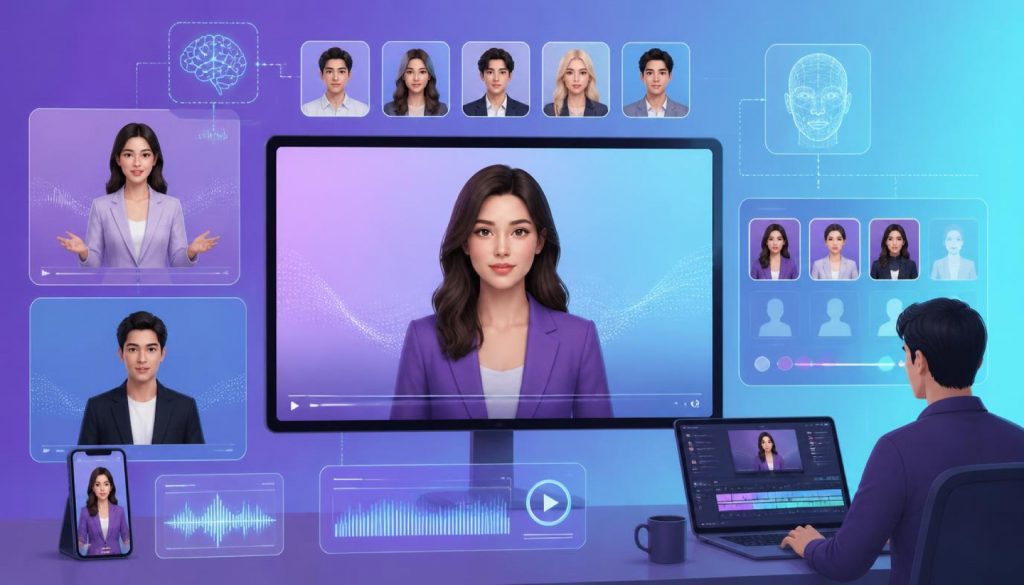
Chen runs content for a cross-border e-commerce company. His boss wanted product introduction videos in English, Japanese, and Spanish. Each needed a human presenter. He ran the numbers: hiring three native speakers, booking studio time, and covering post-production would blow past $50,000. Worse, coordinating schedules alone would eat two weeks minimum.
He searched “AI avatar video generator” and got slammed with options. HeyGen, Synthesia, D-ID, Colossyan. Every landing page claimed to be the best solution. After testing two or three, Chen felt more confused than when he started. They all generated a virtual person talking to camera. But what actually separated them? Which one fit his needs?
Chen isn’t alone in this. By 2026, AI avatar tools have shifted from novelty to serious productivity category. Corporate training, e-commerce marketing, online education, news broadcasts. More teams are replacing human presenters with digital avatars. The differences between these tools run deeper than you’d guess from their websites.
Why Digital Avatars Became Essential
Three years back, most people thought of AI avatars as those creepy videos with mismatched lip sync and frozen expressions. The technology moved faster than anyone expected. Today’s top tools produce avatars you can’t spot as synthetic unless you look closely. Lip sync accuracy jumped dramatically. Facial micro-expressions look natural. Even the small head movements people make while talking got convincingly modeled.
What does this mean in practice? The virtual spokesperson tech that used to require studio budgets now works for three-person teams. The multi-language videos that needed repeated filming, editing, and dubbing can now get generated from a single script.
But this category exploded so fast that tools ended up with different specializations. There’s no universal winner. Pick the wrong one and you waste subscription fees at best, miss project deadlines at worst. So we need to understand where each of these four main players actually excels.
HeyGen: Lip Sync Ceiling, Creator’s First Choice
If you’ve seen videos of Chinese speakers delivering perfect English product demos on social media, odds are high they came from HeyGen. The company first got attention with its video translation feature. Upload your Chinese video, get back an English version with matched lip movements and cloned voice. It looks like you actually speak the language.
HeyGen does more than translation though. Its avatar library covers different skin tones, ages, and styles. The photo-to-avatar feature takes a headshot and generates a virtual presenter based on your face. For individual creators and small startup teams, this is zero-barrier replacement for on-camera work.
Chen picked HeyGen for straightforward reasons. He needed fast multi-language output, and HeyGen’s lip sync came out most natural among the options he tested. From script input to exported video took around ten minutes for a one-minute clip. Price-wise, personal plans run in the low double-digit dollars per month. His small team could afford that.
HeyGen has clear weaknesses though. It acts more like a personal efficiency tool than enterprise platform. Collaboration features are basic. Template selection is thinner than competitors. Managing a team of dozens making videos simultaneously would be awkward.
Synthesia: The Enterprise Training Standard
Different scenario. Zhang manages HR at a mid-size manufacturing company with 500 employees. She produces onboarding training, safety protocols, and compliance education videos constantly. Previously, these meant booking a trainer in a conference room for a full day of recording, then another week in post-production. Content updates were painful. When regulations changed, entire video sets needed re-recording.
Synthesia was built for exactly this case. It holds the highest market share in enterprise training. Customer list includes multiple Fortune 500 names. Its core advantage isn’t about individual video quality. It’s the full enterprise workflow design: brand template management, multi-person collaboration and approval, SCORM standard output (direct import into LMS platforms), automatic translation across 120+ languages.
Synthesia’s avatar styles lean formal and business-appropriate. Not great for casual social media content, but perfect for internal corporate explainers. It supports custom avatars too. Record video of an employee, train their digital twin, and that internal trainer can appear in a hundred training videos simultaneously.
Zhang values one specific detail most: text changes and video regeneration happen almost instantly in Synthesia. Policy updates? Change a few lines of script. Five minutes later, new video is ready. Traditional filming workflows can’t touch this.
Price-wise, Synthesia’s enterprise subscriptions aren’t cheap. Annual contracts typically run in the five-figure range. But for companies already spending hundreds of thousands yearly on training video production, the ROI is clear.
D-ID: Developer-Friendly, Photo-Driven Lightweight Option
If HeyGen and Synthesia target people making videos, D-ID targets people building products. Its most distinctive capability is API-first architecture. You can embed D-ID’s avatar generation into your own application.
Picture this scenario: you’re developing an online education app. You want a virtual teacher in the video window explaining each lesson. You don’t need hundreds of pre-recorded videos. Just send lesson text to D-ID’s API, and it returns the corresponding avatar explainer video in real time. This “generate on demand” model turns avatars from pre-made content into dynamic content.
D-ID has another interesting feature: photo animation. Upload a static portrait (even historical figures or painted portraits), and D-ID makes that photo “come alive.” It speaks, makes expressions, turns its head. Museums and exhibitions use this constantly to let historical figures tell their own stories.
D-ID’s tradeoffs are obvious though. It focuses on API and developer experience. The editor for regular users is relatively simple. If you’re not a developer and just want to make some marketing videos quickly, D-ID’s learning curve is steeper than HeyGen or Synthesia. Pricing works on API call volume. Good fit for teams with technical capability who need batch or dynamic generation.
Colossyan: Education and Learning Scene Specialist
Last one is Colossyan. The name isn’t widely known domestically, but in Western enterprise training and education markets, it competes directly with Synthesia. In certain niche scenarios, it goes deeper.
Colossyan’s differentiation sits in the “learning design” dimension. It doesn’t just generate an avatar talking. It provides a full toolkit optimized for learning outcomes: interactive Q&A segments, scenario branching choices, auto-generated quiz questions, learning progress tracking. Put simply, it aims to be an AI-powered courseware production platform, not just a video generator.
A typical user is an L&D (Learning and Development) department head at a company. Her job isn’t just recording a talk for employees to watch. She needs to ensure employees actually understand the content and pass assessments. Colossyan’s interactive features turn “watching video” into “participating in learning.” That’s a qualitative difference for training effectiveness evaluation.
Colossyan’s avatar style leans young, friendly, and approachable. Works well for content aimed at new employees or students. Multi-language support is expanding rapidly, currently covering dozens of languages. Pricing falls between HeyGen and Synthesia. Mid-size companies find it reasonable.
Core Differences in One Table
| Dimension | HeyGen | Synthesia | D-ID | Colossyan |
|---|---|---|---|---|
| Starting monthly fee | ~$30 | ~$60 (personal) / enterprise pricing varies | Pay-per-use, free trial | ~$35+ |
| Avatar count | 100+ | 200+ | Photo-driven primary | 100+ |
| Language support | 40+ | 120+ | 30+ | 70+ |
| Lip sync quality | ★★★★★ | ★★★★ | ★★★☆ | ★★★★ |
| API capability | Available, not core | Available, enterprise tier | Core capability, most complete | Limited |
| Video translation | Core selling point | Supported | Supported | Supported |
| Collaboration & approval | Basic | Enterprise-grade | Developer-focused | Mid-tier |
| Best use case | Individual creators, cross-border e-commerce, social media | Large company training, compliance education, multi-language internal comms | Product embedding, batch generation, interactive exhibitions | SMB training, online education, courseware production |
This table simplifies things. Each tool iterates quickly. Check official sites for current features and pricing. But the core positioning differences won’t shift in the short term.
How to Choose: Three Decision Paths
If you’re still uncertain after reading this far, here are three simple decision routes:
Budget-first. Individual or small team with monthly budget under a couple hundred dollars? HeyGen offers the highest value entry point. Enterprise needs with five-figure annual budget? Synthesia has the most mature comprehensive capability. Need pay-per-use with uncertain volume? D-ID’s API pricing model has the most flexibility.
Scenario-first. Making social media content, e-commerce short videos, or personal brand videos? Choose HeyGen. Doing internal corporate training, compliance education, or multi-language internal communications? Choose Synthesia or Colossyan. Building product features or embedding avatars in your own app or website? Choose D-ID. Making online courses that need interactivity and assessments? Choose Colossyan.
Team capability-first. Team has no technical background and needs ready-to-use solution? HeyGen or Colossyan editors are most friendly. Team has developers and needs batch automation? D-ID’s API is first choice. Team has established approval workflows and brand guidelines? Synthesia’s enterprise management features are the best match.
One Last Honest Point
The digital avatar video space is going through rapid consolidation. Today’s feature gaps could close in six months. HeyGen is adding enterprise collaboration. Synthesia is improving lip sync. D-ID is simplifying regular user experience. Colossyan is expanding language coverage. Everyone is running toward “do everything well.”
But at least at this 2026 moment, their DNA determines their strongest areas. Choosing a tool has no universal right answer. Only the answer that fits your current scenario best. Rather than obsessing over which is “best,” think clearly about what you actually need avatar videos to do. Who’s the audience? How often do you update? Does it need to embed in your own system?
Answer those questions first. The right tool becomes obvious.
Related reading
- Which AI Video Generator Should You Choose: Runway vs Kling vs Pika vs Veo in 2026
- Which AI Video Editor Saves You the Most Time in 2026: Descript vs CapCut vs Runway vs OpusClip
- AI Video Generators After Sora: Runway vs Pika vs Kling vs Vidu (2026)
Stay updated with our latest AI insights